Temperature20 – 24 °C
Natural range
- Sierra Leone area
- Western Liberia area
KillifishConservation status: Least concern LC
Other scientific names: Aphyosemion occidentale, Aphyosemion occidentales, Aphyosemion occidentalis, Fundulopanchax occidentalis, Roloffia occidentalis
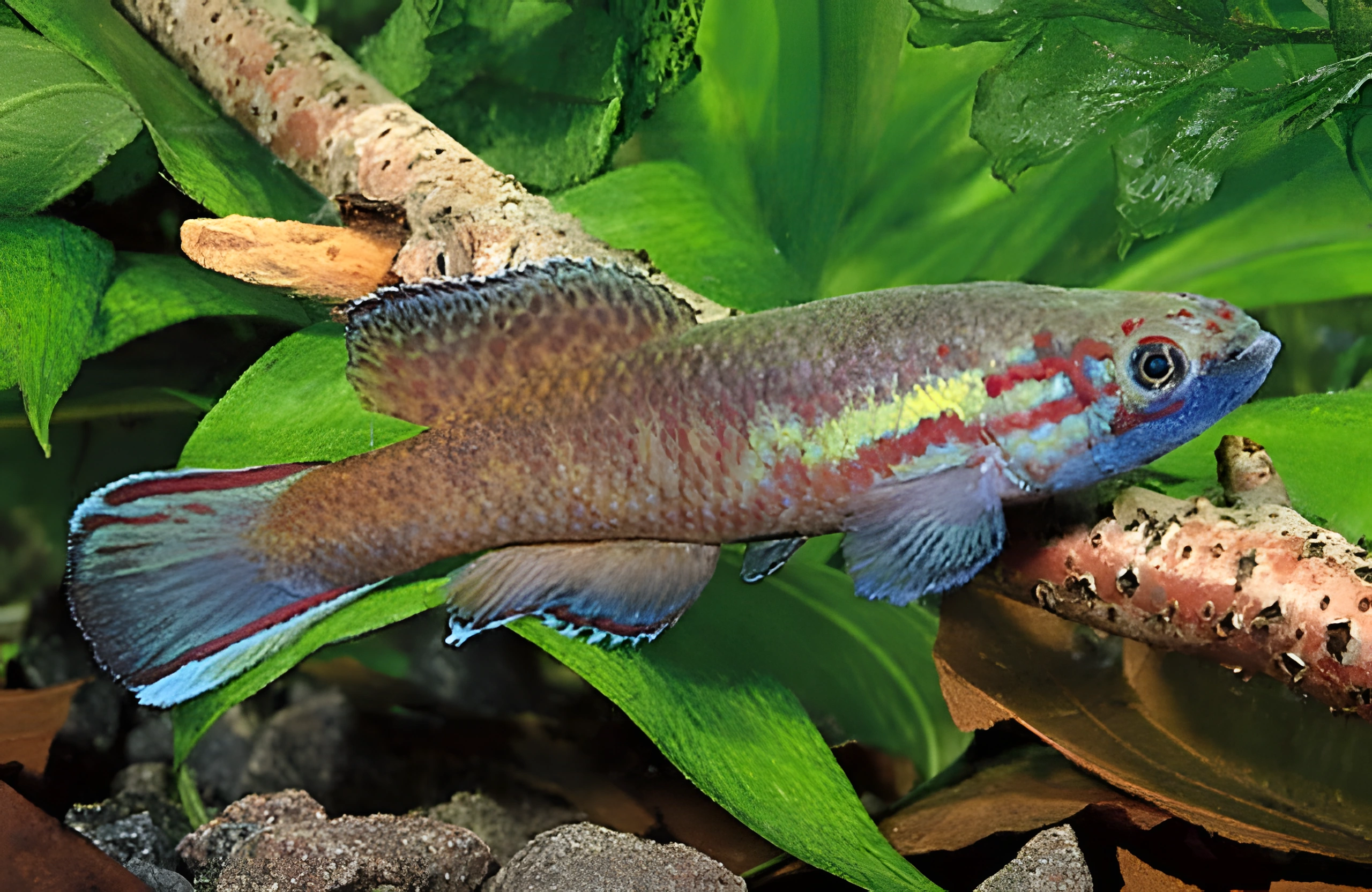
Roloffia occidentalis, also known as the "Golden Pheasant" fish, belongs to the family Nothobranchiidae. Its scientific name is Callopanchax occidentalis, although it was formerly known as Roloffia occidentalis.
- Required aquarium volume
- 40 L
- Size in aquarium
- 9 – 10 cm
- Temperature
- 20 – 24 °C
- Temperament
- Semi-peaceful (including aggression during spawning / intraspecific conflicts)
Parameters
Water pHSlightly acidic (6.3) – Neutral (7)
Water dHVery soft (1) – Soft (6)
Water salinityno salt (freshwater)
Size in aquarium9 – 10 cm
Lifespan2 years
TemperamentSemi-peaceful (including aggression during spawning / intraspecific conflicts)
Toward small fishnot a predator
Required aquarium volume40 L
Lightingmoderate (regular)
Substrategravel (dark)
Water flownone or stagnant (no flow)
FeedingHigh protein (predominantly meat)
CareHarem (1 male and several females)
Description
Among Killifish, Roloffia occidentalis is often considered one of the largest. In favorable aquarium conditions, this species can grow up to 10-12 cm, although individuals measuring 8-9 cm are more common. There are noticeable differences between males and females:
Male: Its back shimmers with greenish-brown tones. The gill covers are adorned with three red stripes. The upper part of the body sides, from the gill cover to the base of the dorsal fin, is golden-yellow, becoming orange closer to the tail. Below, separated by a row of red dots, is a brown area speckled with bluish spots. The belly has a gray-blue hue, which becomes more intense during spawning. The pectoral and pelvic fins are bluish with an orange edge. The anal fin is brown with a blue stripe along the edge. The dorsal fin is decorated with an orange proximal stripe and a bluish stripe along the edge.
Female: Two red stripes are visible on the gill covers. The body has a yellowish tint with a weakly expressed pattern of dark brown markings. The pectoral, pelvic, and anal fins are transparent, colorless; the dorsal and caudal fins are covered with brownish-red dots. In their natural habitat, the lifespan of these fish does not exceed 1 year. The fish known as the "Golden Pheasant" lives exactly as long as its water body exists. When the water body dries up, the fish die, but before this, they manage to lay fertilized eggs. These eggs can survive the dry period in the substrate, awaiting the arrival of the rainy season, and can remain in this state for up to 5 months.
Habitat
This fish originates from Africa. It can be found in the coastal river systems of Sierra Leone, in the western part of Liberia (lower regions), and presumably in southeastern Guinea. Roloffia occidentalis inhabits temporary water bodies that form during the rainy season, as well as marshy areas and swampy sections of streams located in tropical forests and humid forest savannas.
Behavior and Compatibility
High intraspecific aggression is characteristic of Roloffia occidentalis behavior. Keeping two males together is practically impossible, as their clashes often lead to the death of one of the fish. However, males do not show aggression towards females if the aquarium is spacious enough.
Care and Maintenance
For keeping Callopanchax occidentalis, a species-specific aquarium of at least 60 liters is required, with a low water level and a tight-fitting lid, as the fish are prone to jumping. Optimal water parameters: temperature 20–24°C, pH 6.3–7.0, hardness dH 1–6°. Lighting should be subdued, as bright light causes the fish to lose their vibrant coloration. A mixture of fine dark sand and peat moss is recommended as substrate. The aquarium should be densely planted, including floating species, to create shaded areas and hiding spots. Effective filtration and regular weekly water changes of up to 10% are necessary.
Diet
In nature, the fish feed on small invertebrates, insect larvae, and crustaceans. In aquarium conditions, live and frozen foods such as bloodworms, Daphnia, glassworms, or Artemia are preferred. Unlike many other members of the family, this species can consume high-quality dry foods, but to maintain health and vibrant coloration, it is recommended to diversify the diet with live components.
Breeding and Reproduction
The "Golden Pheasant" fish is rarely found in amateur aquariums. This is due to its short lifespan, complex character, and difficulties in breeding. Most often, Roloffia occidentalis is supplied as eggs, which are then placed in a suitable aquatic environment for fry incubation. For keeping one adult male and two to three females, an aquarium of at least 40 liters is optimal. However, since the number and sex of hatched fry cannot be predicted, it is advisable to provide a separate tank in advance. Water parameters should be soft (1-6 dH) and slightly acidic (pH 6.3-7.0), with a temperature of 20-24°C. The bottom of the aquarium should be covered with a soft substrate, on which low-growing, fine-leaved plants, mosses, and ferns are placed. For example, Java moss can be a good choice, as females can hide in its thickets from excessive male attention, and it also serves as a potential spawning site. Live foods are always preferable to dry foods, but Roloffia occidentalis will eat any food offered.
Fish become sexually mature at approximately two months of age. At this time, males begin to exhibit aggressive behavior and should be separated. The eggs are laid by the fish in the substrate a few centimeters deep. As mentioned, the substrate should be very soft; a peat and coconut fiber-based substrate would be ideal. After spawning, this substrate is carefully removed and placed in a separate container to dry to a slightly damp state. The incubation period is typically about five months. If, after this period, the substrate with the eggs is returned to an aquatic environment, the fry can appear within a few hours. The main difficulty in the breeding process is related to preserving the eggs, as the substrate and the eggs themselves are often affected by mold and fungi. Source of scientific data: FishBase. Additional information is available on the website www.killiclubdefrance.org.
Diseases
The species is highly sensitive to water quality and keeping conditions. If environmental parameters are violated or organic compounds accumulate excessively, the fish are susceptible to bacterial infections and skin parasites. Increasing the temperature above the recommended range significantly shortens the lifespan of individuals. Prevention involves maintaining stable water parameters, regular aquarium cleaning, and preventing stressful situations due to intraspecific aggression.
How to choose
When purchasing, choose active fish with clean fins and no visible damage or growths on the body. It is important to note that Callopanchax occidentalis is a territorial and aggressive fish, so it is not recommended to acquire individuals for community tanks. In the store, it is better to prefer young individuals, as they adapt more easily to new conditions. Avoid purchasing fish that appear sluggish, stay near the surface, or have sunken bellies, which may indicate poor health.
Frequently asked questions
The essentials: size, tank volume, water parameters and care
How big does "Golden Pheasant" Fish get?
An adult reaches 9–10 cm in length. Plan the tank around the maximum size: the fish quickly outgrows a cramped setup.
What size aquarium does "Golden Pheasant" Fish need?
The minimum recommended volume is 40 L. A smaller tank speeds up nitrate build-up and raises stress levels.
What water parameters does "Golden Pheasant" Fish need?
Temperature 20–24 °C, pH 6.3–7, hardness 1–6 dGH. Stability matters more than exact values: sudden swings are harder on the fish than a small deviation from the ideal.
How long does "Golden Pheasant" Fish live?
Around 2 years when kept properly. Lifespan depends directly on tank volume, water quality and a varied diet.
Is "Golden Pheasant" Fish aggressive?
Temperament: semi-peaceful (including aggression during spawning / intraspecific conflicts). Keep this in mind when choosing tank mates.
How many "Golden Pheasant" Fish should be kept together?
Recommended setup: harem (1 male and several females). Ignoring this is a common cause of stress and disease.
What does "Golden Pheasant" Fish eat?
Diet type: high protein (predominantly meat). Feed small portions that are finished within a couple of minutes — overfeeding does more harm than underfeeding.
What is the scientific name of "Golden Pheasant" Fish?
The scientific name of the species is Callopanchax occidentalis (старое название Roloffia occidentalis), family Nothobranchiidae. It also appears in the literature as: Aphyosemion occidentale, Aphyosemion occidentales, Aphyosemion occidentalis.