Temperature20 – 30 °C
Natural range
- South America area
UnusualConservation status: Least concern LC
Other scientific names: Eigenmannia lineata, Sternachus virescens, Sternarchus virescens, Sternatchus virescens, Sternopygus lineatus, Sternopygus tumifrons
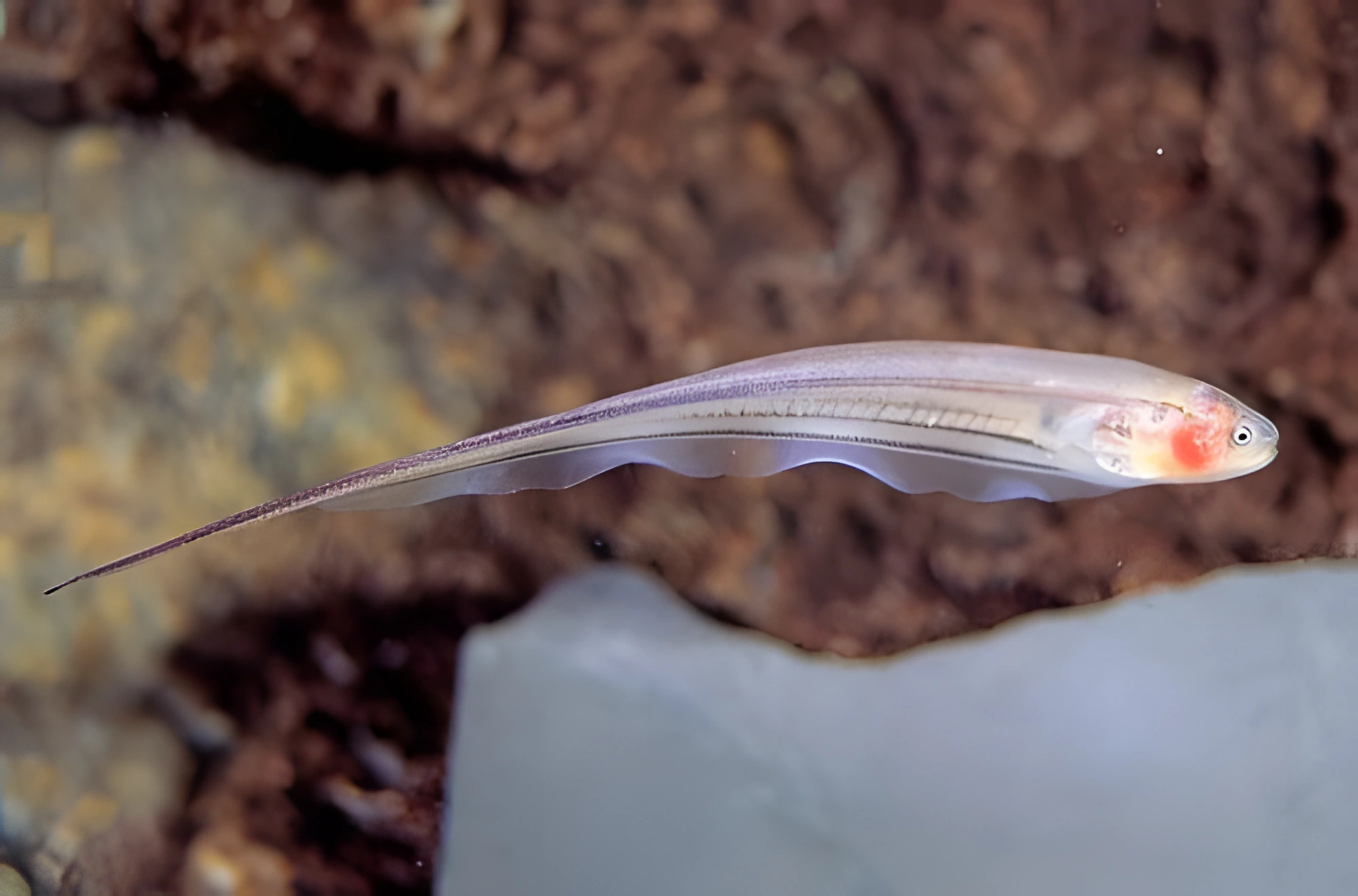
Eigenmannia virescens, known as the Glass Knifefish or Green Knifefish, belongs to the family Sternopygidae. Its name reflects its unusual body shape, resembling a knife blade or scalpel. With proper aquarium setup, keeping this fish is not particularly difficult, making it quite suitable for beginner aquarists.
- Required aquarium volume
- 200 L
- Size in aquarium
- 45 cm
- Temperature
- 20 – 30 °C
- Temperament
- Peaceful (regular)
Parameters
Water pHSlightly acidic (6) – Neutral (7)
Water dHVery soft (2) – Hard (15)
Water salinityno salt (freshwater)
Size in aquarium45 cm
Lifespan6 years
TemperamentPeaceful (regular)
Toward small fishnot a predator
Required aquarium volume200 L
Lightingdimmed (dull)
Substratesandy (regular, light)
Water flowweak or moderate
FeedingMeat / protein (live, frozen, fresh)
CareSmall group (5–6 individuals)
Description
Adult males reach a length of up to 45 cm, while females are significantly smaller, only up to 20 cm. Otherwise, sexual dimorphism is weakly expressed: males and females are practically indistinguishable, except for size. A characteristic feature of this species is its knife-blade-like body shape, which gave it its name. The fish lacks a dorsal fin, and the caudal fin is transformed into a rudimentary organ. However, the anal fin extends along the entire body, and it is thanks to its undulating movements that the Green Knifefish moves, skillfully traveling both forwards and backward. The fish is translucent, so it has no distinct coloration. Its uniqueness is provided by a special organ that generates a weak electromagnetic field, which helps it orient itself in space and find food in poor visibility.
Habitat
The natural habitat of Eigenmannia covers South America, practically the entire vast Amazon river system. These fish inhabit both the main river channels and their tributaries, as well as streams and floodplain lakes. They have successfully adapted to conditions of both strong and weak currents, preferring bottom areas with abundant aquatic vegetation and many snags.
Behavior and Compatibility
These fish are timid and shy, leading a reclusive lifestyle. They are social species and prefer to stay in groups, so it is recommended to acquire at least 5 individuals. Eigenmannia are compatible with other calm, non-aggressive fish, but it is important that tankmates are not too small, otherwise, they may accidentally become prey for the Glass Knifefish.
Care and Maintenance
The optimal aquarium volume should be at least 200 liters. Since the Glass Knifefish is primarily active at night, lighting should be quite dim. For decor, sandy substrate, several snags, and dense thickets of plants are preferred. When choosing vegetation, shade-loving species should be considered. These fish are sensitive to water parameters and composition. Maintaining a stable aquatic environment will require a powerful filtration system and regular aquarium maintenance, including partial water changes and removal of organic waste. Often, UV sterilizers are installed in addition to filters for disease prevention.
Diet
The Green Knifefish is a carnivorous species; in its natural environment, its diet consists of crustaceans, insects, their larvae, and small fish. In a home aquarium, a similar diet should be followed, offering, for example, fresh or frozen bloodworms, brine shrimp, earthworms, as well as pieces of shrimp and mussels. If desired, live small fish can be given. Dry foods are used in very limited quantities, mainly to replenish vitamins and trace elements. Feeding is recommended after the lights are turned off.
Breeding and Reproduction
In their natural environment, spawning occurs during the rainy season, and successful breeding in an aquarium requires creating similar conditions. This is a fairly complex task, which is unlikely to be within the capabilities of either beginner or experienced aquarists.
Diseases
Under favorable conditions, Eigenmannia do not encounter health problems. The main causes of diseases can be a sharp and significant deterioration in water quality, prolonged exposure to water with unsuitable pH and dGH values, and contact with sick fish. More details on symptoms and treatment methods can be found in the "Aquarium Fish Diseases" section.
How to choose
When choosing a glass knifefish, it is preferable to select young individuals, as they adapt more quickly to aquarium conditions. A healthy fish should show activity at dusk or under subdued lighting, have clean skin without whitish spots, ulcers, film, or damage. It is important to carefully inspect the fins: they should be intact, without signs of splitting or erosion.
- Avoid purchasing individuals with signs of emaciation or a sunken belly.
- Pay attention to behavior: a healthy fish should swim confidently, using undulating movements of its anal fin, and show curiosity when offered food.
- Keep in mind that the slender caudal peduncle of this fish is extremely fragile, so when transporting and transferring, it is necessary to use soft, oversized nets to prevent mechanical injuries.
Frequently asked questions
The essentials: size, tank volume, water parameters and care
How big does Glass Knifefish get?
An adult reaches 45 cm in length. Plan the tank around the maximum size: the fish quickly outgrows a cramped setup.
What size aquarium does Glass Knifefish need?
The minimum recommended volume is 200 L. A smaller tank speeds up nitrate build-up and raises stress levels.
What water parameters does Glass Knifefish need?
Temperature 20–30 °C, pH 6–7, hardness 2–15 dGH. Stability matters more than exact values: sudden swings are harder on the fish than a small deviation from the ideal.
How long does Glass Knifefish live?
Around 6 years when kept properly. Lifespan depends directly on tank volume, water quality and a varied diet.
Is Glass Knifefish aggressive?
Temperament: peaceful (regular). Keep this in mind when choosing tank mates.
How many Glass Knifefish should be kept together?
Recommended setup: small group (5–6 individuals). Ignoring this is a common cause of stress and disease.
What does Glass Knifefish eat?
Diet type: meat / protein (live, frozen, fresh). Feed small portions that are finished within a couple of minutes — overfeeding does more harm than underfeeding.
What is the scientific name of Glass Knifefish?
The scientific name of the species is Eigenmannia virescens, family Sternopygidae. It also appears in the literature as: Eigenmannia lineata, Sternachus virescens, Sternarchus virescens.