Temperature24 – 30 °C
Natural range
- India area
- Southeast Asia area
- Philippines area
- Indonesia area
UnusualConservation status: Least concern LC
Other scientific names: Labrus jaculatrix, Sciaena jaculatrix, Toxotes jaculator
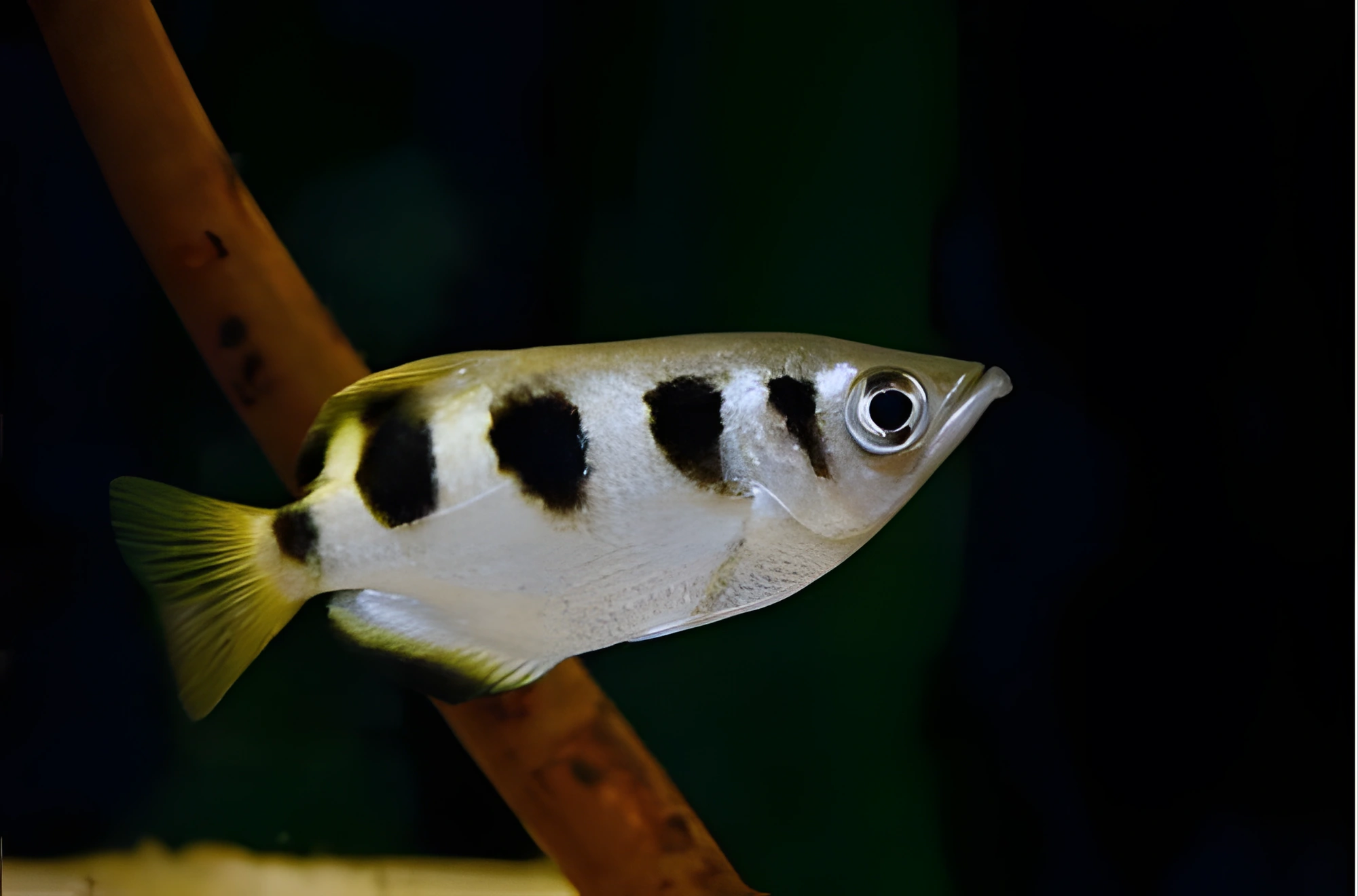
Toxotes jaculatrix, known as the Banded Archerfish, Largescale Archerfish, or simply Archerfish, is a member of the Perciformes family. This fish is famous for its unique hunting method: it knocks insects off foliage above the water with a directed jet of water. This exceptional ability has earned it widespread recognition. Moreover, the Archerfish has been the subject of intriguing scientific research, with results published in the authoritative journal Nature.
- Required aquarium volume
- 250 L
- Size in aquarium
- 15 – 30 cm
- Temperature
- 24 – 30 °C
- Temperament
- Semi-peaceful (dangerous to smaller ones)
Parameters
Water pHNeutral (7) – Slightly alkaline (8)
Water dHMedium hardness (8) – Very hard (20)
Water salinitylow (3–5 g/L)
Size in aquarium15 – 30 cm
Lifespan8 years
TemperamentSemi-peaceful (dangerous to smaller ones)
Toward small fishnot a predator
Required aquarium volume250 L
Lightingmoderate (regular)
Substratesoft sandy (including silted)
Water flowweak
FeedingFor carnivores (live fish, insects, etc.)
CareSchooling (usually from 5–6 individuals and more)
Description
Adults of this fish can reach up to 30 cm in length, although in aquarium conditions their size is usually somewhat smaller. Sexual dimorphism in the species is weakly expressed, making it difficult to distinguish males from females. The Archerfish's body is laterally compressed, and its fins are located closer to the caudal part. Distinctive features include large eyes and a prominent mouth. The silvery body coloration is combined with a dark back and broad dark markings.
Scientists from Oxford University conducted a series of experiments with the Banded Archerfish, studying its ability to recognize patterns. As a result of these studies, it was found that the fish are capable of unerringly recognizing a previously memorized human face among many other faces. Previously, it was assumed that such a function of thinking and memory was the exclusive prerogative of higher primates. The results obtained have far-reaching implications; details of the experiments can be found on the official website http://www.nature.com/articles/srep27523.
Habitat
This species has a very wide habitat range. In the wild, the Banded Archerfish is found from India throughout Southeast Asia. It can be found in numerous archipelagos located between Asia and Australia, such as the Philippines, Micronesia, Palau, Indonesia, the Solomon Islands, Papua New Guinea, and Vanuatu. Due to this extensive distribution, the natural habitat of these fish is quite diverse: they occupy both freshwaters of rivers, lakes, and ponds, as well as brackish coastal areas, including mangrove swamps and river estuaries. The fish preferentially choose shaded areas where vegetation hangs low over the water.
Behavior and Compatibility
Overall, this is a peaceful and calm fish; however, it should not be forgotten that it is capable of preying on smaller aquarium inhabitants. Due to specific requirements for keeping conditions, the choice of compatible species is limited. Some species of Rainbowfish, which are adapted to conditions of increased salinity, can be a good option. Intraspecific relationships are characterized by a hierarchy, where the strongest individual dominates. It is advisable to keep a group of 4–5 fish; with fewer, aggressive behavior may occur.
Care and Maintenance
This fish can be kept in both a traditional aquarium and a paludarium. The latter option is more preferable, as it allows the fish to realize its natural feeding method. For one adult individual, a water volume of at least 500 liters is recommended. Water parameters should be brackish, with a salt concentration of up to 15 grams per liter. Internal current should be kept minimal. Lighting can be bright or moderate, depending on the plants used. The choice of substrate is not essential, as the Banded Archerfish primarily inhabits the water surface. Driftwood is often used in aquarium decoration. When setting up a paludarium, overhanging vegetation is created above the water surface, where food insects are subsequently placed. Given the specifics of keeping and caring for this fish, this task is usually entrusted to professionals, so this article contains only basic information.
Diet
This species is a predator, and its diet includes both terrestrial and aquatic invertebrates. If given the opportunity, they can also hunt small fish. The Plate Archerfish possesses an amazing hunting technique, which has been repeatedly demonstrated in BBC and National Geographic popular science programs. Thanks to its large eyes, the fish can accurately determine the location of insects above the water surface, for example, sitting on tree leaves not far above the water. The special structure of its mouth allows it to generate a powerful jet of water, reaching 1.5 meters in height. The fish "spits" water, knocks down the insect, after which it only needs to swallow its prey. In a home aquarium, floating foods should be offered, such as dry granules, as well as frozen bloodworms or brine shrimp. If a paludarium is available, it can be set up in such a way that the Archerfish can actively hunt live insects.
Breeding and Reproduction
As of the writing of this text, reliable information on the successful breeding of Archerfish in home aquariums is unavailable. In their natural habitat, these fish migrate to marine waters for reproduction, and artificially recreating such conditions presents significant challenges.
Diseases
Archerfish are quite robust when kept in suitable conditions, but they are extremely sensitive to water quality and stress levels. The main diseases encountered in this species include ichthyophthiriasis, which manifests as white spots on the body and fins, and bacterial infections such as fin rot. A significant risk factor is prolonged keeping in freshwater without salt addition, which leads to weakened immunity and reduced lifespan. Disease prevention involves maintaining stable salinity, regular water changes, controlling nitrogenous compounds, and providing a balanced diet. Keeping them individually often causes severe stress in fish, making them more susceptible to infections.
How to choose
When selecting Archerfish, pay attention to their activity and behavior: healthy individuals should be active, show interest in the water surface, and not exhibit signs of timidity or apathy. It is important to check the condition of their skin and fins for damage, spots, or film, which may indicate parasitic or bacterial infections. When purchasing, it is worth clarifying what conditions (freshwater or brackish water) the fish are adapted to, as an abrupt change in water parameters can cause them shock. It is also recommended to observe how the fish accept food: refusal to eat or an emaciated appearance can be signs of chronic stress or health problems.
Frequently asked questions
The essentials: size, tank volume, water parameters and care
How big does Archerfish get?
An adult reaches 15–30 cm in length. Plan the tank around the maximum size: the fish quickly outgrows a cramped setup.
What size aquarium does Archerfish need?
The minimum recommended volume is 250 L. A smaller tank speeds up nitrate build-up and raises stress levels.
What water parameters does Archerfish need?
Temperature 24–30 °C, pH 7–8, hardness 8–20 dGH. Stability matters more than exact values: sudden swings are harder on the fish than a small deviation from the ideal.
How long does Archerfish live?
Around 8 years when kept properly. Lifespan depends directly on tank volume, water quality and a varied diet.
Is Archerfish aggressive?
Temperament: semi-peaceful (dangerous to smaller ones). Keep this in mind when choosing tank mates.
How many Archerfish should be kept together?
Recommended setup: schooling (usually from 5–6 individuals and more). Ignoring this is a common cause of stress and disease.
What does Archerfish eat?
Diet type: for carnivores (live fish, insects, etc.). Feed small portions that are finished within a couple of minutes — overfeeding does more harm than underfeeding.
What is the scientific name of Archerfish?
The scientific name of the species is Toxotes jaculatrix, family Toxotidae. It also appears in the literature as: Labrus jaculatrix, Sciaena jaculatrix, Toxotes jaculator.