Temperature22 – 28 °C
Natural range
- Indo-Pacific Ocean area
- Northern Australia area
- Thailand area
Predators UnusualConservation status: Least concern LC
Other scientific names: Batrachomoeus broadbenti, Batrachus trispinosus, Halophryne trispinosus, Pseudobatrachus eugeneius
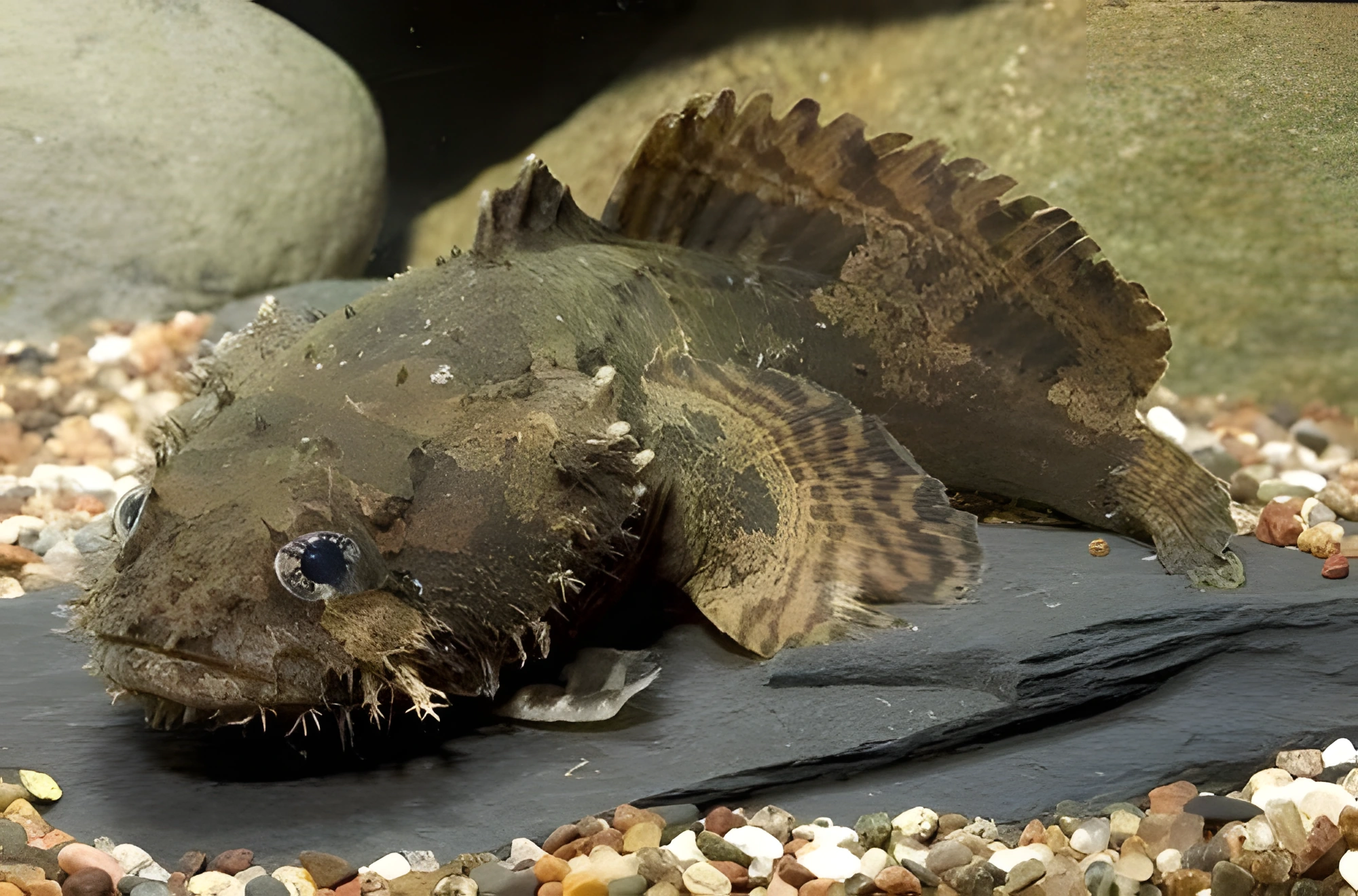
The Three-spined Toadfish (scientific name Batrachomoeus trispinosus), belonging to the family Batrachoididae, presents a rather unusual sight. Its appearance, characterized by a massive head and unconventional growths, may cause surprise, but these very features are highly valued by enthusiasts of exotic fish. Despite its predatory nature, this fish exhibits peacefulness towards other species and is not difficult to care for.
- Required aquarium volume
- 300 L
- Size in aquarium
- 30 cm
- Temperature
- 22 – 28 °C
- Temperament
- Peaceful (regular)
Parameters
Water pHSlightly alkaline (7.8) – Slightly alkaline (8.5)
Water dHHard (15) – Very hard (35)
Water salinitywide range (from ~1 to ~20 g/L)
Size in aquarium30 cm
Lifespan20 years
TemperamentPeaceful (regular)
Toward small fishpredator
Required aquarium volume300 L
Lightingmoderate (regular)
Substratesoft sandy (including silted)
Water flowweak or moderate
FeedingMeat / protein (live, frozen, fresh)
CareSolitary
Description
Adults can reach a length of 30 cm, with the head comprising one-third of the body and adorned with numerous growths. Large pectoral fins serve not only for swimming but also allow the fish to move across soft bottom substrates, functioning like limbs. The tail of these fish is small and rounded. The dorsal fin is divided into two parts and forms a crest running along the entire body. The coloration is dark brown and uneven. Sharp spines, hidden in the skin, help the fish defend itself when it bristles, sensing danger. All this unusual appearance is aimed at one goal — to help the fish successfully camouflage itself as an algal-covered rock or another inconspicuous clump.
Habitat
The natural habitat of this species extends across the Indo-Pacific region, covering territories from southern Australia to northern Thailand. The Three-spined Toadfish inhabits coastal zones, mangrove estuaries, and the lower reaches of rivers flowing into the sea. Its environment is characterized by soft silty substrates, an abundance of natural shelters such as snags and roots, and a bottom strewn with plant debris and organic deposits.
Behavior and Compatibility
Despite its predatory nature, this fish has a peaceful and calm temperament. It can successfully coexist with non-aggressive species of comparable size. However, it should be noted that overly small tank mates may be perceived as prey. In general, the toadfish prefers to be kept alone.
Care and Maintenance
Given the significant size of adult specimens and their inactive lifestyle, a tank of at least 300 L will be required for comfortable keeping. There is no need to recreate the muddy beaches that are characteristic of their natural habitats. For decoration, it is recommended to use dark substrate, for example, gravel with large boulders. The presence of snags and aquatic plants is welcome, with plants needing to be adapted to growing in brackish water. The aquarium should be filled with brackish water with a salt concentration of 5 to 20 grams per 1 liter; the fish cannot survive long in fresh water. The success of keeping largely depends on maintaining stable water parameters. In addition to the efficient operation of the filtration system, it is extremely important to regularly remove organic waste and perform weekly water changes of 25 to 50% or more of the total water volume. The exact volumes of water changes depend on the salinity level and the number of inhabitants. Since the specifics of caring for such an aquarium are individual, it is impossible to give universal instructions.
Diet
Relying on its exceptional camouflage ability, the Three-spined Toadfish can remain motionless for a long time, waiting for prey to swim by. Once the victim is close enough, an instantaneous attack follows, and it is immediately swallowed. In its natural environment, its diet is quite varied and includes fish, crabs, shrimp, octopuses, bivalve mollusks, snails, sea urchins, and polychaete worms. In a home aquarium, it readily accepts bloodworms, earthworms, as well as pieces of fish (e.g., pollock) and shrimp. Feeding is done 1–2 times a week, which corresponds to its natural feeding habits.
Breeding and Reproduction
Breeding in aquarium conditions is not well studied; all known cases are spontaneous. In the natural environment, the female lays large orange eggs, about 5 mm in diameter, in secluded places: under stones, snags, or in empty shells. The clutch is guarded by the parents, more often the male, who can also emit characteristic sounds to protect the territory. The incubation period lasts two to three weeks, after which larvae resembling tadpoles appear.
Diseases
Under favorable keeping conditions, diseases in these fish practically do not occur. The risk of developing diseases increases when feeding live fish, which can be carriers of parasites, as well as with prolonged exposure to water with unsuitable parameters (such as salinity, pH, or dGH). More detailed information on symptoms and treatment methods can be found in the section “Diseases of Aquarium Fish.”
How to choose
When purchasing, choose active fish with clean skin without visible damage, ulcers, or film. It is important to consider that this is a predatory species: in the store, the fish should show interest in food but remain calm. It is recommended to pay attention to the following aspects:
- absence of signs of emaciation (sunken belly);
- clear eyes and absence of signs of parasitic lesions;
- careful handling during transport, as the fins and gills are equipped with sharp spines capable of inflicting painful stings;
- clarification of keeping conditions in the store, as the fish requires brackish water for long-term survival.
Frequently asked questions
The essentials: size, tank volume, water parameters and care
How big does Toadfish get?
An adult reaches 30 cm in length. Plan the tank around the maximum size: the fish quickly outgrows a cramped setup.
What size aquarium does Toadfish need?
The minimum recommended volume is 300 L. A smaller tank speeds up nitrate build-up and raises stress levels.
What water parameters does Toadfish need?
Temperature 22–28 °C, pH 7.8–8.5, hardness 15–35 dGH. Stability matters more than exact values: sudden swings are harder on the fish than a small deviation from the ideal.
How long does Toadfish live?
Around 20 years when kept properly. Lifespan depends directly on tank volume, water quality and a varied diet.
Is Toadfish aggressive?
Temperament: peaceful (regular). This is a predatory species — any fish small enough to fit in its mouth will eventually be eaten.
How many Toadfish should be kept together?
Recommended setup: solitary. Ignoring this is a common cause of stress and disease.
What does Toadfish eat?
Diet type: meat / protein (live, frozen, fresh). Feed small portions that are finished within a couple of minutes — overfeeding does more harm than underfeeding.
What is the scientific name of Toadfish?
The scientific name of the species is Batrachomoeus trispinosus, family Batrachoididae. It also appears in the literature as: Batrachomoeus broadbenti, Batrachus trispinosus, Halophryne trispinosus.