Temperature23 – 29 °C
Natural range
- Amazon River Basin
- Brazil area
- Peru area
- Venezuela area
Predators Labyrinth fishConservation status: Least concern LC
Other scientific names: Monocirrhus mimophyllus
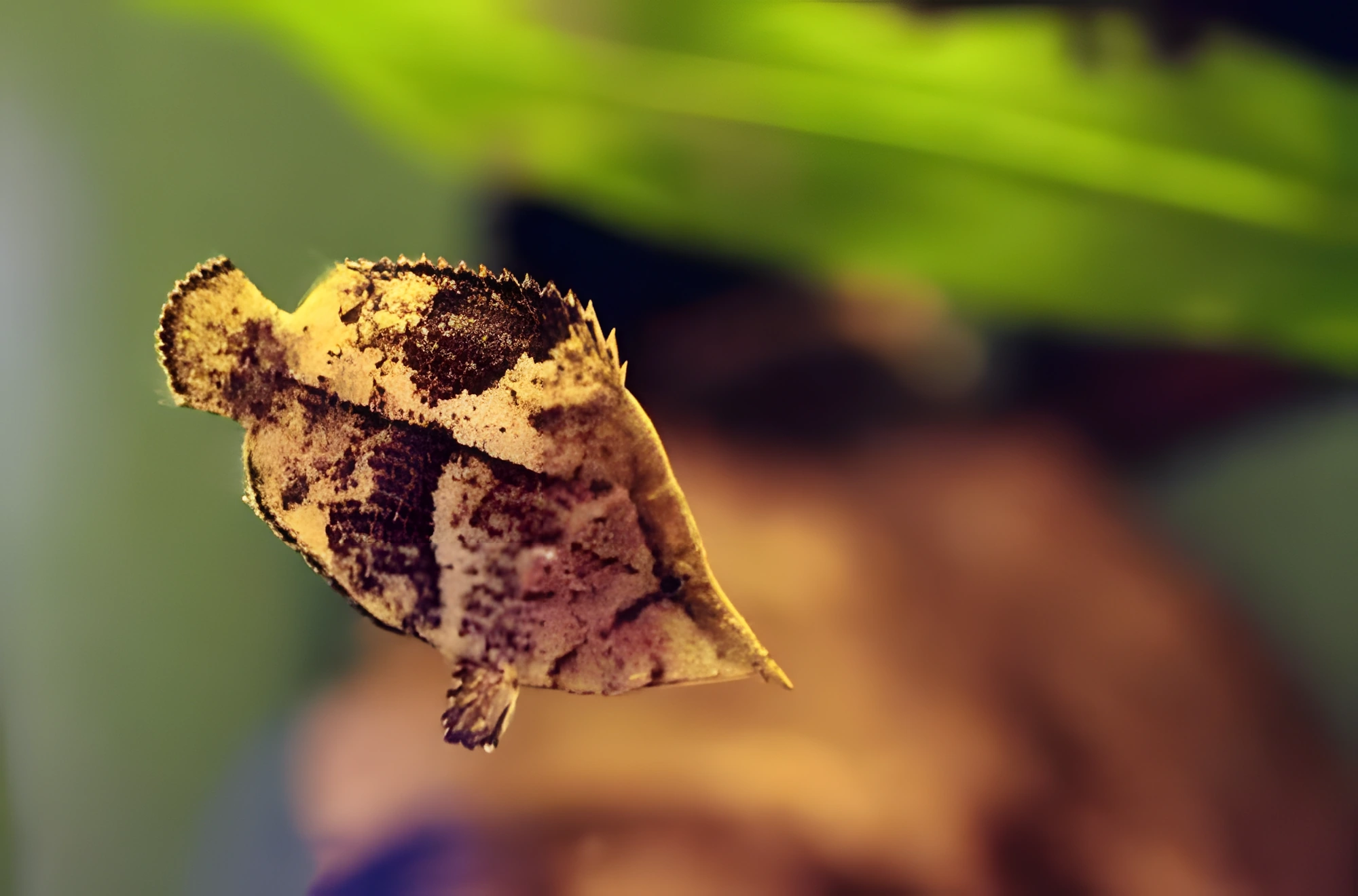
The Leaf Fish, scientifically known as Monocirrhus polyacanthus, belongs to the family Polycentridae. This species possesses a remarkable ability to camouflage itself as fallen leaves, allowing it to discreetly ambush and capture its prey. Although Monocirrhus polyacanthus is a very notable labyrinth fish, its keeping in a home aquarium is associated with significant difficulties, primarily due to its specific diet—the constant need for live fish for feeding. For this reason, as well as high demands on water quality, this species is not recommended for beginner aquarists.
- Required aquarium volume
- 70 L
- Size in aquarium
- 8 – 10 cm
- Temperature
- 23 – 29 °C
- Temperament
- Aggressive / incompatible / unfriendly
Parameters
Water pHSlightly acidic (5) – Neutral (6.8)
Water dHVery soft (1) – Medium hardness (10)
Water salinityno salt (freshwater)
Size in aquarium8 – 10 cm
Lifespan6 years
TemperamentAggressive / incompatible / unfriendly
Toward small fishpredator
Required aquarium volume70 L
Lightingdimmed
Substrateany, but dark
Water flowvery weak
FeedingFor carnivores (live fish, insects, etc.)
CarePair (male/female)
Description
Adults reach a length of about 10 cm. Their appearance is quite unique and fully adapted to a highly specialized predatory lifestyle. The fish's body, narrow and yellowish-brown, strikingly resembles a dried tree leaf in shape and coloration.
Habitat
Its natural habitat is located in South America, covering the territories of modern Brazil, Peru, Venezuela, Colombia, and Bolivia. The Leaf Fish inhabits numerous river systems flowing through tropical forests. It prefers shallow areas with moderate currents, where snags and fallen leaves are abundant.
Behavior and Compatibility
Despite its predatory nature, the Leaf Fish cannot compete with larger fish due to its modest size. The best choice would be a species-specific aquarium, populated exclusively by representatives of the same species. As possible tank mates, only some catfishes can be considered, for example, Farlowella or Leopard Catfish.
Care and Maintenance
For one Leaf Fish, a tank volume of at least 70 liters is recommended. Special attention should be paid to the aquarium's decor: it must contain snags imitating roots or tree branches, large-leaved plants such as Echinodorus, and several clusters of floating vegetation. The substrate should preferably be dark. For additional decoration, the bottom can be covered with fallen tree leaves, which should first be dried, then soaked in water for several days until they sink. Such leaves should be replaced every one to two weeks. Other important requirements include subdued lighting, minimal water flow, and acidic pH values with low carbonate hardness. All necessary equipment is selected and configured taking these conditions into account.
Diet
As a predator, Monocirrhus polyacanthus feeds exclusively on small fish. Its hunting method is truly unique: it not only outwardly resembles a fallen leaf but also mimics its slow, drifting movement in the water. The Leaf Fish ambushes its prey, hovering at an angle among snags or gently swaying like drifting foliage, approaching a school of unsuspecting fry. When the prey is at a sufficient distance, a lightning-fast attack follows, during which the special structure of its jaws allows the fish to literally swallow the unfortunate small fish. The strong predatory instincts of the Leaf Fish mean that it accepts no other food than live fish; fast-breeding guppies and other livebearers are well-suited for feeding. One individual eats one to two fish per day.
Breeding and Reproduction
Breeding is quite feasible in a community tank, provided there are dense thickets of broad-leaved plants in very soft and acidic water, and dim lighting. However, the process of raising fry presents a challenge. At the beginning of the breeding season, males acquire a more intense coloration, while females become noticeably rounder. Spawning is accompanied by a peculiar "dance," during which the fish circle near the water surface until the female lays her eggs. The clutch is located beneath the surface of a broad leaf and can contain up to 300 eggs. The male fully takes on the protection and care of the clutch. Fry emerge after 3–4 days. As they grow, their diet must change. Initially, they are fed Artemia and Daphnia, and then gradually transition to live fry of other fish. Organizing feeding is easier in a separate tank rather than the main aquarium. Furthermore, water quality is of paramount importance, as it rapidly deteriorates due to leftover fry food. Those planning to breed Leaf Fish will need to address the challenges of ensuring constant access to live food and maintaining water purity.
Diseases
The main cause of most diseases in Leaf Fish is unsuitable keeping conditions and poor-quality nutrition. If initial symptoms are observed, it is first necessary to check water parameters and the concentration of dangerous substances such as ammonia, nitrites, and nitrates. If the indicators deviate from the norm, they should be brought back into order, and only then should treatment begin. More detailed information on symptoms and treatment methods can be found in the "Aquarium Fish Diseases" section.
How to choose
When choosing a Leaf Fish, it is important to consider its specialized predatory nature and sensitivity to water quality. A healthy specimen should actively react to movement in front of the glass, although when calm, it can remain motionless for a long time, mimicking a leaf. Avoid specimens with damaged fins, body film, or signs of emaciation, as this species is highly susceptible to bacterial and fungal infections if keeping conditions are compromised.
Before purchasing, you should ask the seller what type of food the fish is accustomed to. Most specimens for sale are wild-caught and require exclusively live food, so refusal to eat in the store could be due to stress or an unwillingness to switch to the offered diet. It is recommended to pay attention to the following indicators:
- absence of sunken eyes and unnaturally sharp head features, indicating emaciation;
- clean skin without whitish spots, ulcers, or excessive mucus;
- calm but not sluggish behavior, absence of convulsive movements or constant presence at the water surface without apparent reason.
Frequently asked questions
The essentials: size, tank volume, water parameters and care
How big does Leaf Fish get?
An adult reaches 8–10 cm in length. Plan the tank around the maximum size: the fish quickly outgrows a cramped setup.
What size aquarium does Leaf Fish need?
The minimum recommended volume is 70 L. A smaller tank speeds up nitrate build-up and raises stress levels.
What water parameters does Leaf Fish need?
Temperature 23–29 °C, pH 5–6.8, hardness 1–10 dGH. Stability matters more than exact values: sudden swings are harder on the fish than a small deviation from the ideal.
How long does Leaf Fish live?
Around 6 years when kept properly. Lifespan depends directly on tank volume, water quality and a varied diet.
Is Leaf Fish aggressive?
Temperament: aggressive / incompatible / unfriendly. This is a predatory species — any fish small enough to fit in its mouth will eventually be eaten.
How many Leaf Fish should be kept together?
Recommended setup: pair (male/female). Ignoring this is a common cause of stress and disease.
What does Leaf Fish eat?
Diet type: for carnivores (live fish, insects, etc.). Feed small portions that are finished within a couple of minutes — overfeeding does more harm than underfeeding.
What is the scientific name of Leaf Fish?
The scientific name of the species is Monocirrhus polyacanthus, family Polycentridae. It also appears in the literature as: Monocirrhus mimophyllus.