Temperature20 – 24 °C
Natural range
- India area
- Pakistan area
- Nepal area
- Bangladesh area
Labyrinth fishConservation status: Least concern LC
Other scientific names: Badis buchanani, Cychla fasciata, Labrus badis, Labrus fasciata
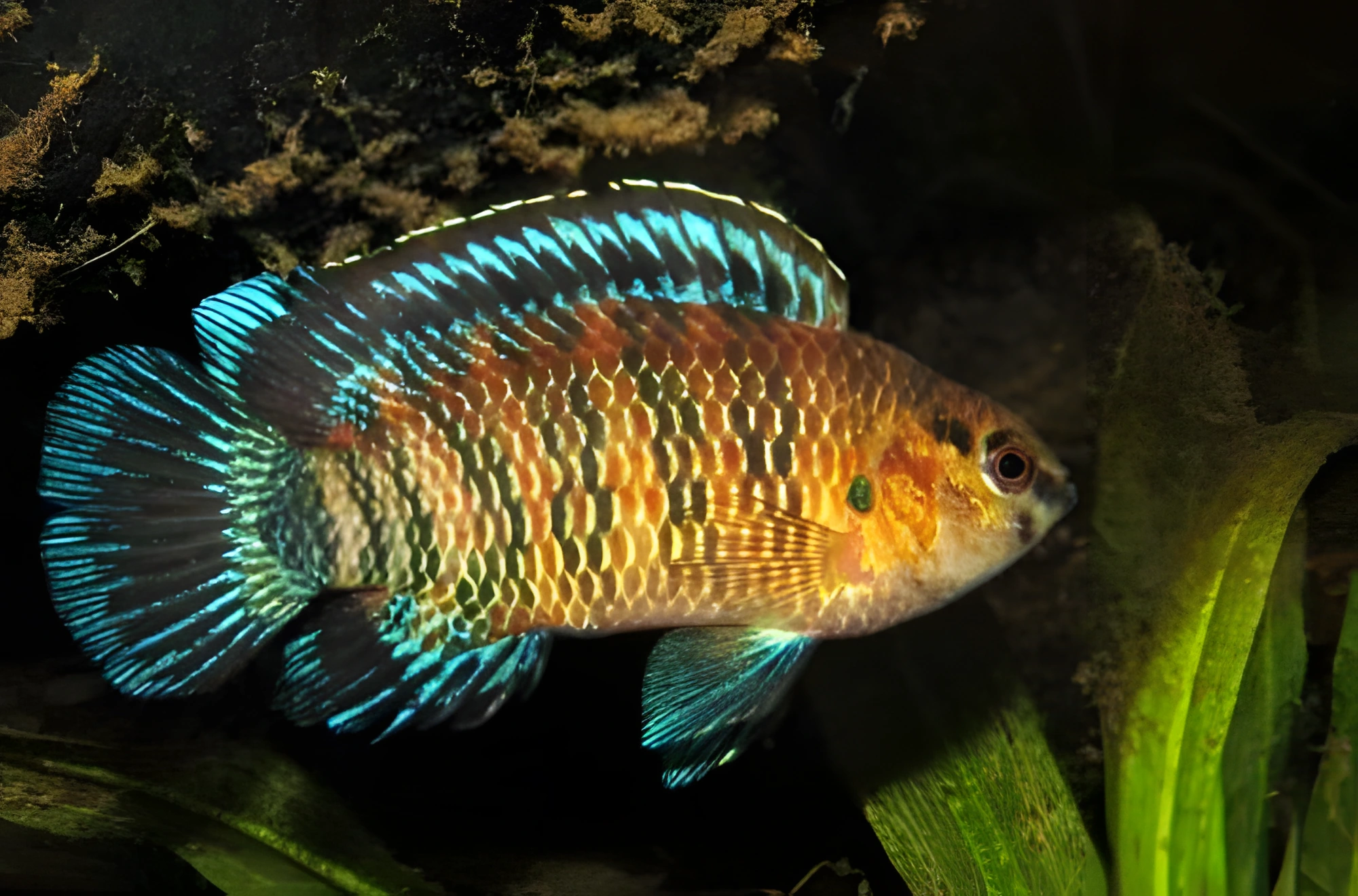
The Chameleon fish, or Badis, also known as the Chameleon Badis, and scientifically as Badis badis, belongs to the family Badidae. This species earned its name for a good reason: its coloration has the ability to change, adapting to its surroundings. These fish are easy to keep and do not have special requirements, so they are often recommended for beginner aquarists.
- Required aquarium volume
- 50 L
- Size in aquarium
- 5 cm
- Temperature
- 20 – 24 °C
- Temperament
- Semi-peaceful (including aggression during spawning / intraspecific conflicts)
Parameters
Water pHSlightly acidic (6) – Neutral (7.5)
Water dHVery soft (3) – Hard (15)
Water salinityno salt (freshwater)
Size in aquarium5 cm
Lifespan4 years
TemperamentSemi-peaceful (including aggression during spawning / intraspecific conflicts)
Toward small fishnot a predator
Required aquarium volume50 L
Lightingweak or moderate
Substrategravel (dark)
Water flownone or stagnant (no flow)
FeedingAny (universal)
CarePair (male/female)
Description
Adults can reach a length of 6 cm. The coloration of these fish is not constant — it depends on the environment and can vary from orange to blue or even purple hues. This variability is precisely what earned the fish the name "Chameleon." Males are generally somewhat larger than females and have brighter coloration, especially pronounced during the breeding season.
Habitat
Its natural habitat is in Southeast Asia, including the modern territories of India, Pakistan, Nepal, Bangladesh, Myanmar, and Thailand. These fish prefer to live in shallow, often murky sections of rivers, characterized by slow currents and abundant aquatic vegetation. The bottom in such places is usually silty and covered with various woody debris: branches, fallen leaves.
Behavior and Compatibility
Badis is a slow-moving and calm fish, so it should not be kept with large or overly active species that might frighten it. However, miniature cyprinids, such as Harlequin Rasboras, Espei Rasboras, and small schools of characins, make excellent tankmates. Within their own species, relationships are based on a hierarchy, where the dominant male occupies a specific territory. In a small aquarium, it is recommended to keep only one male with a female to avoid fierce clashes between multiple male individuals.
Care and Maintenance
For one or a pair of these fish, an aquarium of at least 50 liters is recommended. For decoration, preference is given to sand-gravel substrate, shade-loving rooted plants and clusters of floating species, as well as numerous shelters that can be created using branches, tree roots, and various snags. Decorative elements mimicking grottoes and caves, or ordinary ceramic pots laid on their side, are perfect as future spawning sites. Optimal conditions are achieved with moderate or low lighting and a gentle internal current. It is important to maintain a water temperature between 23–24°C, and in some cases, a heater may not be necessary. Hydrochemical parameters such as pH and dGH allow for a fairly wide range of values and are not critical. Aquarium care includes regular cleaning of the substrate from organic pollutants and weekly partial water changes (10% to 15% of the total volume) with fresh water.
Diet
Although these fish are carnivorous, practice has shown that breeders have successfully adapted Badis to dry foods, thereby eliminating difficulties with their feeding in a home aquarium. To stimulate the best display of their coloration, it is recommended to regularly include live or frozen meaty foods in their diet, such as bloodworms, daphnia, or brine shrimp.
Breeding and Reproduction
The appearance of fry is quite possible even in a community tank, as the Chameleon Badis, like other labyrinth fish, has well-developed parental instincts and will care for and protect its offspring. Spawning occurs in cave-like shelters, under the arches of which the female lays her eggs. Ceramic pots laid on their side are particularly well-suited for this purpose. During the breeding season, the male acquires a richer dark coloration, and his behavior becomes quite aggressive if anyone violates the boundaries of his territory, the center of which becomes the spawning site. The male actively tries to entice the female into his shelter, and if she is ready to spawn, she submits to his calls. After laying the eggs, the female leaves the cave, and the male remains there, guarding the clutch and the hatched fry until they begin to swim freely. This usually takes one to one and a half weeks. After this, the male loses interest in them, and the young should preferably be moved to a separate aquarium with similar conditions.
Diseases
The main cause of most diseases in Leaf Fish is unsuitable keeping conditions and poor-quality nutrition. If initial symptoms are observed, it is first necessary to check water parameters and the concentration of dangerous substances such as ammonia, nitrites, and nitrates. If the indicators deviate from the norm, they should be brought back into order, and only then should treatment begin. More detailed information on symptoms and treatment methods can be found in the "Aquarium Fish Diseases" section.
How to choose
When purchasing, choose active individuals with clean fins and no body damage. Avoid fish with signs of emaciation, sunken bellies, or visible growths. Since Badis badis is a timid species, they often hide in corners or behind decorations in the store, which is normal and not a sign of illness. Before purchasing, make sure the fish show interest in the offered food, as adapting to new feeding conditions can be difficult. Keep in mind that in commercial aquariums, due to stress, their coloration may be pale, but it should quickly recover once conditions normalize.
Frequently asked questions
The essentials: size, tank volume, water parameters and care
How big does Chameleon fish get?
An adult reaches 5 cm in length. Plan the tank around the maximum size: the fish quickly outgrows a cramped setup.
What size aquarium does Chameleon fish need?
The minimum recommended volume is 50 L. A smaller tank speeds up nitrate build-up and raises stress levels.
What water parameters does Chameleon fish need?
Temperature 20–24 °C, pH 6–7.5, hardness 3–15 dGH. Stability matters more than exact values: sudden swings are harder on the fish than a small deviation from the ideal.
How long does Chameleon fish live?
Around 4 years when kept properly. Lifespan depends directly on tank volume, water quality and a varied diet.
Is Chameleon fish aggressive?
Temperament: semi-peaceful (including aggression during spawning / intraspecific conflicts). Keep this in mind when choosing tank mates.
How many Chameleon fish should be kept together?
Recommended setup: pair (male/female). Ignoring this is a common cause of stress and disease.
What does Chameleon fish eat?
Diet type: any (universal). Feed small portions that are finished within a couple of minutes — overfeeding does more harm than underfeeding.
What is the scientific name of Chameleon fish?
The scientific name of the species is Badis badis, family Badidae. It also appears in the literature as: Badis buchanani, Cychla fasciata, Labrus badis.