Temperature23 – 30 °C
Natural range
- Congo River Basin
- West Africa area
- Republic of the Congo area
- Central African Republic area
UnusualConservation status: Least concern LC
Other scientific names: Pantodon buchholtzi
The African Butterflyfish, or Pantodon (scientific name Pantodon buchholzi), belongs to the family Pantodontidae and stands out for its very unusual appearance. Thanks to its friendly nature and unpretentiousness in keeping, it will be an excellent choice for aquarists who want to add something special to their collection. This fish, despite its low mobility, is known for impressive jumps out of the water for several meters, so it is important to provide the aquarium with a reliable and safe lid in advance.
- Required aquarium volume
- 80 L
- Size in aquarium
- 12 cm
- Temperature
- 23 – 30 °C
- Temperament
- Peaceful, calm/shy/inactive
Parameters
Water pHSlightly acidic (6) – Neutral (7.5)
Water dHSoft (5) – Hard (15)
Water salinityno salt (freshwater)
Size in aquarium12 cm
Lifespan5 years
TemperamentPeaceful, calm/shy/inactive
Toward small fishnot a predator
Required aquarium volume80 L
Lightingdimmed
Substrateany (no restrictions)
Water flownone or stagnant (no flow)
FeedingMeat / protein (live, frozen, fresh)
CareMixed (solitary / pair / group)
Description
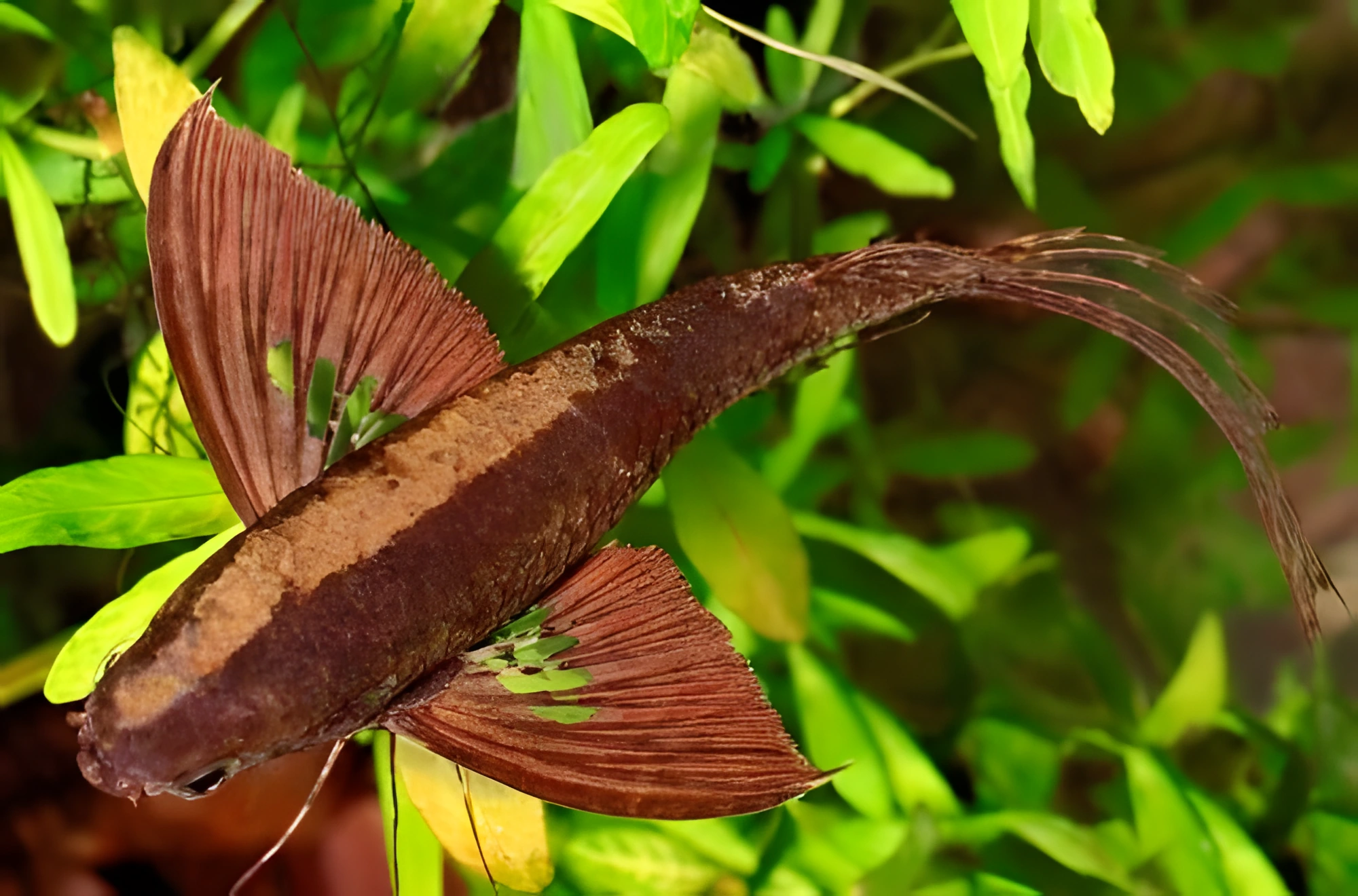
The appearance of the fish is quite peculiar. If you look at it from above, it immediately becomes clear why it was named “African Butterflyfish”. Enlarged pectoral fins, resembling wings, perform two key functions: camouflage and assistance in jumping. For a long time, the fish can calmly swim on the surface, camouflaging itself as a fallen dry leaf. However, if necessary, a sharp movement of its wide tail allows it to jump out of the water for a significant distance, whether to hunt a passing insect or to escape from a predator. Adults grow up to 12 cm in length, but due to their large fins and tail, they appear more substantial. The main body color is gray, with dark pigmentation over the entire surface, and the fin rays look like dotted lines.
Habitat
The origin of Pantodon buchholzi is associated with the regions of West Africa. It can be found in the territories of modern states such as the Republic of the Congo, the Central African Republic, Chad, Nigeria, Sierra Leone, Niger, Gabon, and others. The fish inhabits the Congo River basin, preferring numerous lakes, swamps, and pools of small rivers and streams, where dense aquatic vegetation and an abundance of snags are characteristic.
Behavior and Compatibility
The African Butterflyfish leads a crepuscular and sedentary lifestyle, becoming active only to hunt for surface insects or escape from predators. It is considered a rather peaceful species, but it can show aggression towards other fish living near the surface. In addition, any small species that can fit into its mouth will be eaten. The Butterflyfish is incompatible with species prone to nipping wide fins, such as barbs.
Care and Maintenance
The size of the aquarium directly depends on the number of inhabitants: for keeping one or a pair of fish, a volume of 80 liters or more is recommended. The lower tier can be decorated arbitrarily, for example, using dark substrate and many snags. The surface zone should include some floating plants, but care should be taken to ensure they do not occupy the entire area. The open water surface should be at least half of the total area. Optimal water conditions are characterized by a slightly acidic pH and low carbonate hardness. If desired, a few pre-dried leaves can be added to the water, which will gradually enrich it with tannins as they decompose and give it a characteristic tea tint. These leaves should be replaced every two weeks or more often. Any water movement should be minimized, which imposes restrictions on the choice of filtration equipment. Before purchasing, it is recommended to consult a specialist to select a device that combines high performance with minimal internal current creation. The minimum equipment kit also includes a heater, aerator, and lighting system. Aquarium care involves weekly replacement of 15–20% of the water volume with fresh water, as well as regular cleaning of the substrate from organic debris and glass from plaque.
Diet
The diet of this fish consists exclusively of meat products, which can be either live or frozen. In a home aquarium, bloodworms, Artemia, small worms, and various types of flying insects of suitable size, such as flies or mosquitoes, are suitable for it. It is important to note that feeding occurs only at the surface, so any food that sinks to the bottom will be ignored.
Breeding and Reproduction
Breeding this fish at home is associated with certain difficulties, but it is quite feasible. If other species are kept with them in the main aquarium, a separate tank will be required for spawning. It should be filled with water from the main aquarium. Floating plants that do not require bright lighting are used for decoration, and the substrate can be any or absent altogether. The necessary equipment includes a simple sponge air-lift filter and a heater. Natural light entering from the room will be quite sufficient. The prepared tank receives a pair of fish. Over three weeks, the water volume is gradually reduced until approximately half of the original amount remains. By this time, the hydrochemical composition of the water should reach a slightly acidic pH, and the temperature should be maintained within 26–28°C. Then, over two to three days, cool water is added to the aquarium in small portions, lowering the overall temperature to 23°C. These actions imitate natural processes when the dry season is replaced by a period of rains. In the final stage, the female begins to spawn, laying up to a hundred eggs daily for several days. The eggs are lighter than water, so they immediately float to the surface. Since parental instincts are poorly developed, the eggs must be carefully transferred to a separate temporary container to prevent them from being eaten by the parents. After spawning, both the eggs and the breeders are returned to their original places. Fry appear after three to four days, and their feeding is only possible with microscopic live food. It is important to consider that the fry do not swim in search of food, so food will have to be delivered directly to them using a pipette. It is the feeding of the fry that is the main difficulty in breeding the African Butterflyfish.
Diseases
Balanced nutrition and maintaining optimal living conditions are the best prevention of diseases in freshwater fish. If the first signs of an ailment appear, such as a change in coloration or behavior, it is first necessary to check the water parameters and quality, adjust them to normal if necessary, and only then proceed with treatment. More detailed information on symptoms and treatment methods is presented in the section “Diseases of Aquarium Fish”.
How to choose
When choosing a butterflyfish, you should first observe its behavior in the store. A healthy specimen should stay near the water surface, showing interest in the surrounding space. Avoid specimens that appear emaciated, have damaged fins, cloudy eyes, or strange spots on their bodies. An important indicator of viability is an active feeding response: be sure to ask the seller to feed the fish in your presence. If the specimen ignores food or appears apathetic, it is better to refuse the purchase.
Consider the following risks and features:
- butterflyfish are specialized predators, so in the store they may refuse dry foods, preferring live or frozen products;
- during transportation, it is important to provide the fish with a sufficient amount of air, as it is extremely sensitive to water quality and oxygen levels;
- the presence of damage on the body or fins may indicate recent skirmishes with conspecifics or poor keeping conditions, which often leads to the development of secondary bacterial infections after moving to a new aquarium.
Frequently asked questions
The essentials: size, tank volume, water parameters and care
How big does Butterflyfish get?
An adult reaches 12 cm in length. Plan the tank around the maximum size: the fish quickly outgrows a cramped setup.
What size aquarium does Butterflyfish need?
The minimum recommended volume is 80 L. A smaller tank speeds up nitrate build-up and raises stress levels.
What water parameters does Butterflyfish need?
Temperature 23–30 °C, pH 6–7.5, hardness 5–15 dGH. Stability matters more than exact values: sudden swings are harder on the fish than a small deviation from the ideal.
How long does Butterflyfish live?
Around 5 years when kept properly. Lifespan depends directly on tank volume, water quality and a varied diet.
Is Butterflyfish aggressive?
Temperament: peaceful, calm/shy/inactive. Keep this in mind when choosing tank mates.
How many Butterflyfish should be kept together?
Recommended setup: mixed (solitary / pair / group). Ignoring this is a common cause of stress and disease.
What does Butterflyfish eat?
Diet type: meat / protein (live, frozen, fresh). Feed small portions that are finished within a couple of minutes — overfeeding does more harm than underfeeding.
What is the scientific name of Butterflyfish?
The scientific name of the species is Pantodon buchholzi, family Pantodontidae. It also appears in the literature as: Pantodon buchholtzi.