Temperature22 – 28 °C
Labyrinth fish
Other scientific names: Helostomi temmincki
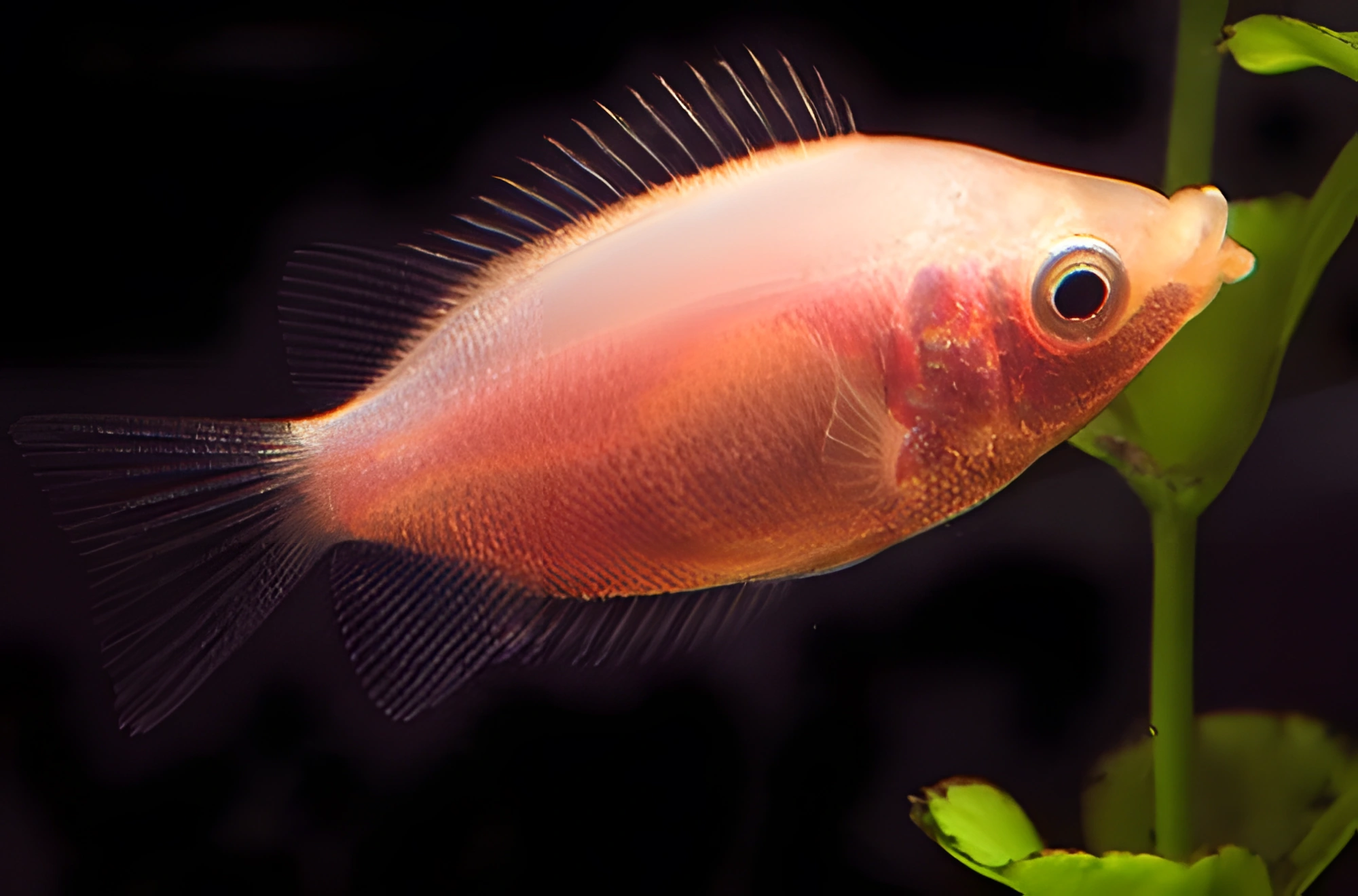
The Pink Kissing Gourami, scientifically known as Helostoma temminkii, is a member of the Helostomatidae family. This fish is the result of artificial selection; it differs from its wild counterpart in its rounded body shape and noticeably smaller size.
- Required aquarium volume
- 200 L
- Size in aquarium
- 13 cm
- Temperature
- 22 – 28 °C
- Temperament
- Territorial (often aggressive)
Parameters
Water pHSlightly acidic (6) – Slightly alkaline (8)
Water dHSoft (5) – Very hard (19)
Water salinityno salt (freshwater)
Size in aquarium13 cm
Lifespan5 years
TemperamentTerritorial (often aggressive)
Toward small fishnot a predator
Required aquarium volume200 L
Lightingmoderate (regular)
Substrateany, but dark
Water flownone or stagnant (no flow)
FeedingMeat with plant additives (omnivores)
CareMixed (solitary / pair / group)
Description
Compared to its predecessor, the gourami's body is relatively small, reaching up to 13 cm in length, and appears somewhat rounded, almost spherical. The main coloration is pink or pinkish-orange, and the fins are transparent. The structure of its mouth serves as a distinctive feature: it is equipped with thick, fleshy lips, on the inner side of which are small teeth. With these teeth, the gourami scrapes algae from various surfaces, be it the aquarium glass or decorative elements.
Habitat
This fish is not found in its natural habitat; it was artificially bred from the Kissing Gourami. It is sometimes encountered under the names “Balloon Kissing Gourami” or “Dwarf Kissing Gourami”.
Behavior and Compatibility
Young individuals coexist well with similarly sized and peaceful fish species, but as the Pink Kissing Gourami matures, its character changes. This fish is territorial and exhibits a clear intraspecific hierarchy. When several individuals are kept in a small aquarium, conflicts over dominance are inevitable. Attacks on other aquarium inhabitants are also possible. The most optimal conditions involve keeping only a few fish in one tank, where each individual has about 100 liters of space. It is strongly not recommended to keep these gouramis with fish that tend to "nip" fins (e.g., barbs), as the slow-moving gourami will become an easy target for them.
Care and Maintenance
Even with all the hardiness of this fish and its ability to use atmospheric oxygen, one should not underestimate the importance of maintaining high water quality. It is recommended to renew a quarter of the aquarium's volume weekly. During routine aquarium cleaning, it is advisable to leave the back wall untouched so that algae, serving as an additional food source, can remain on it. Special attention should be paid to filtration: the filter should be powerful enough, but at the same time, it should not create a strong current, as these fish prefer calm, still waters. The presence of a lid on the aquarium allows for the formation of a layer of humid air above the surface, the temperature of which will be higher than room temperature. This minimizes temperature shock when the fish gulps atmospheric air and reduces the risk of damage to the labyrinth organ. When decorating the aquarium, provide several shelters using natural or artificial elements such as snags, grottoes, imitations of sunken ships, or castles. Any substrate can be used, but dark shades will help enhance the fish's coloration; bright substrates (yellow, red, blue, and others) are not recommended. Plants should be grouped, with a preference for species with stiff leaves or artificial analogs. Floating plants are allowed, provided they do not hinder the fish's access to the water surface.
Diet
These fish readily eat all types of dry commercial foods, including flakes, granules, pellets, and more. To diversify their diet, bloodworms, both live and frozen, can be added. It is also recommended to offer them pieces of fresh vegetables such as cucumber, lettuce leaves, zucchini, or peas. It is important to promptly remove uneaten leftovers from the aquarium to avoid water pollution. Feeding is usually done once or twice a day.
Breeding and Reproduction
This selective breeding species presents certain difficulties in breeding, due to both the need to create suitable conditions and the problem of compatibility. If two or three fish are kept, there is a possibility that they are all of the same sex, as visible external differences between male and female are practically absent. Successful breeding is possible in a separate tank, at least 90 cm long and 60 cm high. Equipment should include a lighting system, a heater, and a simple airlift filter. It is important that the water parameters in the spawning tank match those of the main aquarium. In terms of decor, root and floating plants with small leaves are preferred, with the presence of "Riccia fluitans" being especially welcome; any substrate can be used. A stimulus for spawning is the enrichment of the daily diet with meat products. Soon after, the male will begin to show attention to the female, swimming around her with splayed fins; at this point, the pair should be moved to a separate tank. Courtship continues until the female lays all her eggs, which float and remain on the surface. The parents are returned to the main aquarium. The total number of eggs can reach several thousand; the fry hatch within a day and also constantly stay near the water surface. They will only begin to swim freely after three days. Fry should be fed micro-food and infusoria.
Diseases
In a balanced aquarium, health problems usually do not arise. However, if the keeping conditions deteriorate, the fish become more susceptible to infectious diseases, and digestive difficulties may also occur. More detailed information on symptoms and treatment methods can be found in the "Aquarium Fish Treatment" section.
How to choose
When purchasing, choose active individuals with clean skin, free of spots, sores, and fin damage. It is important to assess their behavior: healthy fish are curious and should not appear emaciated or apathetic. Avoid specimens that constantly hide in corners or stay near the water surface with signs of labored breathing. Since adult individuals are territorial and can exhibit intraspecific aggression, it is recommended to acquire young fish so that they adapt to the conditions of a community tank together.
Frequently asked questions
The essentials: size, tank volume, water parameters and care
How big does Pink Kissing Gourami get?
An adult reaches 13 cm in length. Plan the tank around the maximum size: the fish quickly outgrows a cramped setup.
What size aquarium does Pink Kissing Gourami need?
The minimum recommended volume is 200 L. A smaller tank speeds up nitrate build-up and raises stress levels.
What water parameters does Pink Kissing Gourami need?
Temperature 22–28 °C, pH 6–8, hardness 5–19 dGH. Stability matters more than exact values: sudden swings are harder on the fish than a small deviation from the ideal.
How long does Pink Kissing Gourami live?
Around 5 years when kept properly. Lifespan depends directly on tank volume, water quality and a varied diet.
Is Pink Kissing Gourami aggressive?
Temperament: territorial (often aggressive). Keep this in mind when choosing tank mates.
How many Pink Kissing Gourami should be kept together?
Recommended setup: mixed (solitary / pair / group). Ignoring this is a common cause of stress and disease.
What does Pink Kissing Gourami eat?
Diet type: meat with plant additives (omnivores). Feed small portions that are finished within a couple of minutes — overfeeding does more harm than underfeeding.
What is the scientific name of Pink Kissing Gourami?
The scientific name of the species is Helostoma temminkii, family Kissing Gouramis (Helostomatidae). It also appears in the literature as: Helostomi temmincki.