Temperature18 – 28 °C
Natural range
- La Plata Basin
- Argentina area
- Paraguay area
- Brazil area
CharacinsConservation status: Least concern LC
Other scientific names: Hemigrammus anisitsi, Hemigrammus caudovittatus, Hyphessobrycon erythrurus, Psalidodon anisitsi
Hyphessobrycon anisitsi, known as the Diamond Tetra, belongs to the Characidae family. This fish has long been popular among aquarists worldwide due to its attractive appearance and undemanding nature. Its only drawback might be its frequent habit of nibbling on aquarium plants, without waiting for feeding time.
- Required aquarium volume
- 100 L
- Size in aquarium
- 5 – 7 cm
- Temperature
- 18 – 28 °C
- Temperament
- Peaceful, but may bite fins
Parameters
Water pHSlightly acidic (6) – Slightly alkaline (8)
Water dHVery soft (2) – Very hard (30)
Water salinityno salt (freshwater)
Size in aquarium5 – 7 cm
Lifespan5 years
TemperamentPeaceful, but may bite fins
Toward small fishnot a predator
Required aquarium volume100 L
Lightingmoderate (regular)
Substrateany (no restrictions)
Water flowweak or moderate
FeedingMixed diet (meat + plant-based)
CareSchooling (usually from 5–6 individuals and more)
Description
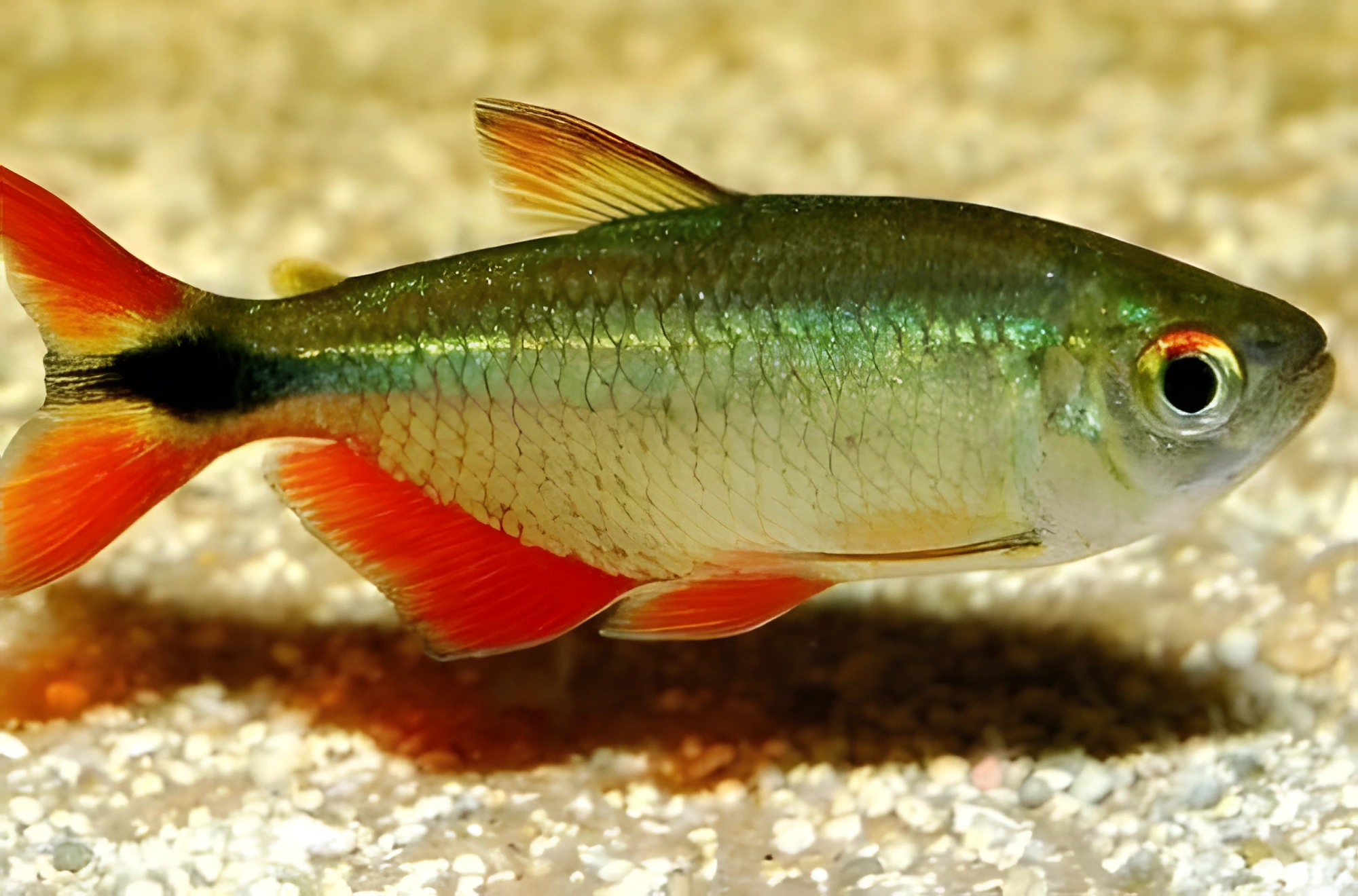
The fish's body shape is classic, well-known from illustrations in biology textbooks. Its coloration is predominantly silvery, with a darker shade on the back. The pelvic, anal, and caudal fins are a rich red, sometimes scarlet, and the dorsal fin may also have a reddish tint. A distinctive feature of this fish is a dark, diamond-shaped spot located on the caudal peduncle.
Males are distinguished by more intense fin coloration, which sometimes takes on a yellowish hue. Females are generally larger and have a rounder abdomen.
Habitat
In 1907, ichthyologist Carl Eigenmann first described this species while studying tropical freshwater fish in the La Plata region, which includes modern-day Argentina, Paraguay, and Brazil. The Diamond Tetra inhabits diverse biotopes such as small streams, rivers, lakes, and ponds. Its natural diet consists of worms, crustaceans, insects, and plant matter.
Behavior and Compatibility
It is recommended to keep these fish in groups of at least 5 individuals. They get along well with other active species that can tolerate their lively behavior. It is important to ensure timely and sufficient feeding to avoid hunger, otherwise, the Tetras may start nipping the fins of their tank mates.
Care and Maintenance
The exceptional hardiness of the Diamond Tetra allows it to adapt to a wide range of pH and dGH values. Standard aquarium equipment, including a filter, air pump, heater, and lighting fixtures, is sufficient for its keeping. Aquarium decoration also presents no difficulty: any substrate can be used, decorated with stones, driftwood, and other ornaments. It is advisable to choose artificial plants, as live ones will be perceived by the fish as food.
Diet
The Diamond Tetra readily accepts all types of food: dry commercial foods, live, frozen, and plant-based. To maintain the vibrancy of its coloration, it is important to include meaty components in its diet, such as bloodworms and daphnia, as well as vegetable supplements, for example, finely chopped lettuce or spinach leaves.
Breeding and Reproduction
Breeding these fish is not particularly difficult. For guaranteed results, it is recommended to keep 6 males and 6 females together, and it is advisable to set up a separate breeding tank for spawning. A 20–30 L tank will be perfectly suitable. Necessary equipment includes a simple mechanical filter with an air stone, which will provide aeration and quality water purification, as well as a heater and lighting fixtures. Optimal water parameters for spawning are slightly acidic, soft water, with a temperature of 23–25°C. The presence of both rooted and floating plants is important. Before spawning, the temperature in the main tank should be set to 23–25°C, and the fish should be actively fed meaty foods for a week or more. As soon as you notice that the female's (or females') abdomen has significantly rounded, this will be the signal to transfer the pair to the breeding tank. The female lays her eggs on plants, and the male, in turn, fertilizes them. After spawning, the adult fish are returned to the community tank. Fry hatch after 24–36 hours, and after 4 days, they begin to actively swim throughout the tank. They should be fed micro-foods.
Diseases
These fish are quite hardy, and disease outbreaks are extremely rare, mainly occurring through contact with infected individuals. More detailed information on symptoms and treatment methods can be found in the "Aquarium Fish Diseases" section.
How to choose
When selecting individuals, attention should be paid to their activity and skin condition. A healthy fish should show curiosity, swim in the water column, and have no visible damage, ulcers, or white film on its scales. Avoid specimens with severely clamped fins, signs of emaciation, or unnatural behavior, such as constantly hovering near the surface or attempting to stay away from the school.
- Assess the cleanliness of the aquarium in the store: the presence of sick fish in neighboring tanks increases the risk of infection.
- Check the integrity of the fins, as this species is prone to intraspecific conflicts and fin-nipping when stressed or lacking space.
- Purchase a group of 8–10 individuals at once to reduce aggression levels and ensure the fish's comfortable social adaptation in the new aquarium.
Frequently asked questions
The essentials: size, tank volume, water parameters and care
How big does Diamond Tetra get?
An adult reaches 5–7 cm in length. Plan the tank around the maximum size: the fish quickly outgrows a cramped setup.
What size aquarium does Diamond Tetra need?
The minimum recommended volume is 100 L. A smaller tank speeds up nitrate build-up and raises stress levels.
What water parameters does Diamond Tetra need?
Temperature 18–28 °C, pH 6–8, hardness 2–30 dGH. Stability matters more than exact values: sudden swings are harder on the fish than a small deviation from the ideal.
How long does Diamond Tetra live?
Around 5 years when kept properly. Lifespan depends directly on tank volume, water quality and a varied diet.
Is Diamond Tetra aggressive?
Temperament: peaceful, but may bite fins. Keep this in mind when choosing tank mates.
How many Diamond Tetra should be kept together?
Recommended setup: schooling (usually from 5–6 individuals and more). Ignoring this is a common cause of stress and disease.
What does Diamond Tetra eat?
Diet type: mixed diet (meat + plant-based). Feed small portions that are finished within a couple of minutes — overfeeding does more harm than underfeeding.
What is the scientific name of Diamond Tetra?
The scientific name of the species is Hyphessobrycon anisitsi, family Characidae. It also appears in the literature as: Hemigrammus anisitsi, Hemigrammus caudovittatus, Hyphessobrycon erythrurus.