Temperature20 – 24 °C
Natural range
- Sierra Leone area
- West Africa area
KillifishConservation status: Least concern LC
Other scientific names: Aphyosemion huwaldi, Roloffia huwaldi
The fish Roloffia huwaldi, known scientifically as Callopanchax huwaldi (formerly Roloffia huwaldi), belongs to the family Nothobranchiidae, or nothobranchs. Its homeland is West Africa, where it is found in Sierra Leone, inhabiting temporary bodies of water that form in the coastal zone.
- Required aquarium volume
- 40 L
- Size in aquarium
- 6 cm
- Temperature
- 20 – 24 °C
- Temperament
- Semi-peaceful (including aggression during spawning / intraspecific conflicts)
Parameters
Water pHSlightly acidic (6.3) – Neutral (7)
Water dHVery soft (1) – Soft (7)
Water salinityno salt (freshwater)
Size in aquarium6 cm
Lifespan2 years
TemperamentSemi-peaceful (including aggression during spawning / intraspecific conflicts)
Toward small fishnot a predator
Required aquarium volume40 L
Lightingmoderate (regular)
Substrategravel (dark)
Water flownone or stagnant (no flow)
FeedingHigh protein (predominantly meat)
CareHarem (1 male and several females)
Description
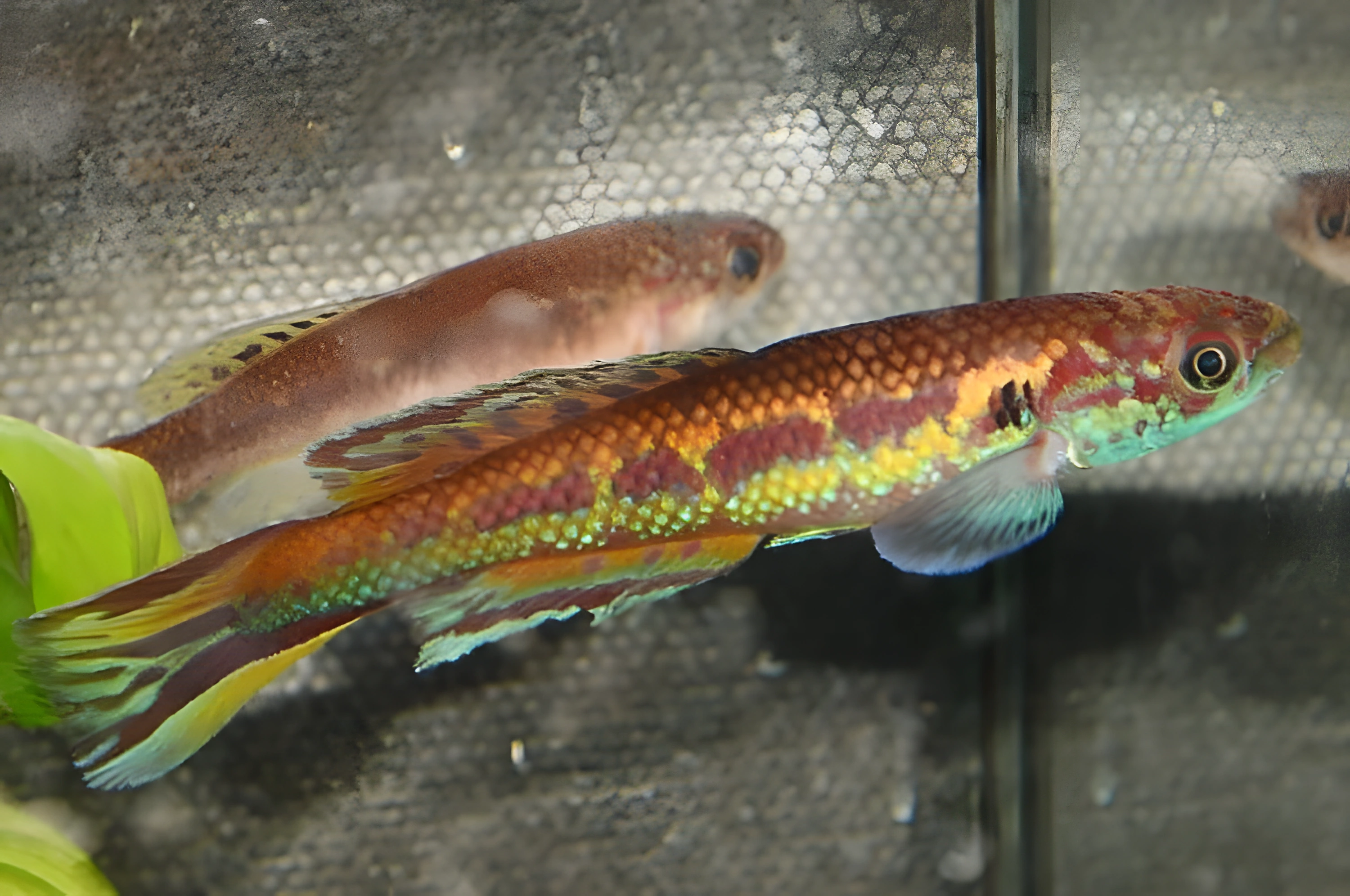
For Roloffia huwaldi, as with closely related species, the term "annual" fish is often used. The natural habitat of wild populations determines their lifespan, which directly depends on the existence of seasonal water bodies – these form during the rainy season and disappear during drought. The life cycle of these fish typically lasts about six months. During this period, they develop from hatching from an egg to maturity and produce offspring. Fertilized eggs can withstand up to 5 months in dried-up soil, awaiting the onset of rains. Adult individuals grow up to 6 cm in length. Males are distinguished by their bright and variegated coloration: the pattern on the body is a combination of red-blue or burgundy-turquoise hues. Red horizontal stripes can be seen on the caudal and anal fins, and the dorsal fin is adorned with red speckles on a blue background. Females, however, have a more modest appearance; their coloration is most often gray or sandy.
Habitat
The species is endemic to Sierra Leone in West Africa. It inhabits temporary water bodies in the coastal zone, which form during the rainy season and completely dry up during periods of drought. In nature, these fish have adapted to life in soft water with neutral or slightly acidic pH levels.
Behavior and Compatibility
Sexually mature males exhibit aggression towards each other, which is due to high competition for females and limited habitat. Similar rivalry can also be observed between representatives of related species.
Care and Maintenance
Roloffia huwaldi is not common in amateur aquariums. Due to their short life cycle and challenging nature, these fish are often supplied as eggs that require subsequent incubation. Below are brief recommendations: the substrate with eggs should be placed in an aquarium with soft water (1-6 dH) at a temperature of 20-24°C. The initial pH level should be close to neutral (7.0), taking into account a subsequent natural decrease. When fry appear, it is recommended to maintain the pH within 6.3-7.0. An abundance of aquatic plants, including floating ones, will have a beneficial effect on the keeping conditions. For the substrate, soft materials are preferable, such as peat substrate, coconut fiber, or similar. This will allow the fish to lay eggs in case of spawning. Natural snags, a layer of fallen leaves from certain trees, or alder cones can be placed on the bottom; they will be a source of valuable tannins. The minimum equipment set includes a lighting system, a heater, and a filter. Since Roloffia huwaldi tolerates current poorly, and the filtration system is often the main source of water movement, a simple air-driven filter would be the preferred choice. As the fish grow, they should be carefully observed. If there are several males in the population, they will need to be separated to prevent conflicts. In a small aquarium, it is advisable to maintain a group consisting of one male and several females. In their natural habitat, their diet consists of small insects falling into the water, larvae, and zooplankton. In a home aquarium, the diet should be based on protein-rich food – this can be live or freeze-dried foods such as bloodworms, Artemia, and Daphnia. Standard dry foods are also acceptable. Under favorable conditions, the lifespan in an aquarium can exceed 1 year. The source of scientific data is FishBase.
Diet
In their natural environment, the diet consists of small insects, their larvae, and zooplankton. In aquarium conditions, it is necessary to provide a varied diet rich in protein. It is recommended to use:
- live foods (bloodworms, Artemia, Daphnia);
- high-quality freeze-dried products;
- specialized dry foods for killifish.
Breeding and Reproduction
These fish belong to the group of "annuals" and in nature, they reproduce in the substrate, which preserves the eggs during the dry season. In an aquarium, a soft substrate, such as peat fiber, is used to stimulate spawning. The eggs require a long incubation period in dry or slightly damp substrate out of water, after which they are flooded with soft water for the fry to hatch. Sexually mature males exhibit pronounced intraspecific aggression, so it is recommended to keep them in groups with a predominance of females.
Diseases
The species is sensitive to sudden changes in water parameters and filtration quality. The main risks are associated with the development of bacterial and fungal infections under poor keeping conditions or excessive current, which the fish tolerate poorly. Prevention includes using air-driven filters, maintaining stable water composition, and regular partial water changes. Due to their short life cycle, the fish are subject to age-related changes, which are often mistakenly taken for diseases.
How to choose
When purchasing, preference should be given to individuals with clean fins and no visible scale damage. It is important to assess the activity of the fish: healthy individuals should show interest in their surroundings, rather than passively staying at the bottom or surface. It is recommended to ask the seller about the conditions in which the fish were kept, as an abrupt change in water parameters can cause stress. Given the rarity of the species, eggs are often sold, the condition of which cannot be visually assessed.
Frequently asked questions
The essentials: size, tank volume, water parameters and care
How big does Roloffia huwaldi get?
An adult reaches 6 cm in length. Plan the tank around the maximum size: the fish quickly outgrows a cramped setup.
What size aquarium does Roloffia huwaldi need?
The minimum recommended volume is 40 L. A smaller tank speeds up nitrate build-up and raises stress levels.
What water parameters does Roloffia huwaldi need?
Temperature 20–24 °C, pH 6.3–7, hardness 1–7 dGH. Stability matters more than exact values: sudden swings are harder on the fish than a small deviation from the ideal.
How long does Roloffia huwaldi live?
Around 2 years when kept properly. Lifespan depends directly on tank volume, water quality and a varied diet.
Is Roloffia huwaldi aggressive?
Temperament: semi-peaceful (including aggression during spawning / intraspecific conflicts). Keep this in mind when choosing tank mates.
How many Roloffia huwaldi should be kept together?
Recommended setup: harem (1 male and several females). Ignoring this is a common cause of stress and disease.
What does Roloffia huwaldi eat?
Diet type: high protein (predominantly meat). Feed small portions that are finished within a couple of minutes — overfeeding does more harm than underfeeding.
What is the scientific name of Roloffia huwaldi?
The scientific name of the species is Callopanchax huwaldi (старое название Roloffia huwaldi), family Nothobranchiidae. It also appears in the literature as: Aphyosemion huwaldi, Roloffia huwaldi.