Temperature22 – 25 °C
Natural range
- French Guiana area
- Suriname area
- Guyana area
- Agila Village, Suriname area
KillifishConservation status: Least concern LC
Other scientific names: Laimosemion manaensis, Rivulus agilae, Rivulus manaensis
Laimosemion agilae, also known as Rivulus agilae, belongs to the family Rivulidae. These fish originate from South America, where they can be found in French Guiana, Suriname, and Guyana. They are named after the village of Agila in Suriname, where a group of scientists first discovered this species in 1902.
- Required aquarium volume
- 40 L
- Size in aquarium
- 4 cm
- Temperature
- 22 – 25 °C
- Temperament
- Semi-peaceful (including aggression during spawning / intraspecific conflicts)
Parameters
Water pHSlightly acidic (6) – Neutral (7)
Water dHSoft (5) – Hard (12)
Water salinityno salt (freshwater)
Size in aquarium4 cm
Lifespan3 years
TemperamentSemi-peaceful (including aggression during spawning / intraspecific conflicts)
Toward small fishnot a predator
Required aquarium volume40 L
Lightingmoderate (regular)
Substratesoft sandy (including silted)
Water flownone or stagnant (no flow)
FeedingHigh protein (predominantly meat)
CareHarem (1 male and several females)
Description
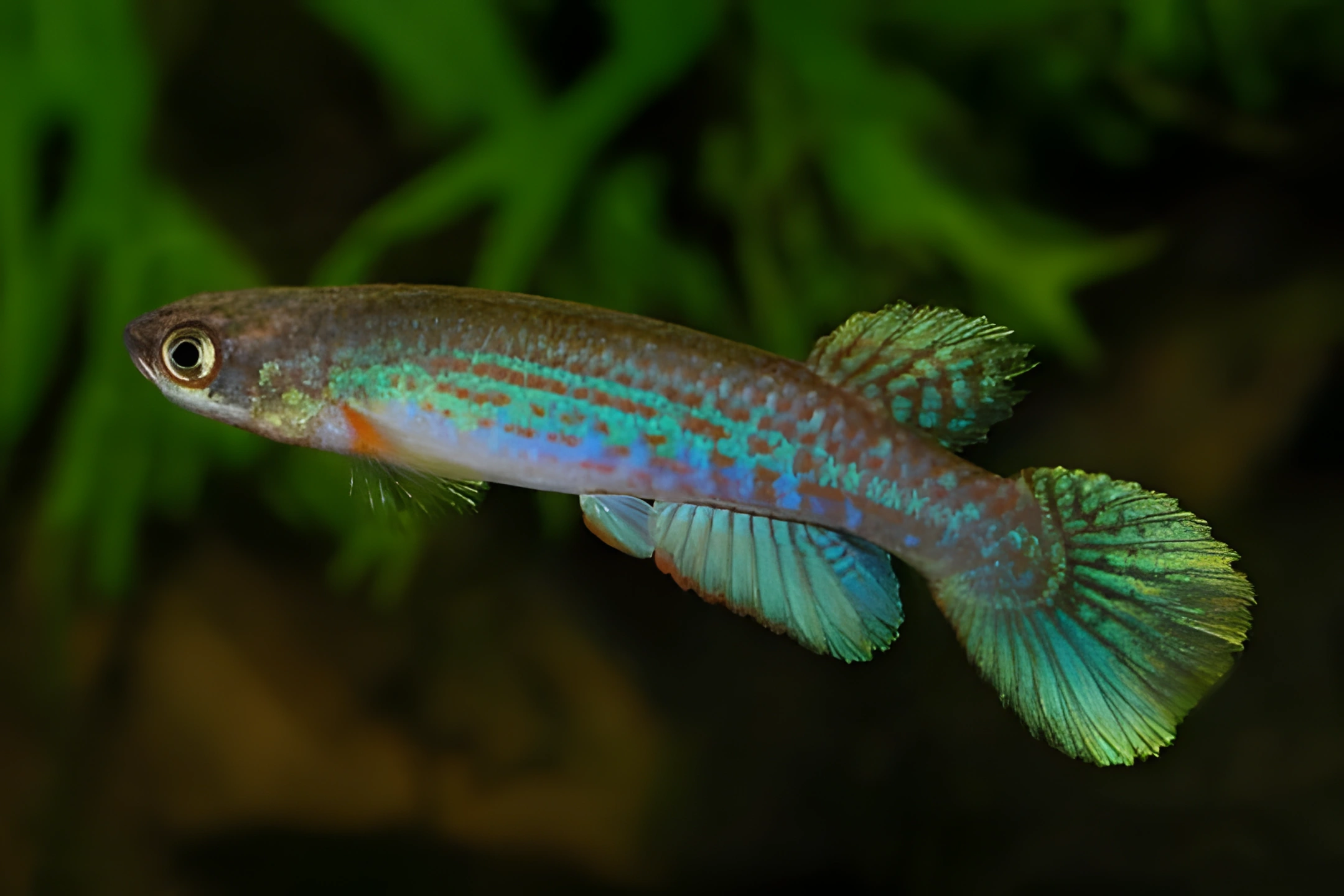
Adults typically reach about 4 cm in length. Rivulus agilae are characterized by an elongated, slender body shape, with the dorsal and anal fins positioned closer to the caudal peduncle. The coloration and pattern on the body of this fish vary greatly. There are many geographical forms, as well as color variations even within a single population. Males display a rich variety of colors. Females of all varieties have a gray-brown body coloration and semi-transparent fins, which sometimes show a pattern characteristic of a specific geographical form. Populations inhabiting French Guiana often have a dark red body coloration, with a bright black stripe running along the lower edge of the tail, transitioning to yellow at the top. Further west, in neighboring Suriname, the fish exhibit more bluish hues; the yellow stripe on the lower part of the tail is often more saturated, and the black edging is less noticeable. Compared to their French counterparts, the body shape of these individuals is less elongated. In the western regions of Guyana, Rivulus agilae displays a bluer body coloration, and the characteristic black and yellow edges of the caudal fin are often absent or weakly expressed.
Habitat
In their natural habitat, these fish can be found in small, sunlit, shallow streams with slow currents and in swamps. These bodies of water are typically located in savannas, near the coast. The characteristic brownish tint of the water is due to the high concentration of tannins released during the decomposition of surrounding vegetation.
Behavior and Compatibility
Among males of this species, there is competition for group leadership and female attention. In small aquariums, such rivalry can become excessively aggressive. Therefore, for keeping in a small aquarium, it is recommended to form a group of one male and several females. Females, unlike males, exhibit peaceful behavior. Rivulus agilae can coexist with other fish species. In the wild, it is often found together with related Rivulus species. However, the behavior of males should be considered, as they can compete even with representatives of other fish species.
Care and Maintenance
Keeping this fish is considered relatively easy. For a group of 4-5 individuals, the optimal aquarium volume starts from 40 L. For decoration, it is recommended to use a soft sand substrate, over which a layer of twigs and leaves is placed; natural driftwood is also used. Detailed information on choosing aquarium leaves can be found in the relevant article. Rooted aquatic plants are placed along the aquarium walls. A small amount of floating plants is permissible, provided they do not cover the entire water surface. Unlike most Rivulus species, this species is not prone to jumping out of the water, so an aquarium lid is not mandatory. The fish prefer a rather narrow water temperature range — 22-25°C. Hardness parameters should be within 5-12 dGH, and acidity — 6.0-7.0.
Diet
In nature, this species is carnivorous, feeding primarily on insect larvae and small invertebrates. In aquarium conditions, the diet should consist mainly of high-quality live or frozen foods, such as Artemia, Daphnia, bloodworms, or glassworms. Dry foods are accepted, but to maintain health and vibrant coloration, it is recommended to prioritize a variety of protein products. Feeding should be done in small portions to avoid water pollution from food remnants.
Breeding and Reproduction
If the fish are kept in a community tank, a separate tank is recommended for successful breeding. Any container from 10 L, equipped with a simple air-driven filter, will suffice for this purpose. Low-growing thickets of fine-leaved plants, aquatic mosses, and ferns should be used as a substrate, where the fish will lay their eggs. One male and several females are placed in the spawning tank. Typically, a protein-rich diet effectively stimulates spawning. Females lay their eggs in a layer of aquatic plants. A female can lay up to 20 eggs per day. The eggs are 1.5 mm in size and amber in color. The incubation period usually lasts about 4 weeks at a water temperature of 22°C. Newly hatched fry can feed on Artemia nauplii or other micro-foods. Source of scientific data: FishBase
Diseases
The species has moderate disease resistance when water parameters are maintained, but it is sensitive to the accumulation of organic compounds and sudden changes in hydrochemical indicators. The main threat comes from bacterial skin and fin infections, which arise from poor filtration or overcrowding. Prevention includes regular partial water changes, maintaining a stable temperature regime, and using quality food. If signs of apathy, scale damage, or unnatural fish behavior appear, it is necessary to check the level of nitrogenous compounds in the aquarium.
How to choose
When selecting individuals, attention should be paid to the activity of the fish, the cleanliness of their skin, and the absence of fin damage. Healthy fish show curiosity, have bright, species-appropriate coloration, and a robust physique without signs of emaciation. Avoid purchasing fish that appear sluggish, stay at the water surface without other reasons, or have visible whitish spots on their bodies. Given the territorial nature of males, it is recommended to plan the group composition in advance to minimize stress and conflicts when settling them into a new aquarium.
Frequently asked questions
The essentials: size, tank volume, water parameters and care
How big does Rivulus agilae get?
An adult reaches 4 cm in length. Plan the tank around the maximum size: the fish quickly outgrows a cramped setup.
What size aquarium does Rivulus agilae need?
The minimum recommended volume is 40 L. A smaller tank speeds up nitrate build-up and raises stress levels.
What water parameters does Rivulus agilae need?
Temperature 22–25 °C, pH 6–7, hardness 5–12 dGH. Stability matters more than exact values: sudden swings are harder on the fish than a small deviation from the ideal.
How long does Rivulus agilae live?
Around 3 years when kept properly. Lifespan depends directly on tank volume, water quality and a varied diet.
Is Rivulus agilae aggressive?
Temperament: semi-peaceful (including aggression during spawning / intraspecific conflicts). Keep this in mind when choosing tank mates.
How many Rivulus agilae should be kept together?
Recommended setup: harem (1 male and several females). Ignoring this is a common cause of stress and disease.
What does Rivulus agilae eat?
Diet type: high protein (predominantly meat). Feed small portions that are finished within a couple of minutes — overfeeding does more harm than underfeeding.
What is the scientific name of Rivulus agilae?
The scientific name of the species is Laimosemion agilae, family Rivulidae. It also appears in the literature as: Laimosemion manaensis, Rivulus agilae, Rivulus manaensis.