Temperature23 – 26 °C
Natural range
- Sulawesi area
- Indonesia area
KillifishConservation status: Endangered EN
Oryzias asinua, known as the Asian Ricefish, belongs to the family Adrianichthyidae and is part of the Killifish group, also called Toothcarps. This fish is a close relative of the Japanese Ricefish, inheriting its qualities: unpretentiousness in keeping, ease of care, and good compatibility with other aquarium inhabitants. Thanks to these characteristics, it can be recommended to aquarists just starting to master this hobby.
- Required aquarium volume
- 40 L
- Size in aquarium
- 3 cm
- Temperature
- 23 – 26 °C
- Temperament
- Semi-peaceful (including aggression during spawning / intraspecific conflicts)
Parameters
Water pHSlightly acidic (5) – Neutral (7)
Water dHVery soft (2) – Medium hardness (10)
Water salinityno salt (freshwater)
Size in aquarium3 cm
Lifespan2 years
TemperamentSemi-peaceful (including aggression during spawning / intraspecific conflicts)
Toward small fishnot a predator
Required aquarium volume40 L
Lightingdimmed
Substraterocky (rock formations, boulders, etc.)
Water flowweak
FeedingAny (universal)
CareSchooling (usually from 5–6 individuals and more)
Description
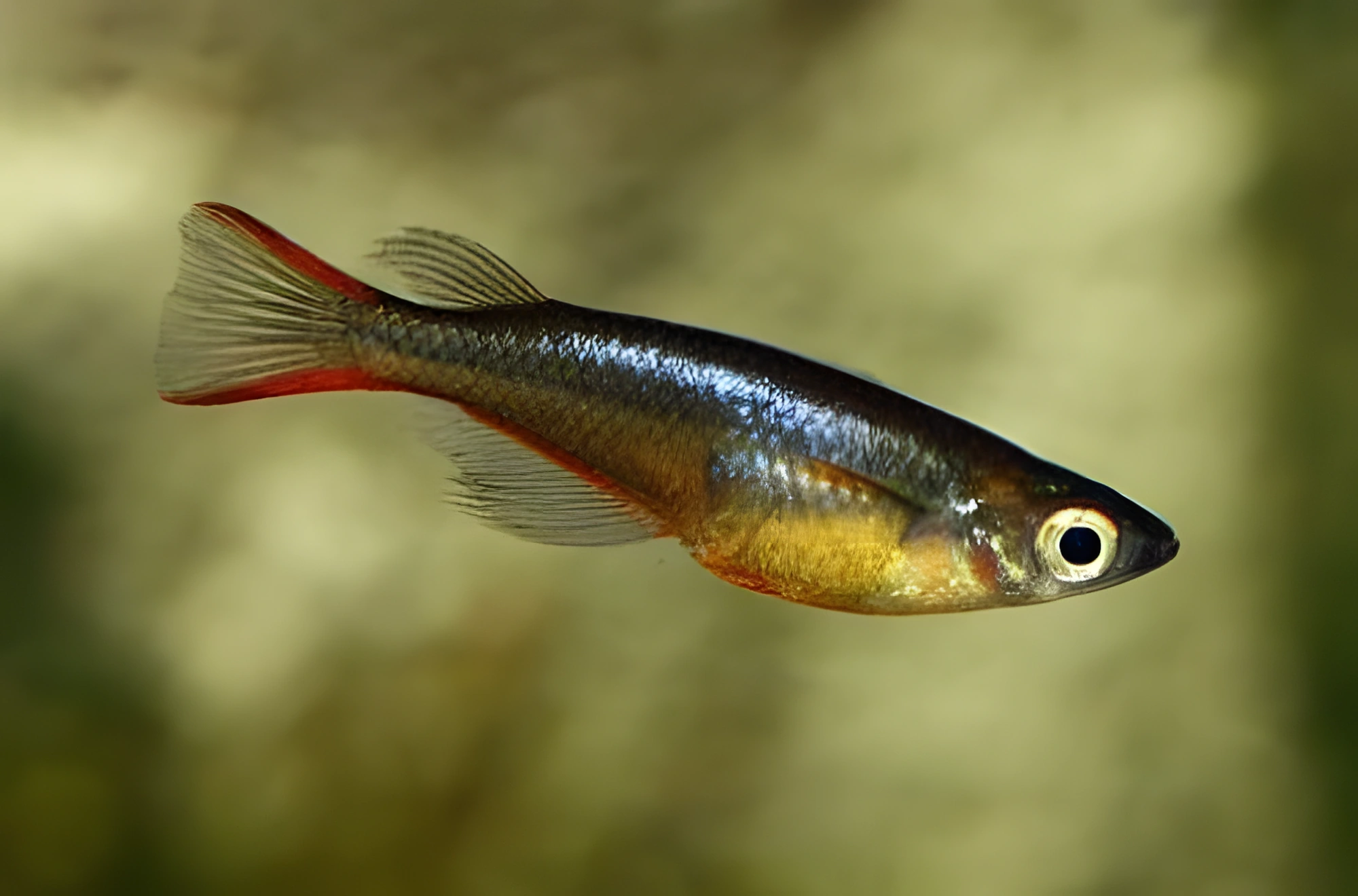
Adults typically reach 3 cm in length. Their main body color is gray, often with a noticeable pink sheen, and their caudal fins are distinctly red. Under certain lighting angles, the scales of this fish can shimmer effectively with blue. Males, as a rule, appear brighter and more colorful, with noticeably elongated dorsal and anal fins. Females, on the other hand, are distinguished by a larger physique, although their coloration is not as intense.
Habitat
The origin of this fish is associated with the river systems of the Indonesian island of Sulawesi, located in Southeast Asia, where it is found exclusively. These fish inhabit river floodplains and swamps, and are also widely present in rice fields, as rice, as is known, requires an aquatic environment for growth. They prefer shallow, well-warmed water areas with stagnant water or slow currents. Their natural habitat is characterized by silty substrates and abundant aquatic vegetation.
Behavior and Compatibility
These schooling fish have a peaceful disposition, but also feel perfectly fine alone. They get along well with other non-aggressive species of similar size, provided they can live in similar conditions.
Care and Maintenance
The small size of adult fish allows them to be kept even in small aquariums or even in ordinary three-liter jars. However, a preferred tank volume is considered to be 20–40 liters. For aquarium decoration, it is recommended to use dark substrate, areas with dense aquatic vegetation, and various shelters created, for example, from intertwined snags. Dim lighting should be provided; floating plants on the surface can serve as an additional means of shading. In such conditions, the fish display their most vibrant coloration, as it harmonizes with their natural habitat. Maintaining high water quality is critically important for any fish species, so the aquarium must be equipped with an effective filtration system, and its regular maintenance is mandatory. This includes periodic removal of organic waste, cleaning decorative elements of plaque, and weekly partial water changes (15–20% of the total volume) with fresh water. When choosing a filter, preference should be given to models that do not create a strong current, as, as already mentioned, the Ricefish prefers bodies of water with stagnant water.
Diet
This fish is undemanding regarding its diet. In home conditions, the Asian Ricefish readily eats various types of dry foods, such as flakes or granules. To enrich its diet, live or frozen foods can be used, for example, small bloodworms, artemia, or daphnia. The key point is the size of the food particles: they must be small enough for the fish to swallow them without difficulty.
Breeding and Reproduction
Breeding Asian Ricefish in captivity is possible, but requires the creation of suitable conditions. Spawning can occur both in a community tank and in a separate aquarium with dense vegetation. Males court females, after which eggs are laid on fine-leaved plants. Parents may eat the fry, so to preserve the offspring, it is recommended to transfer the parents or use special spawning substrates. Fry are fed with small foods, such as infusoria or specialized dry mixes for juveniles.
Diseases
This species is considered hardy and unpretentious. In a well-balanced aquarium system, diseases are rare. Health problems can arise with a significant deterioration in keeping conditions, as well as upon contact with already sick fish. Detailed information on symptoms and treatment methods can be found in the section "Aquarium Fish Diseases."
How to choose
When choosing fish, attention should be paid to their external condition and behavior. Healthy individuals should be active, have clean fins without damage or ulcers, and even scales without signs of plaque or spots. It is important to avoid buying fish that look emaciated, stay near the water surface, or show signs of apathy. It is recommended to purchase individuals from a single source to minimize the risk of introducing infections, and to clarify their keeping conditions at the store beforehand.
Frequently asked questions
The essentials: size, tank volume, water parameters and care
How big does Ricefish get?
An adult reaches 3 cm in length. Plan the tank around the maximum size: the fish quickly outgrows a cramped setup.
What size aquarium does Ricefish need?
The minimum recommended volume is 40 L. A smaller tank speeds up nitrate build-up and raises stress levels.
What water parameters does Ricefish need?
Temperature 23–26 °C, pH 5–7, hardness 2–10 dGH. Stability matters more than exact values: sudden swings are harder on the fish than a small deviation from the ideal.
How long does Ricefish live?
Around 2 years when kept properly. Lifespan depends directly on tank volume, water quality and a varied diet.
Is Ricefish aggressive?
Temperament: semi-peaceful (including aggression during spawning / intraspecific conflicts). Keep this in mind when choosing tank mates.
How many Ricefish should be kept together?
Recommended setup: schooling (usually from 5–6 individuals and more). Ignoring this is a common cause of stress and disease.
What does Ricefish eat?
Diet type: any (universal). Feed small portions that are finished within a couple of minutes — overfeeding does more harm than underfeeding.
What is the scientific name of Ricefish?
The scientific name of the species is Oryzias asinua, family Adrianichthyidae.