Temperature24 – 30 °C
Natural range
- Amazon River Basin
- Colombia area
- Peru area
- Brazil area
CichlidsConservation status: Least concern LC
Other scientific names: Acara heckelii, Acara subocularis, Geophagus thayeri
Acarichthys heckelii, known as Heckel's Acara or Threadfin Acara, belongs to the Cichlidae family. This vibrant and attractive fish is relatively easy to keep, standing out with its unusual behavior during the breeding season. In a spacious aquarium, it generally does not cause significant trouble for its owner.
- Required aquarium volume
- 300 L
- Size in aquarium
- 20 cm
- Temperature
- 24 – 30 °C
- Temperament
- Semi-peaceful (including aggression during spawning / intraspecific conflicts)
Parameters
Water pHSlightly acidic (6) – Neutral (7)
Water dHVery soft (1) – Hard (12)
Water salinityno salt (freshwater)
Size in aquarium20 cm
Lifespan8 years
TemperamentSemi-peaceful (including aggression during spawning / intraspecific conflicts)
Toward small fishnot a predator
Required aquarium volume300 L
Lightingdimmed
Substratesandy (regular, light)
Water flownone or stagnant (no flow)
FeedingAny (universal)
CareMixed (solitary / pair / group)
Description
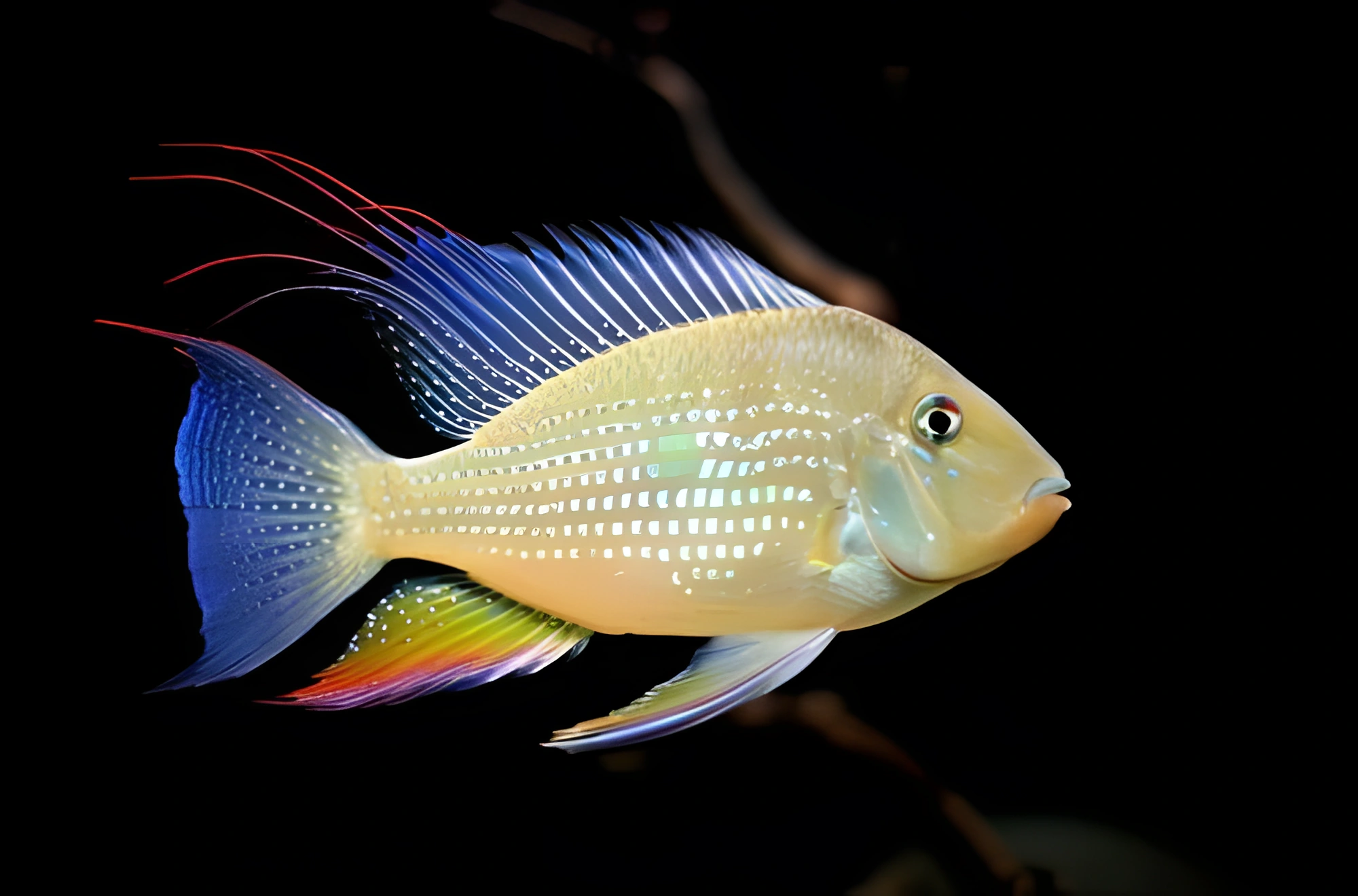
Adults can reach a length of about 20 cm. Females are usually larger, while males are distinguished by brighter coloration. Their bodies are beige, adorned with rows of blue speckles. The caudal and dorsal fins are blue, with elongated outer rays resembling threads. The pelvic and anal fins display a variety of all the colors of the rainbow.
Habitat
Its natural habitat is South America, primarily the northern part of the Amazon River basin, covering territories in Colombia, Peru, and parts of Brazil. This species is found in numerous rivers and streams flowing through tropical rainforests. During the rainy season, when water levels rise, Heckel's Acara swims into flooded areas of the Amazon forest. It is worth noting that this species has successfully established itself in Southeast Asia, particularly in the Singapore area.
Behavior and Compatibility
These fish are relatively peaceful and calm, but as adults, their behavior can become unpredictable. Many external factors influence the fish's temperament: the volume of the aquarium and the number of inhabitants. The smaller the tank and the more fish it contains, the higher the risk of aggression. Conversely, in spacious aquariums, aggression problems are practically non-existent. The Threadfin Acara is safe with other species, provided they are large enough not to fit into its mouth.
Care and Maintenance
For two fish, an aquarium of 300 liters is sufficient; however, a school of Threadfin Acaras may require a tank over 1000 liters. For decor, it is recommended to use a sandy substrate and several snags imitating roots or tree branches. Lighting should be subdued. These fish tend to actively dig in the substrate, which can significantly alter the aquarium's "landscape," so rooted plants are not recommended. Alternatively, floating shade-loving plants, as well as aquatic mosses and ferns attached to the surface of snags, can be used. Successful long-term keeping critically depends on maintaining high water quality. The fish do not tolerate the accumulation of organic waste and nitrogen cycle products. Therefore, in addition to standard maintenance procedures, weekly water changes of a significant portion (50–70% of the volume) with fresh water are necessary, as well as the installation of an efficient filtration system, preferably external. When choosing a specific filter model and its mounting location, it is recommended to consult with specialists. The filter should provide effective purification, not create excessive water movement, and be resistant to clogging with sand, which can get into it when the fish dig in the substrate, stirring up sediment.
Diet
Being an omnivorous species, this fish readily accepts various popular aquarium foods: dry flakes, pellets, as well as frozen or live bloodworms, daphnia, and brine shrimp. An essential part of their diet includes plant supplements such as spirulina or blanched pieces of spinach and lettuce. The absence of plant food can lead to damage to aquatic plants in the aquarium, if present.
Breeding and Reproduction
Breeding this species in a home aquarium is unlikely. The main reason is the need to create conditions that mimic the natural habitat: both rising and falling water levels, as well as corresponding changes in temperature and hydrochemical composition, which serve as a stimulus for reproduction. Additionally, these fish are characterized by a special spawning method involving the construction of an elaborate nest for egg-laying. During the breeding season, notably, the female shows the most activity. In natural conditions, she digs intricate horizontal tunnels (burrows) in the substrate with several vertical entrances, some of which are false to confuse potential predators. A spacious chamber is created deep within this system, intended for spawning. After construction is complete, the female begins to attract the male. Once a partner is found and spawning is complete, the primary responsibility for protecting the offspring falls to the male. The parents continue to care for the fry until they reach a sufficiently large size—approximately 1 cm.
Diseases
The main cause of diseases often lies in the keeping conditions: if they go beyond acceptable limits, immunity decreases, making the fish vulnerable to various infections inevitably present in the environment. At the first suspicion of illness, it is important first of all to check the water parameters and ensure there are no dangerous concentrations of nitrogen cycle products. Often, restoring normal, suitable conditions promotes recovery. However, in some cases, medication may be required. Detailed information on symptoms and treatment methods is presented in the "Aquarium Fish Diseases" section.
How to choose
When purchasing, choose active individuals with clean fins and no body damage. Avoid fish with sunken bellies, signs of emaciation, or unnatural behavior, such as apathy or a constant desire to hide in a corner. It is important to carefully inspect the scales and eyes for cloudy spots, ulcers, or film, which may indicate infectious diseases.
Before purchasing, ask the seller about the current water parameters in the aquarium and their feeding regimen. Threadfin Acara are sensitive to environmental quality, so an abrupt change in conditions during transport and transfer can provoke stress and weaken their immune system. It is advisable to acquire young individuals, as they adapt more easily to new keeping conditions than adult fish.
Frequently asked questions
The essentials: size, tank volume, water parameters and care
How big does Threadfin Acara get?
An adult reaches 20 cm in length. Plan the tank around the maximum size: the fish quickly outgrows a cramped setup.
What size aquarium does Threadfin Acara need?
The minimum recommended volume is 300 L. A smaller tank speeds up nitrate build-up and raises stress levels.
What water parameters does Threadfin Acara need?
Temperature 24–30 °C, pH 6–7, hardness 1–12 dGH. Stability matters more than exact values: sudden swings are harder on the fish than a small deviation from the ideal.
How long does Threadfin Acara live?
Around 8 years when kept properly. Lifespan depends directly on tank volume, water quality and a varied diet.
Is Threadfin Acara aggressive?
Temperament: semi-peaceful (including aggression during spawning / intraspecific conflicts). Keep this in mind when choosing tank mates.
How many Threadfin Acara should be kept together?
Recommended setup: mixed (solitary / pair / group). Ignoring this is a common cause of stress and disease.
What does Threadfin Acara eat?
Diet type: any (universal). Feed small portions that are finished within a couple of minutes — overfeeding does more harm than underfeeding.
What is the scientific name of Threadfin Acara?
The scientific name of the species is Acarichthys heckelii, family Cichlids (Cichlidae). It also appears in the literature as: Acara heckelii, Acara subocularis, Geophagus thayeri.