Temperature24 – 26 °C
Natural range
- South America area
Predators UnusualConservation status: Least concern LC
Other scientific names: Paratrygon laticeps, Potamotrygon alba, Potamotrygon labradori, Potamotrygon laticeps, Potamotrygon pauckei, Taeniura motoro
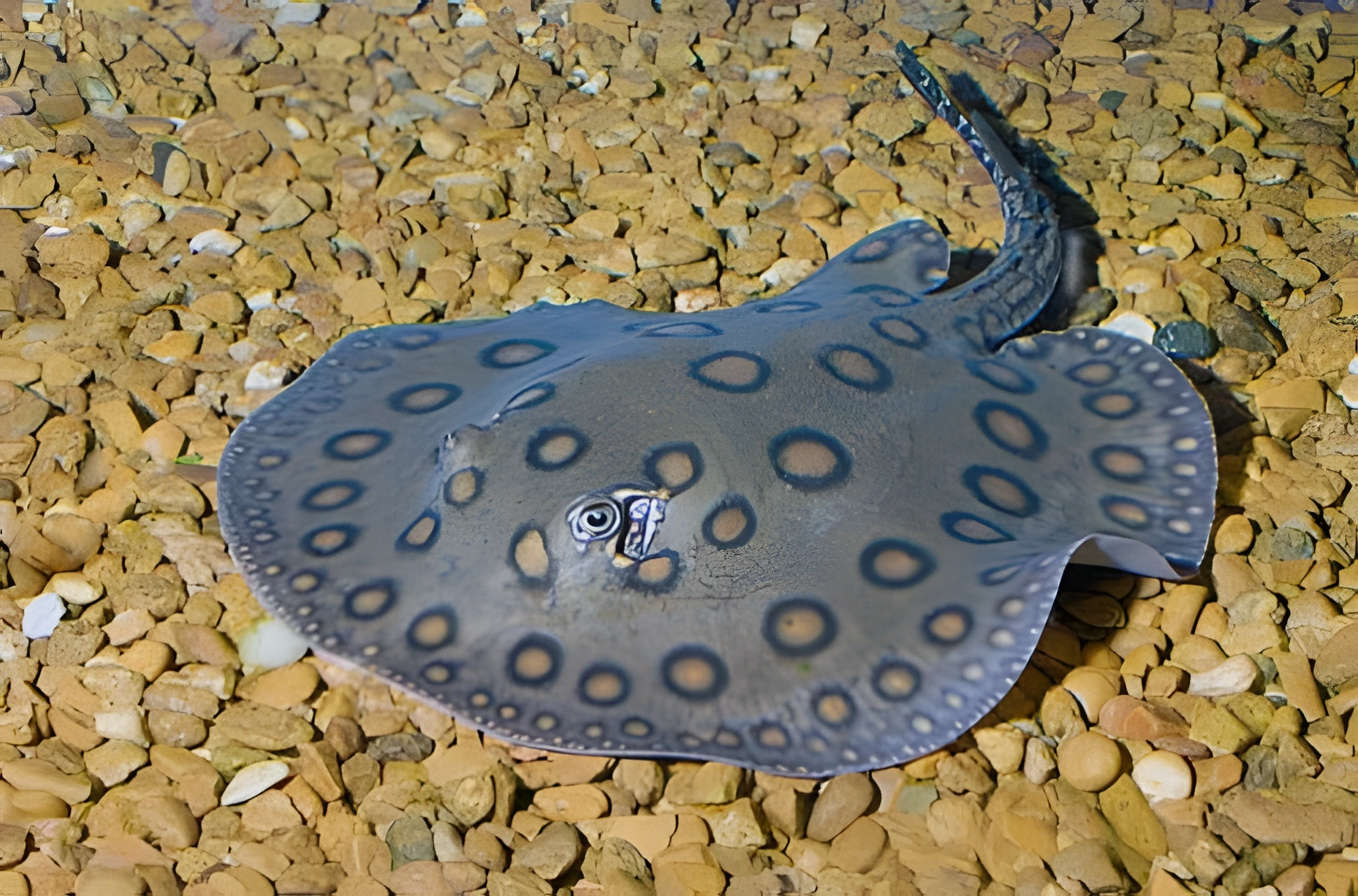
The Ocellated River Stingray, also known as the South American Freshwater Stingray (scientific name Potamotrygon motoro), belongs to the family Potamotrygonidae. This predator poses a certain danger to aquarists due to the presence of a barb on the tip of its tail. Its keeping requires significant financial investment associated with the maintenance of specialized equipment and the provision of large volumes of fresh or live food. Consequently, the Ocellated River Stingray is a rare inhabitant of amateur aquariums.
- Required aquarium volume
- 1700 L
- Size in aquarium
- 60 cm
- Temperature
- 24 – 26 °C
- Temperament
- Aggressive / incompatible / unfriendly
Parameters
Water pHSlightly acidic (6) – Neutral (7)
Water dHVery soft (1) – Hard (12)
Water salinityno salt (freshwater)
Size in aquarium60 cm
Lifespan10 years
TemperamentAggressive / incompatible / unfriendly
Toward small fishpredator
Required aquarium volume1700 L
Lightingdimmed (dull)
Substratesandy (regular, light)
Water flowweak or moderate
FeedingMeat / protein (live, frozen, fresh)
CareBoth solitary and in group (flexible)
Description
The size of adult individuals varies depending on their region of origin. In aquarium conditions, they typically reach up to 60 cm. Sexual dimorphism in these stingrays is weakly expressed; males can be distinguished by special appendages near the anal fins, used for semen excretion. The body coloration is gray or brown, with evenly distributed light spots surrounded by a dark border — it is precisely because of these “ocellate” spots that the species received its name. The tail has a sharp barb used for defense. In case of threat, the stingray can strike with its tail, impaling its “weapon.” Inexperienced handling of these fish significantly increases the risk of injury.
Habitat
The native habitat of this species is South America. It can be found almost throughout the Amazon River basin, as well as in other large river systems of the continent. This freshwater stingray has adapted to life in various biotopes, but their common feature is always sandy or silty bottom areas where it can burrow. During the rainy season, the stingray often swims into flooded areas of tropical forests. Below is a brief overview of the species.
Behavior and Compatibility
In its natural habitat, the South American Freshwater Stingray is one of the main predators. Therefore, the choice of suitable tank mates is very limited. In a spacious tank, cohabitation is possible with large fish that prefer the middle and upper water layers, such as Pacu, Brazilian Geophagus, or peaceful Cichlasoma. These stingrays can live either alone or in a group.
Care and Maintenance
A pair of fish will require an aquarium with a volume of at least 1700 L. A rounded tank shape, devoid of sharp corners, is preferable. The decor can be quite simple and chosen according to the aquarist's taste, however, key conditions are a sandy substrate and the presence of extensive open areas on the bottom. When choosing decorative elements, avoid rooted plants, as they will be quickly dug up and damaged. Mosses and ferns make an excellent alternative; they can successfully grow on driftwood and rocks and are also perfectly adapted to low light conditions, which should be provided in the aquarium. The filtration system plays a crucial role in keeping the Ocellated River Stingray. The filter must effectively cope with a significant volume of organic waste and ensure complete water circulation at least four times per hour. This means that for a 1700 L aquarium, its capacity should reach approximately 7000 L per hour. Additionally, half of the water volume must be replaced with fresh water every week. Fulfilling all these requirements implies substantial investment in the acquisition and installation of equipment, as well as its subsequent maintenance, so this work is usually carried out by specially trained specialists or very experienced aquarists.
Diet
This carnivorous species naturally feeds on other fish and various aquatic invertebrates, including crustaceans and worms. In a home aquarium, the diet should correspond to their natural needs. The diet should be based on fresh or live fish of appropriate size, shrimp, mussels, as well as earthworms and other similar foods. Feeding should be done twice a day in small portions. It is important to exclude mammalian and bird meat from the diet, as the substances contained in it are poorly digested and can negatively affect the health of river stingrays.
Breeding and Reproduction
Ocellated River Stingrays reproduce using an intrauterine strategy, where fully formed individuals are born. The development of the fry occurs inside the female. After they consume their yolk sacs, nutrition is provided through special filaments, which represent a primitive form of placenta. Typically, there are up to 8 fry in a single brood. River stingrays show selectivity in choosing a partner, so simply placing a male and female in the same tank is not enough for successful breeding. Natural pair formation can occur if several young fish grow together for several years. However, such a breeding strategy often exceeds the capabilities of most hobbyists. When a pair is formed, the male exhibits courtship behavior during the spawning period, pursuing the female until she is ready to mate. Then the stingrays press their ventral sides together, and the male introduces semen into the female's body using special appendages. The incubation period lasts from 9 to 12 weeks, but in aquarium conditions, this period may be shorter, which is likely due to more comfortable conditions and constant access to food.
Diseases
This fish species is characterized by its resilience and unpretentiousness. With favorable keeping conditions, health problems usually do not arise. The main cause of most diseases is a sharp and significant deterioration in water quality. More detailed information on symptoms and treatment methods can be found in the "Aquarium Fish Diseases" section.
How to choose
When purchasing a river stingray, it is extremely important to assess its physical condition, as emaciated individuals are often beyond rehabilitation. A healthy fish should be active and have a good appetite. Be sure to ask the seller to demonstrate feeding: a healthy stingray rarely refuses offered food. Avoid specimens that appear apathetic or ignore food.
Carefully inspect the fish's body for signs of emaciation and disease. In a healthy individual, the base of the tail should be significantly thicker than its tip. The presence of depressions in the area of the caudal tubercles, as well as visible skeletal protrusions, indicates critical malnutrition. Absolutely do not purchase individuals with upward-curled disc edges, which is a sure sign of imminent death due to prolonged stress or starvation. Also, refuse to buy if whitish spots, film, skin damage, or a traumatized tail are visible on the body.
Frequently asked questions
The essentials: size, tank volume, water parameters and care
How big does River Stingray get?
An adult reaches 60 cm in length. Plan the tank around the maximum size: the fish quickly outgrows a cramped setup.
What size aquarium does River Stingray need?
The minimum recommended volume is 1700 L. A smaller tank speeds up nitrate build-up and raises stress levels.
What water parameters does River Stingray need?
Temperature 24–26 °C, pH 6–7, hardness 1–12 dGH. Stability matters more than exact values: sudden swings are harder on the fish than a small deviation from the ideal.
How long does River Stingray live?
Around 10 years when kept properly. Lifespan depends directly on tank volume, water quality and a varied diet.
Is River Stingray aggressive?
Temperament: aggressive / incompatible / unfriendly. This is a predatory species — any fish small enough to fit in its mouth will eventually be eaten.
How many River Stingray should be kept together?
Recommended setup: both solitary and in group (flexible). Ignoring this is a common cause of stress and disease.
What does River Stingray eat?
Diet type: meat / protein (live, frozen, fresh). Feed small portions that are finished within a couple of minutes — overfeeding does more harm than underfeeding.
What is the scientific name of River Stingray?
The scientific name of the species is Potamotrygon motoro, family Potamotrygonidae (River Stingrays). It also appears in the literature as: Paratrygon laticeps, Potamotrygon alba, Potamotrygon labradori.