Temperature20 – 28 °C
Natural range
- Thailand area
- Cambodia area
- Vietnam area
- Mekong River Basin
CyprinidsConservation status: Near threatened NT
Other scientific names: Rasbora urophthalma, Rasbora urophthalmoides
Boraras urophthalmoides, known as the Firefly Rasbora, belongs to the family Cyprinidae. This fish is characterized by its miniature size, bright and vibrant coloration, and high activity. Its keeping and breeding do not require special efforts, provided that proper conditions are ensured and tank mates are carefully selected.
- Required aquarium volume
- 40 L
- Size in aquarium
- 2 cm
- Temperature
- 20 – 28 °C
- Temperament
- Peaceful (regular)
Parameters
Water pHSlightly acidic (6) – Neutral (7)
Water dHVery soft (1) – Medium hardness (10)
Water salinityno salt (freshwater)
Size in aquarium2 cm
Lifespan5 years
TemperamentPeaceful (regular)
Toward small fishnot a predator
Required aquarium volume40 L
Lightingdimmed
Substrateany (no restrictions)
Water flowweak
FeedingAny (universal)
CareGroup (8–10 individuals)
Description
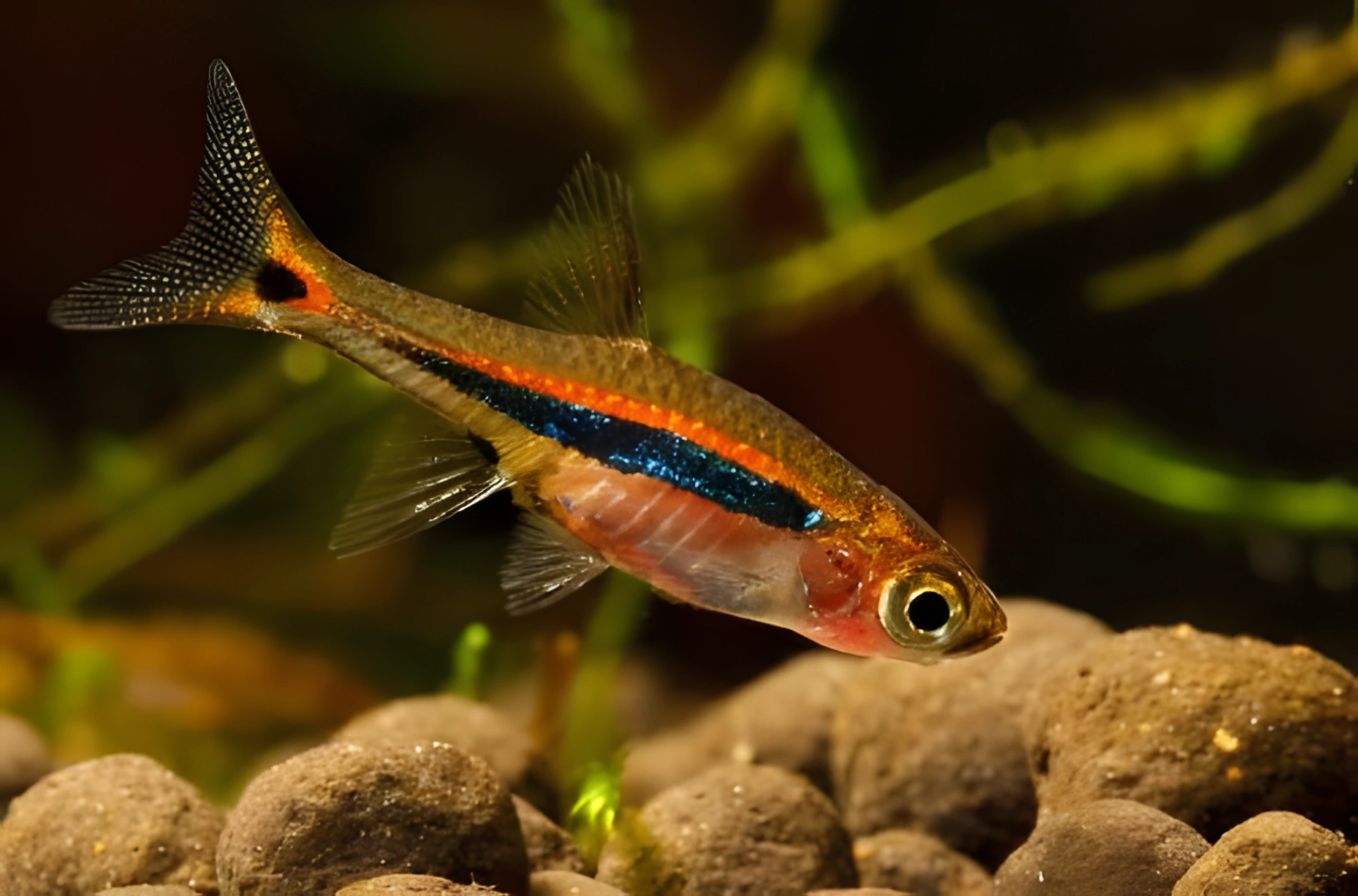
This popular aquarium fish is distinguished by its extremely small size; adults reach only about 2 cm. Their evolution was determined by a nutrient-poor habitat, leading to a process known as miniaturization: initially larger fish gradually decreased in size. However, it should be noted that some representatives of the species have retained their former dimensions and can reach 4 cm. The body coloration is dominated by orange and red tones. Two horizontal stripes — red and black — run along the sides, from head to tail. A dark mark is visible at the base of the caudal fin, which, combined with the stripe, creates the impression of an exclamation mark. Sexual dimorphism in these fish is quite weak.
Habitat
In the wild, these fish inhabit Thailand, Cambodia, and Vietnam. Their preferred habitats are shallow, heavily overgrown bodies of water with clear water: swamps, river floodplains, and rice paddies. During the rainy season, their range significantly expands due to the flooding of coastal areas.
Behavior and Compatibility
This peaceful schooling fish prefers the company of its own kind. Keeping them in a group of 8–10 individuals allows the Firefly Rasbora to feel protected, which positively affects its behavior and color intensity. During spawning, males become territorial and may attack any "uninvited guest," but such actions almost never result in injuries, being more of an external display of strength. Due to their tiny size, they are compatible only with other dwarf species, such as Boraras brigittae, Harlequin Rasbora, Hengel's Rasbora, and others. Avoid cohabitation with larger relatives to prevent hybridization and preserve the miniature size of your fish.
Care and Maintenance
Despite its modest size, the Firefly Rasbora requires an aquarium of at least 40 liters. This is because during the breeding season, dominant males establish and guard temporary territories from rivals. Soft substrates, an abundance of rooted and floating plants, as well as snags, roots, and tree branches as shelters, are suitable for aquarium decoration. The fish are extremely sensitive to any, even weak, current, so when choosing a filter, it is crucial to consult a specialist to select a model that provides high performance without excessive water movement. The minimum necessary equipment set also includes a heater, aerator, and lighting system. Water conditions should be characterized by slightly acidic pH values with low carbonate hardness. More detailed information on pH and dGH parameters can be found in the "Hydrochemical composition of water" section. Regular aquarium maintenance includes weekly water changes of 10–15% of the volume with fresh water, as well as cleaning the substrate from waste products and the glass from organic buildup.
Diet
The diet of these fish can include all types of dry, frozen, and live foods suitable for their size. To maintain good overall fish health, it is recommended to offer a varied menu. Feeding should be done 2–3 times a day, in portions that the fish can consume within 5 minutes.
Breeding and Reproduction
The Firefly Rasbora is an egg-laying species: females scatter eggs among plant thickets, and males fertilize them. Parental instincts in these fish are weakly expressed; immediately after spawning, they may eat both eggs and hatched fry. Despite their ability to breed year-round without much intervention from the aquarist, the survival rate of fry remains very low due to this. To increase the chances of fry survival and protect them from adults, it is recommended to breed them in a separate tank — a breeding aquarium. The setup of such an aquarium should be simple, with an emphasis on egg preservation. Low-growing, fine-leaved plants or mosses, such as Riccia fluitans and Java moss, are used, planted over most of the substrate surface. Dense plant thickets serve as reliable cover for eggs, no worse than special substrates or nets. A breeding aquarium for this species is usually about 10 liters in volume and filled halfway. Equipment includes an aerator, heater, and a simple, low-power sponge air-driven filter to prevent accidental suction of eggs and fry. Spawning occurs under dim lighting, so a light source is not required initially. To systematize the breeding process, experienced breeders regulate the hydrochemical composition of the water. In particular, the stimulus for spawning is the inclusion of protein (meat) food in the daily diet, as well as setting pH values at 5.0–6.5 with dGH around 1–5° and a temperature of 26–27°C. The beginning of the breeding period can be determined by the noticeably rounded abdomen of the females, while the males choose an area of the aquarium and begin to actively attract females. By this point, a separate tank should be prepared, filled with water from the main aquarium, then several females and the brightest males should be transferred there, where they will spend several days. Spawning can be initiated by adding cool water, lowering the temperature by several degrees. If this is done in the evening, offspring may appear by morning. The end of spawning is easiest to determine by the females — they will become noticeably slimmer. After this, the fish are returned to the main aquarium. Fry appear after 18–48 hours, and after another day, they begin to swim freely. They are fed specialized microscopic food for aquarium fish fry.
Diseases
Balanced nutrition and properly selected keeping conditions are the best prevention of diseases in freshwater fish. If the first signs of illness appear, such as changes in coloration or behavior, the first step should be to check the water parameters and quality. If necessary, all values should be brought back to normal, and only then should treatment begin. More detailed information on symptoms and treatment methods can be found in the "Diseases of Aquarium Fish" section.
How to choose
When choosing Firefly Rasboras, pay attention to the overall activity of the school in the aquarium: healthy fish should be active and constantly moving in the water column. Avoid individuals with signs of emaciation, sunken bellies, or fin damage, as their small size makes them extremely sensitive to stress during transportation. It is important to check for the absence of white spots, film, or unnatural spots on the body, which may indicate the presence of parasites or fungal infections. Since these fish are schooling, it is recommended to purchase a group of 8–10 individuals at once to minimize stress levels after moving to a new aquarium. In the store, it is better to prefer individuals with bright, rich coloration, which indicates good keeping conditions and proper feeding from the supplier.
Frequently asked questions
The essentials: size, tank volume, water parameters and care
How big does Firefly Rasbora get?
An adult reaches 2 cm in length. Plan the tank around the maximum size: the fish quickly outgrows a cramped setup.
What size aquarium does Firefly Rasbora need?
The minimum recommended volume is 40 L. A smaller tank speeds up nitrate build-up and raises stress levels.
What water parameters does Firefly Rasbora need?
Temperature 20–28 °C, pH 6–7, hardness 1–10 dGH. Stability matters more than exact values: sudden swings are harder on the fish than a small deviation from the ideal.
How long does Firefly Rasbora live?
Around 5 years when kept properly. Lifespan depends directly on tank volume, water quality and a varied diet.
Is Firefly Rasbora aggressive?
Temperament: peaceful (regular). Keep this in mind when choosing tank mates.
How many Firefly Rasbora should be kept together?
Recommended setup: group (8–10 individuals). Ignoring this is a common cause of stress and disease.
What does Firefly Rasbora eat?
Diet type: any (universal). Feed small portions that are finished within a couple of minutes — overfeeding does more harm than underfeeding.
What is the scientific name of Firefly Rasbora?
The scientific name of the species is Boraras urophthalmoides, family Cyprinids (Cyprinidae). It also appears in the literature as: Rasbora urophthalma, Rasbora urophthalmoides.