Temperature22 – 26 °C
Natural range
- Ratchaburi Province area
- Western Thailand area
CyprinidsConservation status: Critically endangered CR
Other scientific names: Barbus somphongsi, Rasbora somphongsi
Somphongs's Rasbora, or Trigonostigma somphongsi, is a species belonging to the family Cyprinidae. These fish are extremely rare, seldom encountered both in aquariums and in their natural habitat. Until recently, they were believed to be completely extinct until they were unexpectedly discovered among a shipment of other Rasbora species delivered to Germany. If you are fortunate enough to acquire these fish, their keeping will not present significant difficulties. They are known for their unpretentiousness and peaceful nature, making them a suitable choice even for beginner aquarists.
- Required aquarium volume
- 40 L
- Size in aquarium
- 2 – 3 cm
- Temperature
- 22 – 26 °C
- Temperament
- Peaceful (regular)
Parameters
Water pHSlightly acidic (5) – Neutral (7)
Water dHVery soft (1) – Medium hardness (8)
Water salinityno salt (freshwater)
Size in aquarium2 – 3 cm
Lifespan3 years
TemperamentPeaceful (regular)
Toward small fishnot a predator
Required aquarium volume40 L
Lightingweak or moderate
Substrateany (no restrictions)
Water flowweak or moderate
FeedingAny (universal)
CareGroup (8–10 individuals)
Description
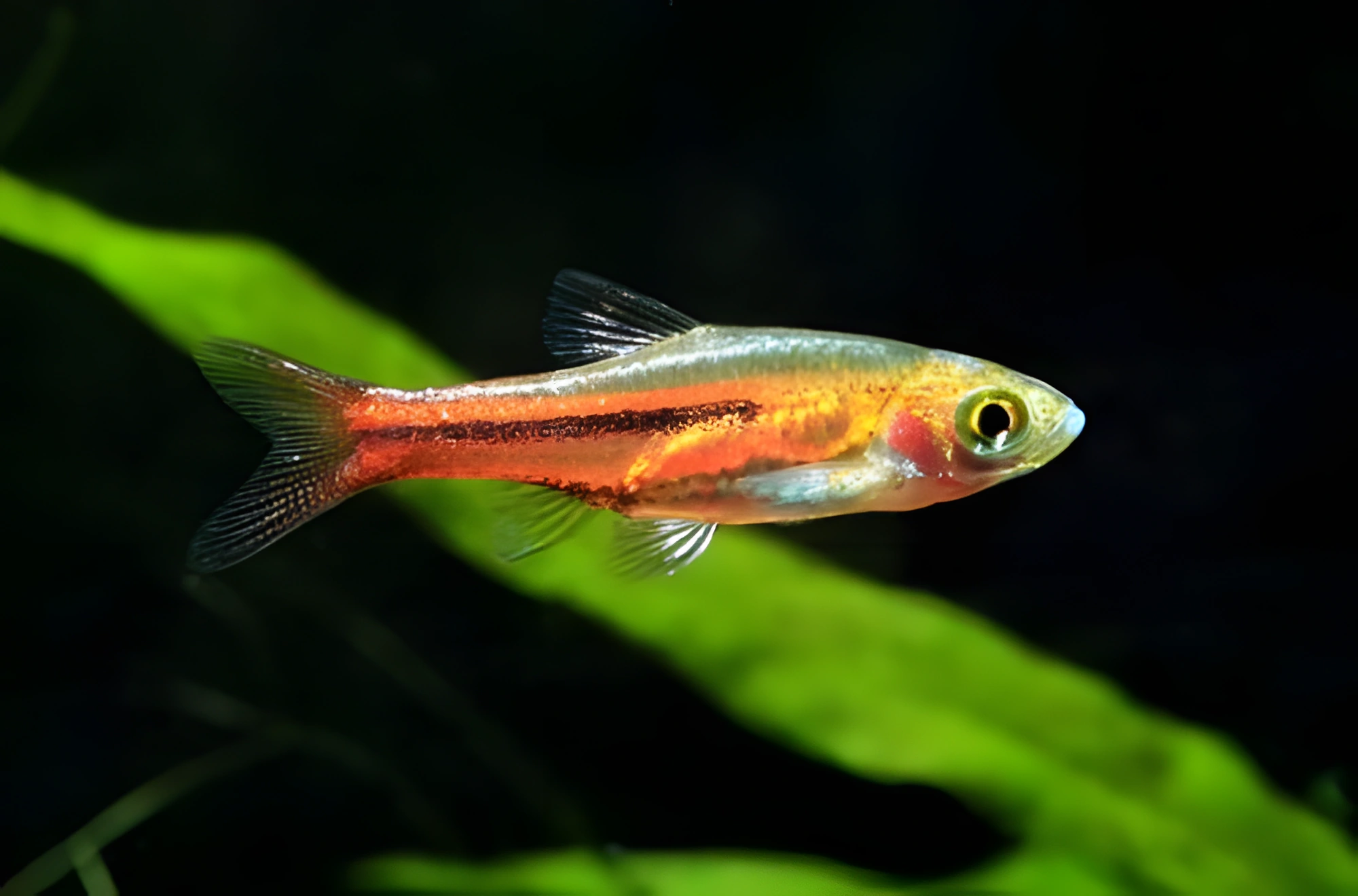
Adults of this fish typically reach a length of about 3 cm. Their coloration varies from coppery-red to yellowish, adorned with a black stripe that runs from the middle of the body to the tail. The fins and tail remain transparent. Sexual dimorphism is weakly expressed: males, although having a more intense coloration, are smaller than females.
Habitat
Their origin is linked to Southeast Asia, specifically to Ratchaburi Province in western Thailand, near Bangkok. It is likely that their range was once significantly wider, but by now, this species has practically disappeared in the wild due to intensive human economic activity. Natural biotopes have undergone significant changes caused by dam construction, which disrupted the seasonal flooding cycles of tropical forests. It is presumed that these fish inhabited small forest streams densely overgrown with aquatic plants of the Cryptocoryne genus. The water in these areas acquired a characteristic brownish tint due to the large amount of decomposing organic matter such as leaves, branches, and fruits.
Behavior and Compatibility
This fish is characterized by schooling and peaceful behavior; it coexists perfectly with other non-aggressive species of comparable size. No intraspecific conflicts are observed. It is advisable to keep a group of at least 8–10 individuals; with fewer numbers, the fish become more timid and tend to seek shelter, especially in the presence of larger tank mates.
Care and Maintenance
For a small school of these fish, a tank of at least 60 liters is required. When aquascaping, it is advisable to create conditions that mimic their natural habitat: this involves using a large number of shade-loving plants, driftwood, and other elements. Lighting should be subdued. Adding dried leaves will help give the water a characteristic brownish tint. Maintenance of an aquarium with Rasbora somphongsi corresponds to standard requirements. It is important to regularly clean the substrate and decorations, perform partial water changes with fresh water, monitor nitrate levels, and maintain optimal hydrochemical parameters.
Diet
This species is not particularly demanding when it comes to food. In a home aquarium, they readily accept most common foods, provided they are of appropriate size, including dry, live, and frozen options. It is recommended to choose high-quality, protein-rich products, as this positively affects the fish's vitality and helps them display their best coloration.
Breeding and Reproduction
Given that this species has practically disappeared in the wild, its breeding in aquariums takes on particular importance. The process itself is not especially difficult. Like other cyprinids, Rasbora somphongsi will spawn regularly when favorable conditions are provided. During the breeding period, the fish lay their eggs on the surface of broad leaves, after which they do not participate further in caring for the offspring; moreover, they may eat the eggs or fry if given the opportunity. The incubation period lasts 1–2 days, depending on water temperature. In a community tank, fry survival is usually low, as they fall victim to their own parents and other fish, and can also die from lack of food. If the goal is to save the entire brood or a significant portion of it, the eggs should be promptly transferred to a separate breeding tank with identical water conditions. Then, the hydrochemical parameters of the water in this tank should be gradually adjusted to the following values: pH 5.0–6.0 and 1–5 dGH. The setup should include thickets of mosses and ferns, and the lighting should be subdued. Equipment should be limited to a heater and a simple sponge filter with an air pump. Fry are fed micro-foods, such as powdered mixtures, or, if available, Artemia nauplii.
Diseases
In a stable aquarium ecosystem, with suitable water conditions and regular care, fish health problems usually do not arise. Diseases can be a consequence of improper maintenance or injuries. More detailed information on symptoms and treatment methods can be found in the "Aquarium Fish Diseases" section.
How to choose
When purchasing Rasbora somphongsi, it is important to ensure there are no external signs of disease, such as fin damage, body film, or an unnaturally bloated abdomen. Healthy fish should be active and stay within their group. Avoid individuals that appear lethargic, stay isolated, or show signs of emaciation.
Given the rarity of the species, before purchasing, it is recommended to clarify the keeping conditions at the store and check the water quality in the aquarium with the fish. Since the species is extremely sensitive to stress and environmental quality, avoid buying fish immediately after their arrival from the supplier, as adaptation to new conditions can be difficult. A sign of good health is vibrant coloration and a lack of timid behavior when approaching the aquarium.
Frequently asked questions
The essentials: size, tank volume, water parameters and care
How big does Somphongs's Rasbora get?
An adult reaches 2–3 cm in length. Plan the tank around the maximum size: the fish quickly outgrows a cramped setup.
What size aquarium does Somphongs's Rasbora need?
The minimum recommended volume is 40 L. A smaller tank speeds up nitrate build-up and raises stress levels.
What water parameters does Somphongs's Rasbora need?
Temperature 22–26 °C, pH 5–7, hardness 1–8 dGH. Stability matters more than exact values: sudden swings are harder on the fish than a small deviation from the ideal.
How long does Somphongs's Rasbora live?
Around 3 years when kept properly. Lifespan depends directly on tank volume, water quality and a varied diet.
Is Somphongs's Rasbora aggressive?
Temperament: peaceful (regular). Keep this in mind when choosing tank mates.
How many Somphongs's Rasbora should be kept together?
Recommended setup: group (8–10 individuals). Ignoring this is a common cause of stress and disease.
What does Somphongs's Rasbora eat?
Diet type: any (universal). Feed small portions that are finished within a couple of minutes — overfeeding does more harm than underfeeding.
What is the scientific name of Somphongs's Rasbora?
The scientific name of the species is Trigonostigma somphongsi, family Cyprinids (Cyprinidae). It also appears in the literature as: Barbus somphongsi, Rasbora somphongsi.