Temperature20 – 25 °C
Natural range
- Malay Peninsula area
- Borneo area
CyprinidsConservation status: Endangered EN
Other scientific names: Rasbora dorsiocellata, Rasbora macrophthalma
The Spotted-back Rasbora, scientifically known as Brevibora dorsiocellata, belongs to the carp family (Cyprinidae). This popular tropical fish has been successfully bred in artificial aquarium environments for many generations. Thanks to this adaptation, it does not require special acclimatization and is considered quite undemanding, making its home care relatively simple.
- Required aquarium volume
- 40 L
- Size in aquarium
- 2.5 – 5 cm
- Temperature
- 20 – 25 °C
- Temperament
- Peaceful (regular)
Parameters
Water pHSlightly acidic (5) – Neutral (7.5)
Water dHVery soft (1) – Medium hardness (10)
Water salinityno salt (freshwater)
Size in aquarium2.5 – 5 cm
Lifespan5 years
TemperamentPeaceful (regular)
Toward small fishnot a predator
Required aquarium volume40 L
Lightingdimmed
Substratesandy (dark)
Water flowweak
FeedingAny (universal)
CareGroup (8–10 individuals)
Description
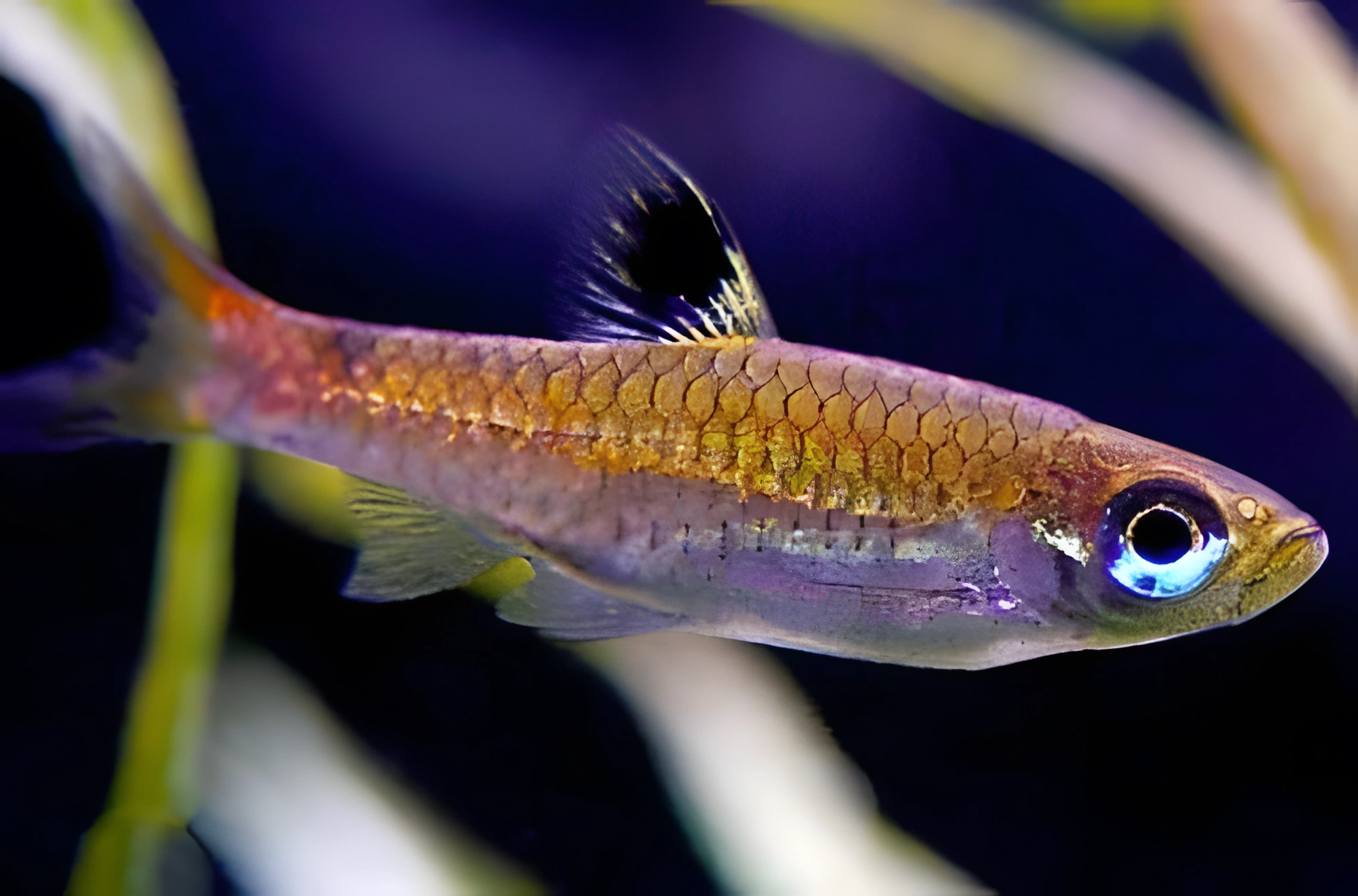
This is a miniature fish; adults reach only 3.5 cm in length. Sexual dimorphism in the Spotted-back Rasbora is not pronounced: males are usually slightly smaller and have a reddish tint at the base of the tail, while females have a yellow one. The main body color is grey, and the fins are translucent. One of its most striking and characteristic features is a white dorsal fin with a noticeable large black spot.
Habitat
The natural habitats of this fish are found in Southeast Asia, specifically on the Malay Peninsula, as well as on the islands of Borneo and Sumatra. It prefers small rivers and streams that flow under the dense canopy of tropical forests and originate in ancient peat swamps. The water in these bodies of water is characterized by a rich brown hue, caused by a high content of dissolved tannins and other organic substances. The source of these substances is abundant fallen leaves, roots, and branches of trees, as well as other aquatic vegetation. Unfortunately, today these unique natural areas are under threat of destruction due to active human economic activity.
Behavior and Compatibility
This species is distinguished by its peaceful and friendly disposition. For these small fish to feel secure, they should be kept in a shoal consisting of at least 8–10 individuals. In a group, males are forced to compete for the attention of females; since aggressive behavior is not typical for them, they express this rivalry by intensifying the brightness of their coloration. Consequently, if kept alone or in the absence of other males, the Rasbora may become sluggish and dull. It coexists well with most other calm species of similar temperament and size. In nature, it can often be found alongside fish familiar to aquarists, such as the Five-banded Barb and the Brilliant Rasbora. It is important to remember that any large fish can potentially pose a threat.
Care and Maintenance
An aquarium with a volume of at least 40 liters will be required to keep these fish. When decorating, preference is given to a soft sandy substrate, as well as shelters, which can be represented by snags, branches, or tree roots. Rooted and floating plants are also important; the latter provide additional shading, which is especially valuable since the Spotted Rasbora prefers subdued light. To create optimal water conditions that mimic their natural habitat – tropical swamps – it is recommended to use cloth bags with natural peat (which should only be purchased from pet stores) or a filtration system with a peat filler. This gives the water a characteristic brown tint, and the pH level stabilizes at slightly acidic values with low hardness. More detailed information on pH and dGH indicators is available in the “Hydrochemical composition of water” section. The standard set of equipment, in addition to the filter, includes a lighting system, heater, and aerator. Aquarium care involves weekly replacement of 15–20% of the water volume with fresh water and regular cleaning of the substrate from organic waste.
Diet
The Spotted Rasbora readily accepts all types of appropriately sized food: dry, frozen, and live. To keep the fish in good condition, it is recommended to offer them a varied diet. Feeding should be done 2–3 times a day, giving an amount of food that will be completely eaten within 5 minutes.
Breeding and Reproduction
Rasbora belongs to egg-laying species: females scatter eggs in the water column, and males immediately fertilize them. Since their parental instincts are poorly developed, after spawning, the fish can eat both their eggs and newly hatched fry. They are capable of producing offspring year-round without much intervention from the aquarist, but due to the reasons mentioned, the survival rate of fry will be very low. To increase the chances of survival of the young and protect them from adult fish, it is recommended to breed them in a separate tank — a spawning aquarium. The setup of the spawning tank is quite simple; the main attention is paid to the substrate: it should consist of sufficiently large particles that do not fit tightly together, forming voids. These can be pebbles or decorative glass beads. When the eggs sink to the bottom, most of them fall into these voids, becoming inaccessible to the fish. A similar effect is achieved with a fine-mesh net fixed to the bottom. Another way to preserve the eggs is to use low-growing, fine-leaved plants or mosses, such as Riccia fluitans or Java moss, planted over most of the substrate surface (in this case, the substrate can be any). Dense plant thickets create a reliable shelter for the eggs, no worse than a special substrate. For this species, a spawning aquarium of about 20 liters, half-filled, is usually sufficient. Equipment used includes an aerator, heater, and a simple low-power sponge air-lift filter, which helps avoid accidental suction of eggs and fry. Spawning occurs in dim light, so a light source is not required initially. The beginning of the breeding period can be noticed by the rounded females and the active attention of the males to their chosen mates. By this time, a separate tank should be prepared, filled with water from the main aquarium, then several females and the brightest males should be transferred there. Spawning can be initiated by adding cool water and lowering the temperature by several degrees. If this is done in the evening, offspring may appear by morning. The end of spawning is easily determined by the females – they become noticeably slimmer. After this, the fish are returned to the main aquarium. Fry will hatch in approximately 18–48 hours, and after another 1–2 days, they will begin to swim freely. They should be fed specialized microscopic food intended for aquarium fish fry.
Diseases
Balanced nutrition and properly selected keeping conditions are the best prevention of diseases in freshwater fish. If the first signs of illness appear, such as changes in coloration or behavior, the first step should be to check the water parameters and quality. If necessary, all values should be brought back to normal, and only then should treatment begin. More detailed information on symptoms and treatment methods can be found in the "Diseases of Aquarium Fish" section.
How to choose
When purchasing, choose active, mobile individuals with clean fins and scales without visible damage, spots, or film. Avoid fish with signs of emaciation, sunken bellies, or apathetic behavior, such as hovering motionless at the surface or bottom. Healthy rasboras should have clear coloration, consistent with species standards, and their eyes should be clear and transparent. Since these fish are schooling, it is advisable to acquire a group of 8–10 individuals at once to reduce stress during relocation and adaptation. In the store, pay attention to the keeping conditions: the water in the aquarium should be clean, and the tank mates peaceful, as stress from aggressive fish in the store can negatively affect the future health of your pets.
Frequently asked questions
The essentials: size, tank volume, water parameters and care
How big does Spotted-back Rasbora get?
An adult reaches 2.5–5 cm in length. Plan the tank around the maximum size: the fish quickly outgrows a cramped setup.
What size aquarium does Spotted-back Rasbora need?
The minimum recommended volume is 40 L. A smaller tank speeds up nitrate build-up and raises stress levels.
What water parameters does Spotted-back Rasbora need?
Temperature 20–25 °C, pH 5–7.5, hardness 1–10 dGH. Stability matters more than exact values: sudden swings are harder on the fish than a small deviation from the ideal.
How long does Spotted-back Rasbora live?
Around 5 years when kept properly. Lifespan depends directly on tank volume, water quality and a varied diet.
Is Spotted-back Rasbora aggressive?
Temperament: peaceful (regular). Keep this in mind when choosing tank mates.
How many Spotted-back Rasbora should be kept together?
Recommended setup: group (8–10 individuals). Ignoring this is a common cause of stress and disease.
What does Spotted-back Rasbora eat?
Diet type: any (universal). Feed small portions that are finished within a couple of minutes — overfeeding does more harm than underfeeding.
What is the scientific name of Spotted-back Rasbora?
The scientific name of the species is Brevibora dorsiocellata, family Cyprinids (Cyprinidae). It also appears in the literature as: Rasbora dorsiocellata, Rasbora macrophthalma.