Temperature22 – 26 °C
Natural range
- Thailand area
- Laos area
- Cambodia area
- Vietnam area
CyprinidsConservation status: Least concern LC
Other scientific names: Rasbora paviei
The scientific name Rasbora paviana belongs to the family Cyprinidae, or carps. It is quite common to encounter the mistaken assumption that the name "Paviana" is associated with primates. However, this is not the case: the fish was named after its discoverer, the biologist Auguste Pavie, which in its Latinized form sounds like "paviana." The similarity to the name of the monkey genus is merely a result of Russian transcription.
- Required aquarium volume
- 100 L
- Size in aquarium
- 9 – 10 cm
- Temperature
- 22 – 26 °C
- Temperament
- Peaceful (regular)
Parameters
Water pHNeutral (6.5) – Neutral (7.5)
Water dHVery soft (1) – Hard (15)
Water salinityno salt (freshwater)
Size in aquarium9 – 10 cm
Lifespan5 years
TemperamentPeaceful (regular)
Toward small fishnot a predator
Required aquarium volume100 L
Lightingdimmed or moderate
Substrateany (no restrictions)
Water flownone or stagnant (no flow)
FeedingAny (universal)
CareMedium group (6–8 individuals)
Description
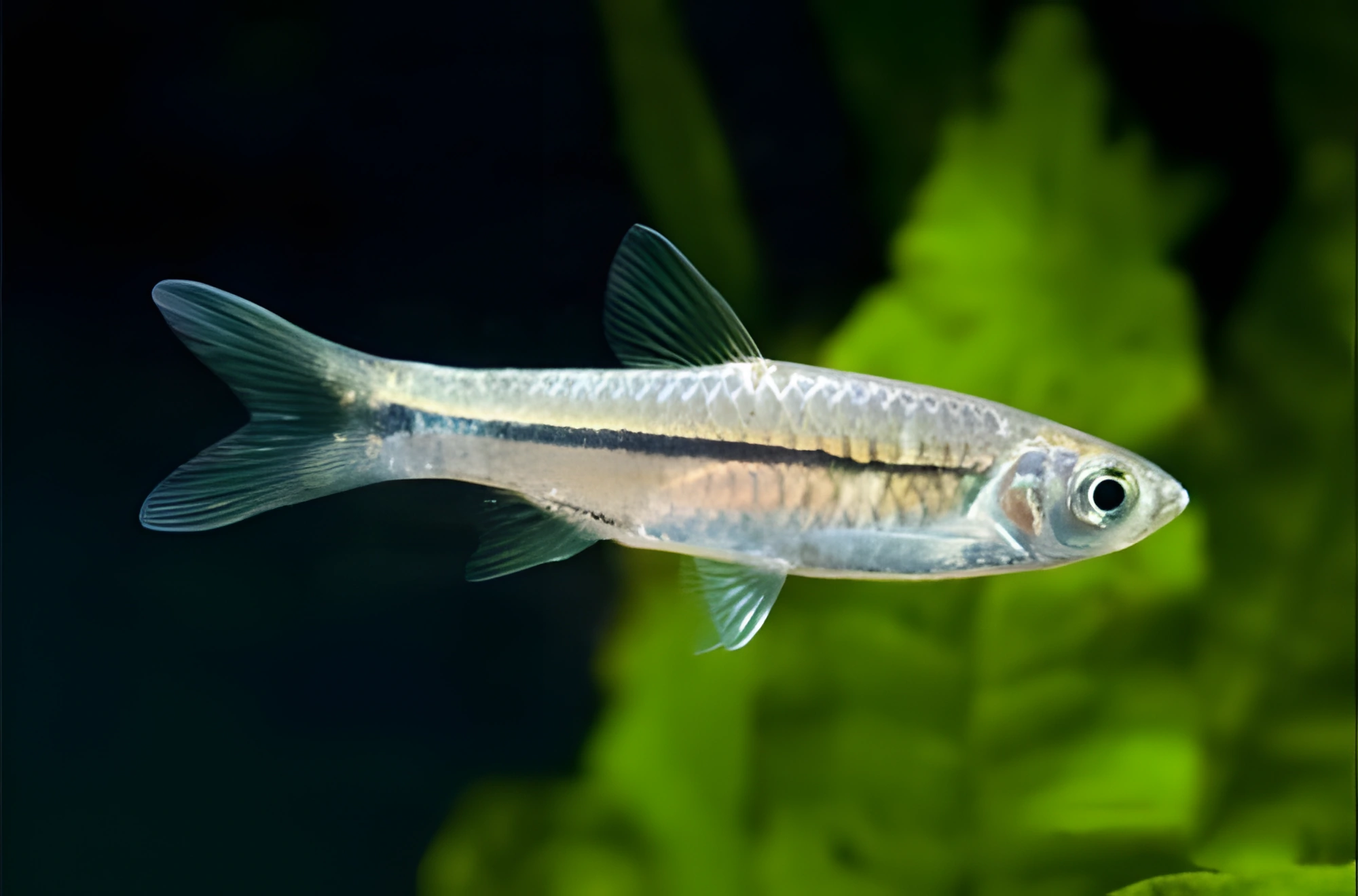
Adults reach a length of 9 to 12 cm. Their bodies are colored in silvery shades, which can shimmer pink or copper depending on the lighting. The fins and tail are translucent, sometimes showing yellow tones. A characteristic feature is a black stripe running along the body, resembling a safety pin: narrower at the head and widening at the base of the tail. Sexual dimorphism in this species is weakly expressed; males and females have virtually no noticeable external differences.
Habitat
The natural habitat of this fish is Southeast Asia. It inhabits significant territories of Thailand, Laos, Cambodia, and Vietnam, populating the basins of most major river systems. Pavie Rasbora is found everywhere: it can be found in fast-flowing streams as well as in rivers with rocky or boulder bottoms, and also in stagnant, swampy bodies of water where the water is often turbid and the substrate is silty.
Behavior and Compatibility
Distinguished by its peaceful disposition, this fish easily adapts to various hydrochemical conditions, making it an excellent choice for a community tank. It is compatible with most non-aggressive species of comparable size. In their natural environment, Pavie Rasboras live in small schools, so it is recommended to keep a group of 6 to 8 individuals in an aquarium.
Care and Maintenance
For a group of 6 fish, the optimal aquarium volume starts from 100–120 liters. The aquarium setup can be arbitrary, but it is important to provide enough free swimming space. Water quality is crucial for successful keeping. It is necessary to prevent the accumulation of organic waste, which can disrupt the biological balance, and also to avoid sharp fluctuations in pH and dGH values. Pavie Rasbora adapts well to different levels of hardness and acidity, but any changes should occur gradually. An important aspect of maintaining water quality is the uninterrupted operation of the filtration system. In addition, weekly partial water changes are mandatory, and it is recommended to combine them with the removal of food residues, excrement, and other waste. In aquarium conditions, the main component of the daily diet will be common dry, frozen, and live foods of appropriate size.
Diet
The daily diet in aquarium conditions will include popular dry, frozen, and live foods of appropriate size. The breeding strategy of Pavie Rasbora is similar to that of most carp fish. Under suitable conditions, they spawn regularly, laying eggs among plant thickets or scattering them in the water if plants are absent. Parental instincts are not developed, so adults often eat their own eggs and newly hatched fry. Under favorable keeping conditions, cases of disease are rare. As a rule, the cause of illness is deteriorating water quality, poor nutrition, or injuries, which suppress the fish's immunity and make it susceptible to infections. Treatment almost always begins with eliminating negative environmental factors, and only then (if necessary) do they proceed with administering medication. More details can be found in the "Aquarium Fish Diseases" section.
Breeding and Reproduction
The breeding process of Pavie Rasbora is similar to that of most carp species. Under favorable conditions, spawning occurs regularly among dense plant thickets; if there are none, the eggs are simply scattered in the water column. These fish lack parental instincts, so adults often eat both their own eggs and newly hatched fry.
Diseases
When kept in favorable conditions, fish rarely get sick. Diseases usually arise due to deteriorating water quality, unsuitable nutrition, or injuries, which weaken the immune system and make the fish vulnerable to infections. Treatment, as a rule, begins with identifying and eliminating negative environmental factors, and only then, if necessary, do they proceed with administering medications. Detailed information is available in the "Aquarium Fish Diseases" section.
How to choose
When selecting individuals, attention should be paid to their activity and the integrity of their skin. Healthy fish should exhibit schooling behavior, be active, and have clean fins without signs of damage or white coating. Avoid specimens with signs of emaciation, sunken bellies, or unnaturally bloated abdomens, as well as fish that keep to themselves or show signs of apathy. Since the species is highly prone to jumping, when purchasing, it is important to ensure that the keeping conditions in the store exclude the risk of injury to the fish if they attempt to jump out of the tank. An important criterion is the absence of external parasites and ulcers on the body, which indicates proper water quality in the seller's aquarium. It is recommended to purchase a group of 6 or more individuals, as fish kept alone are subject to severe stress, which negatively affects their immunity and coloration.
Frequently asked questions
The essentials: size, tank volume, water parameters and care
How big does Pavie Rasbora get?
An adult reaches 9–10 cm in length. Plan the tank around the maximum size: the fish quickly outgrows a cramped setup.
What size aquarium does Pavie Rasbora need?
The minimum recommended volume is 100 L. A smaller tank speeds up nitrate build-up and raises stress levels.
What water parameters does Pavie Rasbora need?
Temperature 22–26 °C, pH 6.5–7.5, hardness 1–15 dGH. Stability matters more than exact values: sudden swings are harder on the fish than a small deviation from the ideal.
How long does Pavie Rasbora live?
Around 5 years when kept properly. Lifespan depends directly on tank volume, water quality and a varied diet.
Is Pavie Rasbora aggressive?
Temperament: peaceful (regular). Keep this in mind when choosing tank mates.
How many Pavie Rasbora should be kept together?
Recommended setup: medium group (6–8 individuals). Ignoring this is a common cause of stress and disease.
What does Pavie Rasbora eat?
Diet type: any (universal). Feed small portions that are finished within a couple of minutes — overfeeding does more harm than underfeeding.
What is the scientific name of Pavie Rasbora?
The scientific name of the species is Rasbora paviana, family Cyprinids (Cyprinidae). It also appears in the literature as: Rasbora paviei.