Temperature20 – 28 °C
Natural range
- Malay Peninsula area
- Thailand area
- Malaysia area
CyprinidsConservation status: Data deficient DD
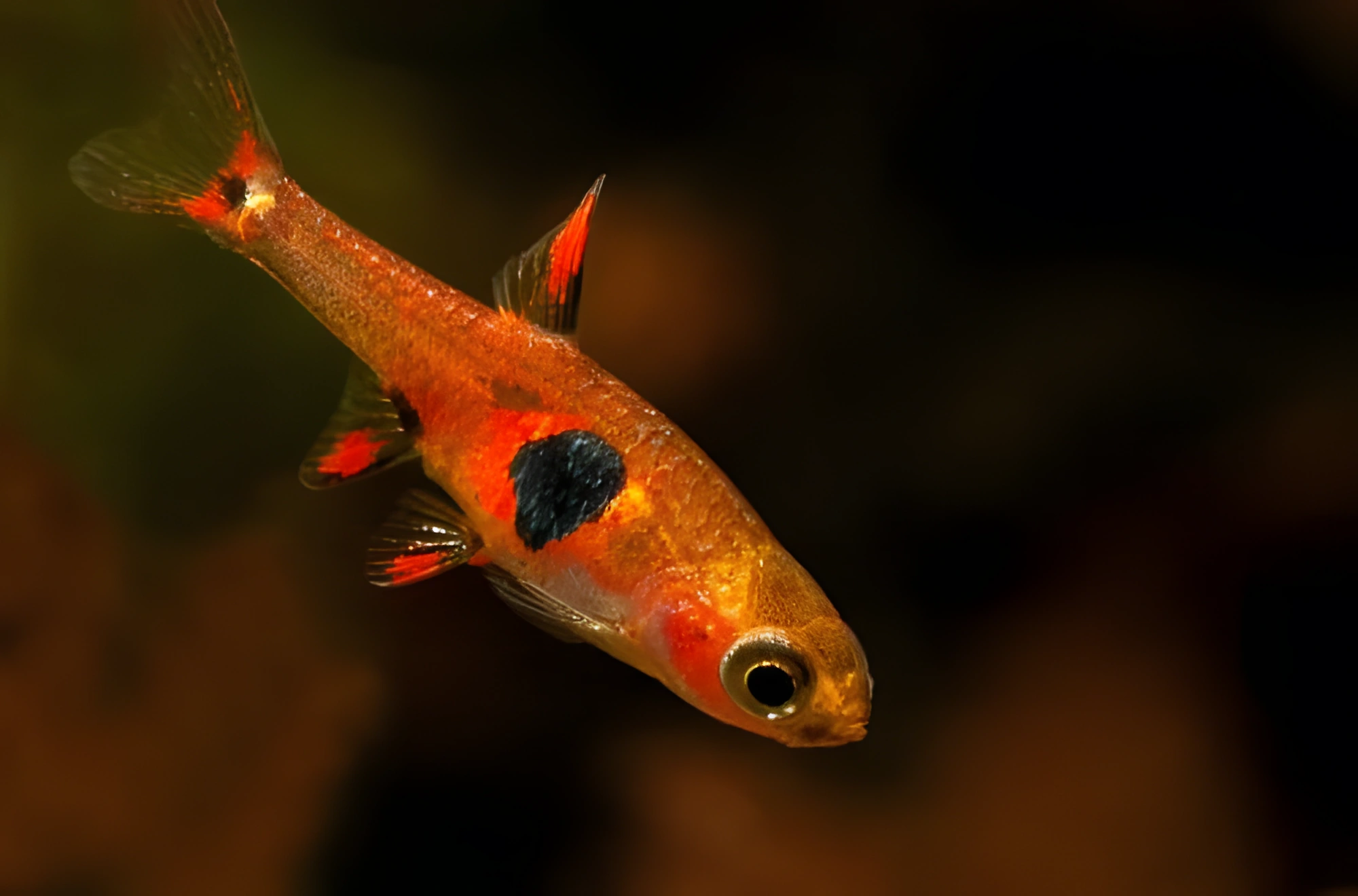
Boraras naevus, also known as the Strawberry Rasbora (scientific name Boraras naevus), belongs to the family Cyprinidae. These fish are among the most miniature aquarium inhabitants. They are undemanding to care for and get along well with peaceful, similarly sized species, making them an excellent choice for beginner aquarists.
- Required aquarium volume
- 40 L
- Size in aquarium
- 2 cm
- Temperature
- 20 – 28 °C
- Temperament
- Peaceful (regular)
Parameters
Water pHSlightly acidic (5) – Neutral (7)
Water dHVery soft (1) – Medium hardness (10)
Water salinityno salt (freshwater)
Size in aquarium2 cm
Lifespan4 years
TemperamentPeaceful (regular)
Toward small fishnot a predator
Required aquarium volume40 L
Lightingweak or moderate
Substrateany (no restrictions)
Water flowweak or moderate
FeedingAny (universal)
CareGroup (8–10 individuals)
Description
These fish reach only 2 cm in length, making them one of the smallest aquarium species. Their coloration is bright red with black spots. Males have a more intense color and a noticeable spot on their belly.
Habitat
This species is originally found in Southeast Asia, occurring on the Malay Peninsula, in the territories of modern-day Thailand and Malaysia. They prefer swampy areas and lakes where the density of aquatic vegetation is particularly high. Natural bodies of water often have a brownish tint due to the high content of tannins, yet the water remains clear. Unfortunately, much of this fish's natural habitat has now been converted into agricultural land, primarily rice paddies.
Behavior and Compatibility
These are calm, peaceful fish that prefer to live in schools. It is recommended to keep them in groups of 8–10 individuals or more, especially when kept with other species—this will help them feel less timid. They get along perfectly with other non-aggressive and small fish.
Care and Maintenance
Thanks to their modest size, a school of Boraras naevus can be kept in small tanks, so-called nano-aquariums, with a volume of 20 to 40 liters. The aquarium setup can be anything, but it is important to provide an abundance of aquatic vegetation, including floating species. Plants serve several functions: they provide shelter, create shade, and diffuse light. To maintain optimal conditions, regular maintenance procedures are necessary—this includes cleaning the substrate, glass, and decorations, as well as water changes and equipment checks. An efficient filtration system is extremely important. When choosing a filter, it should be noted that Boraras naevus do not tolerate strong currents well, and the filter should not create excessive water movement. In this matter, it is best to consult a specialist to select a suitable model. A simple air-driven sponge filter can be a reliable solution.
Diet
Boraras naevus are not demanding about food. They readily accept most standard foods of appropriate size, such as flakes and granules, especially when combined with brine shrimp. To enhance the intensity of their coloration, it is recommended to include protein-rich foods in their diet.
Breeding and Reproduction
Under favorable conditions, Boraras naevus will spawn regularly. However, successful rearing of fry presents certain difficulties. These fish do not possess parental instincts and may quickly eat their eggs and fry. In addition, finding suitable micro-food for the fry can be a problem. Despite all risks, some fry can still survive to adulthood in a community tank, finding refuge in dense plant thickets. Paramecium, which are often present in the substrate of a mature aquarium, can serve as food in the initial stage. If the goal is to save the entire brood, the eggs or young should be promptly moved to a separate tank with similar water conditions, where they will be safe. For this breeding tank, a simple air-driven sponge filter and a heater will be needed. In the first months of the fry's life, a separate lighting system is not required. Shade-loving plants, such as ferns and mosses, can be used for decoration.
Diseases
In a stable aquarium ecosystem, with suitable water conditions and regular care, fish health problems usually do not arise. Diseases can be a consequence of improper maintenance or injuries. More detailed information on symptoms and treatment methods can be found in the "Aquarium Fish Diseases" section.
How to choose
When purchasing, choose active individuals that stay in a school and show natural curiosity. Avoid fish with signs of emaciation, fin damage, white film on the body, or an unnaturally bloated belly. Healthy specimens should have vibrant coloration and confident movements. Since the species is sensitive to abrupt changes in water parameters, it is recommended to inquire about the keeping conditions at the store in advance and ensure smooth adaptation when transferring them to a home aquarium. Purchase a group of 8–10 individuals at once, as fish experience significant stress and become timid when alone.
Frequently asked questions
The essentials: size, tank volume, water parameters and care
How big does Boraras naevus get?
An adult reaches 2 cm in length. Plan the tank around the maximum size: the fish quickly outgrows a cramped setup.
What size aquarium does Boraras naevus need?
The minimum recommended volume is 40 L. A smaller tank speeds up nitrate build-up and raises stress levels.
What water parameters does Boraras naevus need?
Temperature 20–28 °C, pH 5–7, hardness 1–10 dGH. Stability matters more than exact values: sudden swings are harder on the fish than a small deviation from the ideal.
How long does Boraras naevus live?
Around 4 years when kept properly. Lifespan depends directly on tank volume, water quality and a varied diet.
Is Boraras naevus aggressive?
Temperament: peaceful (regular). Keep this in mind when choosing tank mates.
How many Boraras naevus should be kept together?
Recommended setup: group (8–10 individuals). Ignoring this is a common cause of stress and disease.
What does Boraras naevus eat?
Diet type: any (universal). Feed small portions that are finished within a couple of minutes — overfeeding does more harm than underfeeding.
What is the scientific name of Boraras naevus?
The scientific name of the species is Boraras naevus, family Cyprinids (Cyprinidae).