Temperature20 – 28 °C
Natural range
- Northwestern Thailand area
- Thailand area
CyprinidsConservation status: Least concern LC
Boraras micros, also known as the Dwarf Rasbora, belongs to the family Cyprinidae. Despite its rather modest coloration, which makes this species not the most sought-after among aquarists, these fish are quite capable of becoming a pleasant addition to any freshwater aquarium community. They are unpretentious and easy to keep, making them suitable even for beginner aquarists.
- Required aquarium volume
- 40 L
- Size in aquarium
- 1 – 5 cm
- Temperature
- 20 – 28 °C
- Temperament
- Peaceful (regular)
Parameters
Water pHSlightly acidic (6) – Neutral (7)
Water dHVery soft (2) – Medium hardness (10)
Water salinityno salt (freshwater)
Size in aquarium1 – 5 cm
Lifespan4 years
TemperamentPeaceful (regular)
Toward small fishnot a predator
Required aquarium volume40 L
Lightingdimmed
Substrateany (no restrictions)
Water flowweak
FeedingSmall / appropriate size / pieces
CareGroup (8–10 individuals)
Description
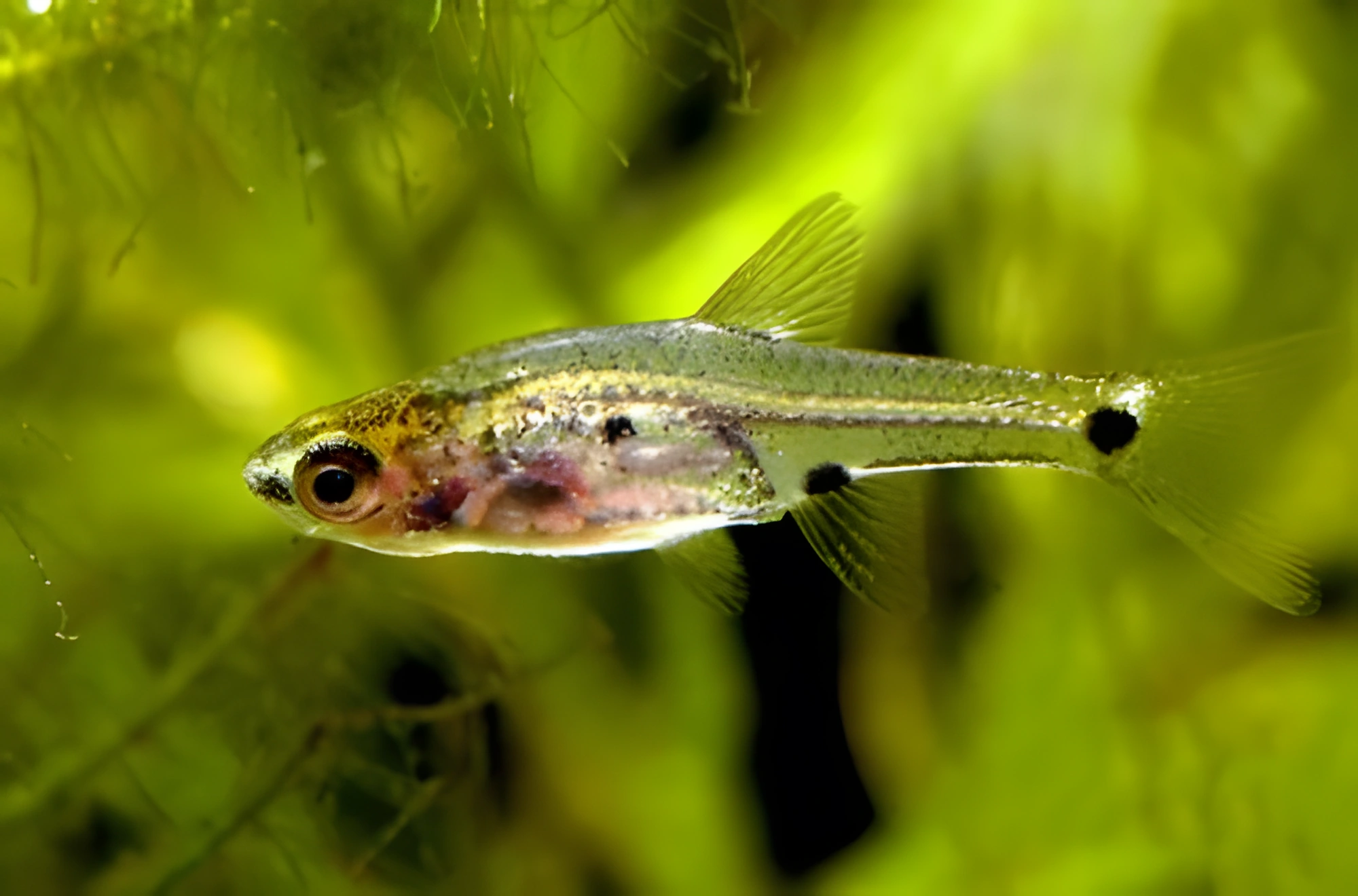
These fish reach only 1.5 cm in length, making them among the most miniature aquarium inhabitants. Perhaps their size is their main distinguishing feature. Their coloration is rather inconspicuous – gray and translucent, allowing the spine to be seen through the body. Sexual dimorphism is weakly expressed, making it quite difficult to distinguish males from females.
Habitat
Its natural habitat is in Southeast Asia, in the extensive Mekong River basin, which stretches across northwestern Thailand. In nature, these fish prefer shallow bodies of water with clear water, such as swamps, river floodplains, flooded areas of tropical forests, and are also found in agricultural areas, such as rice paddies.
Behavior and Compatibility
This is a peaceful and calm fish that coexists well with other species of comparable size. It should be kept in a school of at least 8–10 individuals, as the larger the group, the more comfortable they feel. When kept alone, the fish may become timid and tend to hide in shelters.
Care and Maintenance
An aquarium of 20 liters or more is suitable for these small fish. When decorating, it is recommended to create many shelters using aquatic plants, including floating ones, as well as snags. Lighting should be kept subdued. Since Boraras micros inhabit waters with weak currents, they do not tolerate moderate or strong water movement well. Therefore, when choosing a filtration system, preference should be given to models that do not create excessive flows. Aquarium care includes several essential procedures: regular cleaning of organic waste (excrement and uneaten food), weekly partial water changes with fresh water, and monitoring key hydrochemical parameters such as pH and dGH.
Diet
In a home aquarium, these fish readily accept most common foods, provided they are of appropriate size. The daily diet can consist of dry flakes or granules, which should ideally be combined with live or frozen foods, such as Artemia or Daphnia.
Breeding and Reproduction
In a mature aquarium, with suitable conditions and a certain number of adult females and males, spawning will occur regularly. During the breeding period, the fish scatter their eggs, which sink to the bottom and from that moment are left without parental care. Parents do not care for their offspring and may eat their own eggs if given the opportunity. Consequently, the survival rate of fry in a community tank will be extremely low. To save the entire brood, the eggs must be transferred immediately after spawning to a separate tank – a breeding aquarium. Such an aquarium usually has a volume of 10–15 liters and is equipped with a heater, as well as a simple air-driven sponge filter. Lighting is not essential for it. Unpretentious shade-loving plants or ferns can be used as decor. The incubation period lasts approximately 2 days, and after another 24 hours, the fry begin to swim independently in search of food. Despite the apparent simplicity of breeding, feeding the fry can be a challenge due to their tiny size. At the first stage, paramecia will serve as ideal food. After about 10 days, the juveniles grow enough to transition to Artemia nauplii or other small foods.
Diseases
Cottelata brittani is a hardy and undemanding fish. When suitable keeping conditions are met, health problems usually do not arise. Diseases can appear in cases of injury, contact with already sick fish, or a significant deterioration of habitat parameters (for example, in a dirty aquarium or with poor nutrition). More detailed information on symptoms and treatment methods can be found in the section "Diseases of aquarium fish."
How to choose
When purchasing Boraras micros, it is important to consider their extremely small size and timidity. Healthy individuals should actively swim in a school, have clean fins without signs of damage or film, and a firm body without visible deformities. Avoid purchasing fish that appear emaciated, stay alone near the surface or at the bottom, or have sunken bellies.
Since the species is rarely widely available and is often confused with other members of the genus, carefully examine the coloration: in this species, it is quite modest, without the bright red spots characteristic of close relatives. In the store, fish may look pale due to stress, but they should react to external stimuli. It is recommended to purchase a group of 8–10 individuals at once, as solitary keeping or purchasing too few fish leads to severe stress and rapid death.
Frequently asked questions
The essentials: size, tank volume, water parameters and care
How big does Boraras micros get?
An adult reaches 1–5 cm in length. Plan the tank around the maximum size: the fish quickly outgrows a cramped setup.
What size aquarium does Boraras micros need?
The minimum recommended volume is 40 L. A smaller tank speeds up nitrate build-up and raises stress levels.
What water parameters does Boraras micros need?
Temperature 20–28 °C, pH 6–7, hardness 2–10 dGH. Stability matters more than exact values: sudden swings are harder on the fish than a small deviation from the ideal.
How long does Boraras micros live?
Around 4 years when kept properly. Lifespan depends directly on tank volume, water quality and a varied diet.
Is Boraras micros aggressive?
Temperament: peaceful (regular). Keep this in mind when choosing tank mates.
How many Boraras micros should be kept together?
Recommended setup: group (8–10 individuals). Ignoring this is a common cause of stress and disease.
What does Boraras micros eat?
Diet type: small / appropriate size / pieces. Feed small portions that are finished within a couple of minutes — overfeeding does more harm than underfeeding.
What is the scientific name of Boraras micros?
The scientific name of the species is Boraras micros, family Cyprinids (Cyprinidae).