Temperature23 – 26 °C
Natural range
- Siam Gulf coast area
- Cambodia area
- Thailand area
- Phu Quoc Island area
CyprinidsConservation status: Least concern LC
Other scientific names: Rasbora espei, Rasbora heteromorpha
Trigonostigma espei, known as the Espei rasbora or false harlequin rasbora, belongs to the family Cyprinidae. This attractive, miniature schooling fish inhabits overgrown streams in tropical rainforests. It was only in the second half of the 20th century that it was identified as a distinct species. The fish demonstrates enviable hardiness and unpretentiousness, provided suitable water parameters are maintained. Thanks to these qualities, it can be highly recommended to aquarists taking their first steps in this hobby.
- Required aquarium volume
- 40 L
- Size in aquarium
- 3 cm
- Temperature
- 23 – 26 °C
- Temperament
- Peaceful, active/mobile
Parameters
Water pHSlightly acidic (6) – Neutral (6.5)
Water dHSoft (5) – Hard (12)
Water salinityno salt (freshwater)
Size in aquarium3 cm
Lifespan5 years
TemperamentPeaceful, active/mobile
Toward small fishnot a predator
Required aquarium volume40 L
Lightingdimmed
Substrateany, but dark
Water flowmoderate or strong
FeedingSmall / appropriate size / pieces
CareSchooling (usually from 5–6 individuals and more)
Description
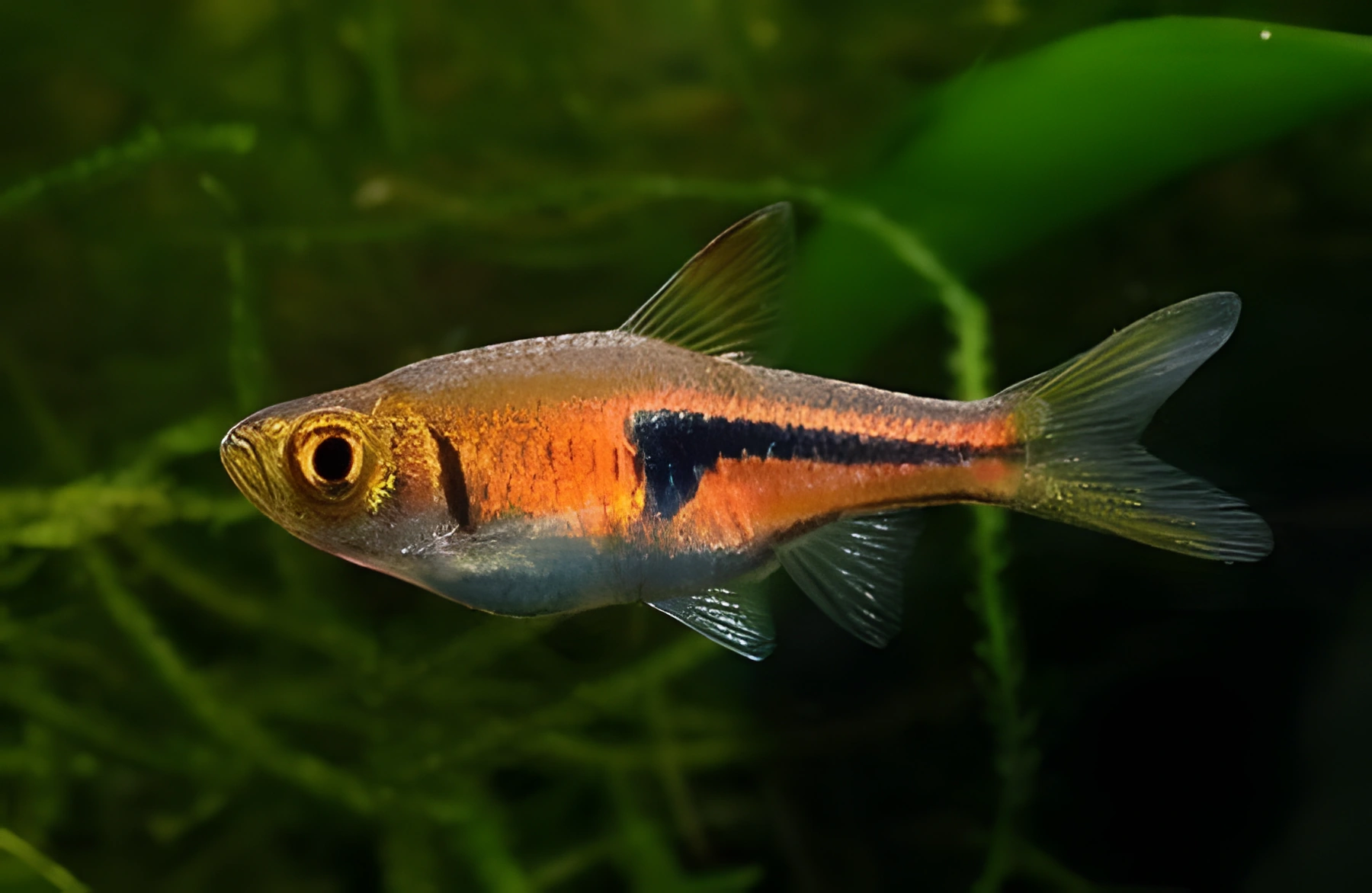
The Espei rasbora is an elegant fish, reaching a length of no more than 3 cm. Its dominant coloration is coppery-orange with pink iridescence, while its belly has a silvery hue. Depending on its region of origin, the intensity of the red color can vary. A characteristic feature is the black pigmentation, which begins as a wide stripe approximately from the middle of the body and extends to the tail. Adults males differ from females by their brighter coloration and a more pronounced dark wedge-shaped stripe on the body. Females, in turn, have a higher body and a more rounded abdomen.
Habitat
The description of the False Harlequin Rasbora appeared in 1967. Its natural range covers Southeast Asia, including the eastern coast of the Gulf of Thailand in Cambodia and Thailand, and it has also recently been discovered on the Vietnamese island of Phu Quoc. In natural conditions, the fish prefers dense thickets of aquatic plants in calm rivers, ponds, and swamps. The water in such places often acquires a yellowish tint due to the decomposition of plant debris rich in tannins. Rasboras gather in schools, and their diet consists of small insects, worms, crustaceans, and zooplankton.
Behavior and Compatibility
These are peaceful schooling fish, and they should be kept in a group of at least eight individuals, even if they swim individually in the aquarium. Intraspecific competition does not lead to conflicts or injuries, but rather manifests in brighter coloration in males striving to attract females. Rasboras get along well with other peaceful and small fish, but their activity can cause some inconvenience to slower tankmates.
Care and Maintenance
Keeping these fish is not difficult, as their natural habitat sometimes resembles a slightly neglected aquarium with yellowish water. However, in an aquarium, the water should not be allowed to reach such a state, as in a confined space this can promote the development of pathogenic microorganisms. It is important to keep the water soft and slightly acidic, renewing half of it monthly. A powerful filtration system is not necessary; a simple sponge filter is sufficient. The fish prefer to inhabit the upper and middle layers of the water, so the bottom can be planted with broad-leaved plants, placing dense thickets along the aquarium walls. The presence of floating plants will give the fish a sense of security and dim the light. A dark substrate, which should not contain sharp elements, will help enhance the brightness of the fish's coloration. The use of bogwood is highly desirable, as it releases tannins, bringing the water's chemical composition as close as possible to natural conditions.
Diet
For aquarium fish of this species, it is recommended to use high-quality dry foods in the form of flakes or granules. The diet can be enriched with live foods such as daphnia, artemia, and small bloodworms, and plant components can also be added.
Breeding and Reproduction
For breeding Trigonostigma espei, a separate aquarium will be required, the main purpose of which is to protect fry and eggs from parents who may prey on them. In the spawning tank, it is necessary to provide dim lighting, a water level of up to 20 cm, and low pH values. It is important to add plants with broad-leaved surfaces. Equipment needed includes an aerator, a heater set to 28°C, and a simple sponge filter. By placing one or two pairs in the spawning aquarium, the high temperature will stimulate spawning. After performing the mating dance, the male fertilizes the eggs, which the female attaches to plant leaves. The parents do not participate further, so they should be removed. In the spawning aquarium, the water level is lowered to 10–15 cm, ensuring that the eggs are underwater, and the light is dimmed. Ambient light from the room where the aquarium is located will be sufficient. Fry appear in approximately 24 hours, and begin free-swimming after 7–14 days, depending on environmental conditions. Special micro-food, available in pet stores, is used to feed the fry.
Diseases
Under favorable conditions, this species shows resistance to most diseases characteristic of tropical fish. However, if conditions deteriorate, the fish's immune system may weaken, making it susceptible to infections. Detailed information on symptoms and treatment methods can be found in the "Fish Diseases" section. Features
How to choose
When choosing Trigonostigma espei at the store, pay attention to the overall activity of the shoal: healthy fish should be active and constantly moving, not hiding in corners or lying on the bottom. Inspect the skin for white film, ulcers, or visible parasites — scales should be tightly adhered to the body, and fins should be spread out and without signs of damage. Avoid purchasing individuals with severely sunken bellies or deformed spines, as this may be a sign of chronic emaciation or infections. Given the external similarity to other species, such as Trigonostigma hengeli or the Harlequin Rasbora, carefully compare the coloration and the shape of the dark spot on the side. Purchase at least 8–10 individuals at once to minimize stress during relocation and ensure comfortable schooling behavior in the new aquarium.
Frequently asked questions
The essentials: size, tank volume, water parameters and care
How big does Espei Rasbora get?
An adult reaches 3 cm in length. Plan the tank around the maximum size: the fish quickly outgrows a cramped setup.
What size aquarium does Espei Rasbora need?
The minimum recommended volume is 40 L. A smaller tank speeds up nitrate build-up and raises stress levels.
What water parameters does Espei Rasbora need?
Temperature 23–26 °C, pH 6–6.5, hardness 5–12 dGH. Stability matters more than exact values: sudden swings are harder on the fish than a small deviation from the ideal.
How long does Espei Rasbora live?
Around 5 years when kept properly. Lifespan depends directly on tank volume, water quality and a varied diet.
Is Espei Rasbora aggressive?
Temperament: peaceful, active/mobile. Keep this in mind when choosing tank mates.
How many Espei Rasbora should be kept together?
Recommended setup: schooling (usually from 5–6 individuals and more). Ignoring this is a common cause of stress and disease.
What does Espei Rasbora eat?
Diet type: small / appropriate size / pieces. Feed small portions that are finished within a couple of minutes — overfeeding does more harm than underfeeding.
What is the scientific name of Espei Rasbora?
The scientific name of the species is Trigonostigma espei, family Cyprinids (Cyprinidae). It also appears in the literature as: Rasbora espei, Rasbora heteromorpha.