Temperature20 – 26 °C
Natural range
- Peninsular Malaysia area
- Borneo area
CyprinidsConservation status: Least concern LC
Other scientific names: Leuciscus dusonensis, Parluciosoma dusonensis, Rasbora argyrotaenoides
Rasbora dusonensis, or Duson Rasbora, belongs to the family Cyprinidae. Until 2013, this species was considered only a variant of Thien's Rasbora, but was then recognized as a separate species. This fish is unpretentious and easy to keep, and gets along well with other freshwater species. Thanks to these qualities, it can be confidently recommended to beginner aquarists.
- Required aquarium volume
- 100 L
- Size in aquarium
- 9 – 10 cm
- Temperature
- 20 – 26 °C
- Temperament
- Peaceful (regular)
Parameters
Water pHAcidic (4) – Neutral (7.5)
Water dHVery soft (1) – Hard (12)
Water salinityno salt (freshwater)
Size in aquarium9 – 10 cm
Lifespan4 years
TemperamentPeaceful (regular)
Toward small fishnot a predator
Required aquarium volume100 L
Lightingany
Substrateany (no restrictions)
Water flowany
FeedingAny (universal)
CareMedium group (6–8 individuals)
Description
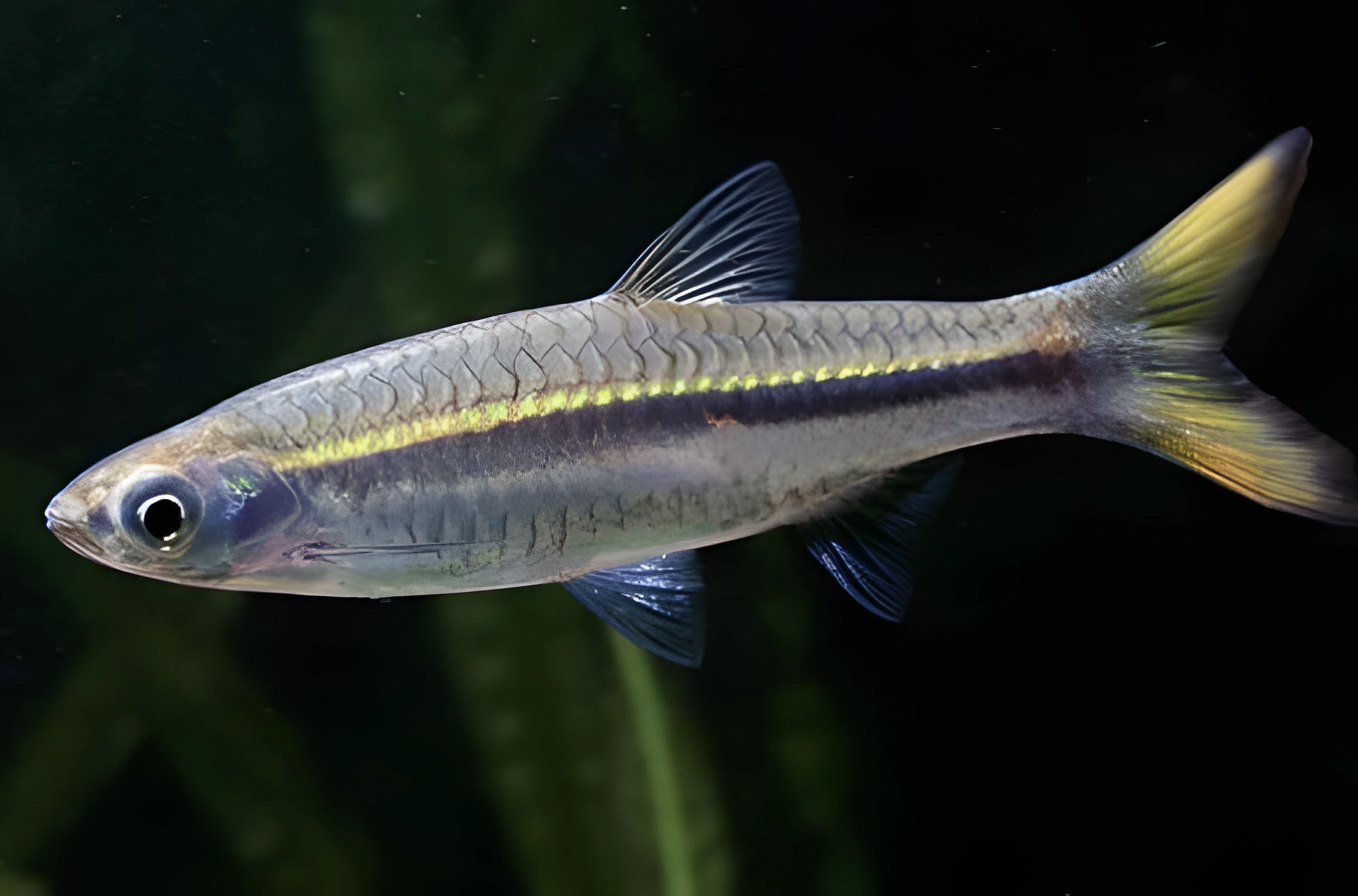
Adults reach approximately 10 cm in length. Outwardly, the Duson Rasbora bears a significant resemblance to Thien's Rasbora, which for a long time made their separation difficult. The main differences are noticeable in the coloration of the fins and tail: Duson Rasbora usually has predominant yellowish hues. Otherwise, they are almost identical: they have large silvery scales, and a double horizontal stripe runs along the sides of the body — dark in combination with golden. Sexual dimorphism is weakly expressed and manifests itself in some size differences: females are generally slightly larger than males.
Habitat
The natural habitat of these fish covers Southeast Asia, including peninsular Malaysia, as well as the islands of Borneo and Sumatra. In nature, they can inhabit a wide variety of conditions: from clear lowland rivers to stagnant swamps, and are also found in artificial reservoirs such as ponds and reservoirs.
Behavior and Compatibility
This is a peaceful schooling fish, capable of coexisting harmoniously with many other non-aggressive species of comparable size. It is advisable to keep them in a group of at least 6 individuals — the more, the better. Solitary specimens may exhibit excessive shyness.
Care and Maintenance
For a small school of these fish, the optimal aquarium volume starts from 100 liters. The decor does not play a critical role, which is explained by the wide range of their natural habitat. Duson Rasboras will feel good even in an empty tank. Standard aquarium maintenance includes regular cleaning of the substrate and decorative elements, weekly partial water changes with fresh water, as well as monitoring the level of nitrogen compounds and maintaining stable hydrochemical parameters. An aquarium lid is very important to prevent fish from accidentally jumping out.
Diet
In a home aquarium, these fish readily accept most common foods, whether dry, frozen, or live. For their complete nutrition, it is recommended to alternate different types of products, for example, combining flakes and granules with bloodworms or Artemia.
Breeding and Reproduction
At present, there is no reliable information on the breeding of Duson Rasbora in home aquariums. However, this is not due to the complexity of the process, but to the fact that the species was recognized as independent relatively recently, in 2013. It is assumed that breeding should proceed similarly to Thien's Rasbora. Under favorable conditions and a sufficient number of individuals, spawning can occur regularly. Eggs, scattered in the water column, settle on any available surfaces. The incubation period lasts from 24 to 48 hours, depending on the water temperature. Parental instinct is absent, so future fry face many dangers in a community tank. They can be eaten, including by their own parents, and those who do manage to hatch will likely suffer from a lack of food. To increase fry survival, it is recommended to promptly move them to a separate tank with identical water parameters. Such breeding tanks are usually equipped with a simple air-driven sponge filter and a heater, and shade-loving mosses and ferns are used as decor. Fry are fed specialized micro-foods and/or Artemia nauplii.
Diseases
In a stable aquarium ecosystem, with suitable water conditions and regular care, fish health problems usually do not arise. Diseases can be a consequence of improper maintenance or injuries. More detailed information on symptoms and treatment methods can be found in the "Aquarium Fish Diseases" section.
How to choose
When choosing individuals, pay attention to the cleanliness of the scales and the integrity of the fins, which should not have white spots, films, or signs of damage. A healthy fish is active, stays in a school, and reacts quickly to external stimuli. Avoid buying fish with signs of exhaustion, sunken bellies, or unnatural behavior, such as apathy or attempts to stay separate from the group in the corner of the aquarium.
- purchase specimens only from well-maintained aquariums with clear water
- prefer fish with bright, clear coloration appropriate for the species
- ensure that the fish in the store show a healthy appetite when fed
Frequently asked questions
The essentials: size, tank volume, water parameters and care
How big does Duson Rasbora get?
An adult reaches 9–10 cm in length. Plan the tank around the maximum size: the fish quickly outgrows a cramped setup.
What size aquarium does Duson Rasbora need?
The minimum recommended volume is 100 L. A smaller tank speeds up nitrate build-up and raises stress levels.
What water parameters does Duson Rasbora need?
Temperature 20–26 °C, pH 4–7.5, hardness 1–12 dGH. Stability matters more than exact values: sudden swings are harder on the fish than a small deviation from the ideal.
How long does Duson Rasbora live?
Around 4 years when kept properly. Lifespan depends directly on tank volume, water quality and a varied diet.
Is Duson Rasbora aggressive?
Temperament: peaceful (regular). Keep this in mind when choosing tank mates.
How many Duson Rasbora should be kept together?
Recommended setup: medium group (6–8 individuals). Ignoring this is a common cause of stress and disease.
What does Duson Rasbora eat?
Diet type: any (universal). Feed small portions that are finished within a couple of minutes — overfeeding does more harm than underfeeding.
What is the scientific name of Duson Rasbora?
The scientific name of the species is Rasbora dusonensis, family Cyprinids (Cyprinidae). It also appears in the literature as: Leuciscus dusonensis, Parluciosoma dusonensis, Rasbora argyrotaenoides.