Temperature20 – 28 °C
Natural range
- Borneo area
- Kalimantan Barat area
Cyprinids
The Brigittae Rasbora, scientifically known as Boraras brigittae, belongs to the carp family (Cyprinidae). It was named after the wife of the researcher who first described this species. Given its unpretentiousness and ease of care, the Brigittae Rasbora will be a wonderful addition to any freshwater aquarium. This species can be confidently recommended to beginner aquarists.
- Required aquarium volume
- 40 L
- Size in aquarium
- 2 cm
- Temperature
- 20 – 28 °C
- Temperament
- Peaceful (regular)
Parameters
Water pHAcidic (4) – Neutral (7)
Water dHVery soft (1) – Medium hardness (10)
Water salinityno salt (freshwater)
Size in aquarium2 cm
Lifespan6 years
TemperamentPeaceful (regular)
Toward small fishnot a predator
Required aquarium volume40 L
Lightingdimmed
Substrateany (no restrictions)
Water flowweak
FeedingAny (universal)
CareGroup (8–10 individuals)
Description
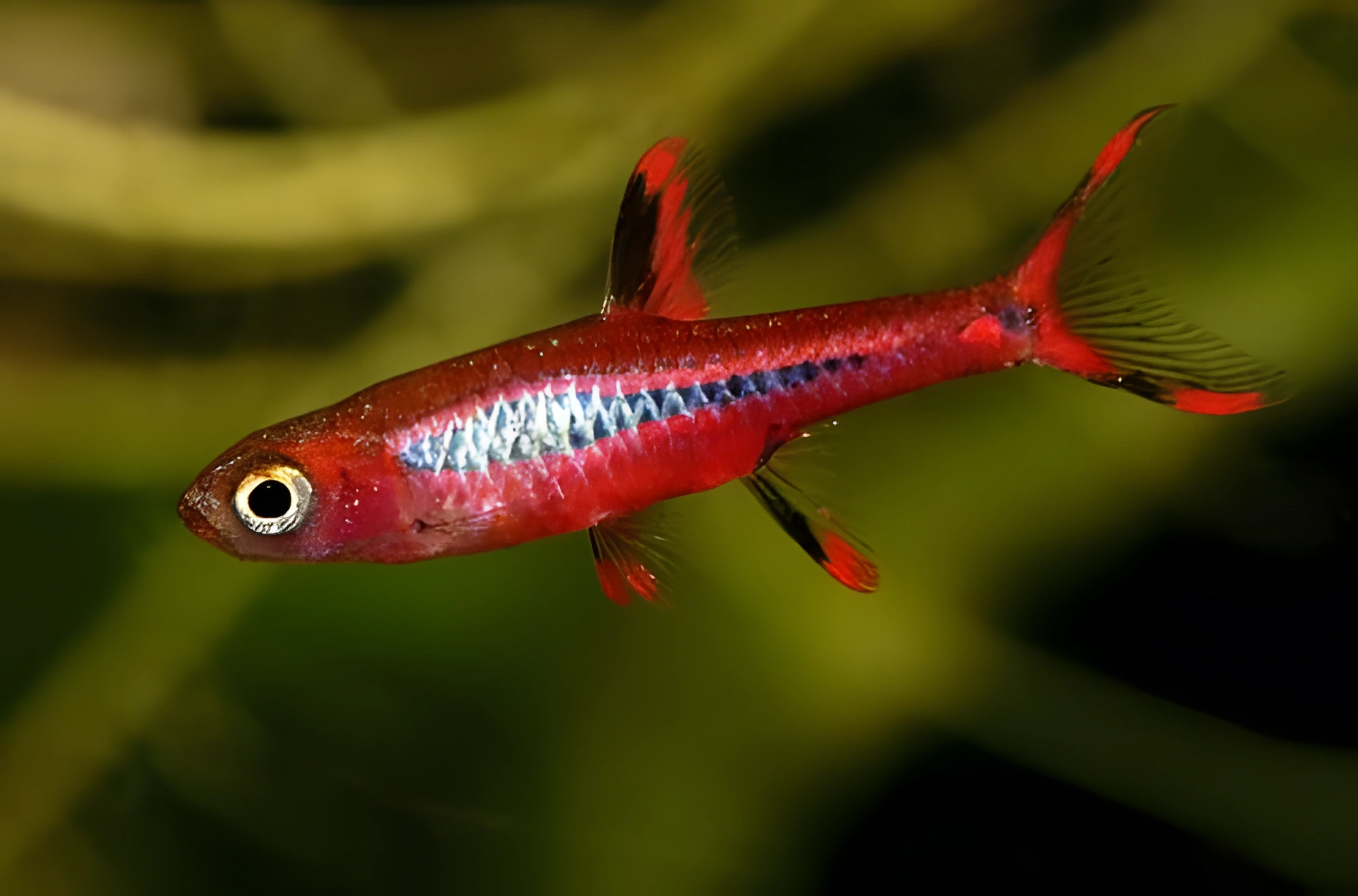
Adults of this fish reach a length of only about 2 cm. Their coloration is predominantly red, intersected by a black stripe running along the central part of the body. The fins remain translucent, sometimes with a slight reddish or pinkish tint. Sexual dimorphism in Brigittae Rasbora is not pronounced: females are typically slightly larger than males and have a more rounded abdomen.
Habitat
This species is endemic to the western part of Borneo Island, located in Southeast Asia. Its natural habitat is peat swamps, as well as associated rivers and streams, sheltered under the canopy of dense tropical forest. The water in these areas acquires a rich brown color due to the high content of tannins, which are formed during the decomposition of fallen leaves, branches, fruits, and other plant debris.
Behavior and Compatibility
This fish has a peaceful and calm disposition, coexisting well with other non-aggressive species of comparable size. It is important to keep them in a group of at least 8–10 individuals; with fewer, they become timid and tend to constantly hide.
Care and Maintenance
For a small school of these fish, an aquarium of 40 L or more will be optimal, although smaller volumes may also be suitable. It is advisable to use many shade-loving plants in the design, including floating plants, to create additional shading. A sandy substrate is recommended for the bottom, along with various shelters, such as driftwood. Lighting should be subdued. To create the characteristic brownish tint of the water, dried tree leaves can be placed on the bottom; as they decompose, they will enrich the water with tannins (more detailed information on this topic can be found in the article "Which tree leaves can be used in an aquarium"). Aquarium care for Brigittae Rasboras is relatively simple if a few essential procedures are followed: regularly remove organic waste, weekly change a portion of the water with fresh water, and constantly monitor pH and dGH parameters. When choosing a filter, it is worth preferring models that do not create excessive current, as these fish originate from still waters and are poorly adapted to strong water movement.
Diet
Like many other representatives of the Rasbora genus, this species is not particularly picky about food, readily accepting most common foods of appropriate size. The daily diet can include dry flakes and granules, supplemented with live or frozen Artemia and Daphnia.
Breeding and Reproduction
Under favorable conditions, with the presence of mature females and males, spawning in Brigittae Rasboras occurs regularly. The fish scatter their eggs in the water column and show no further parental care. Moreover, if given the opportunity, they may eat their own offspring, so the survival rate of fry in a community tank is extremely low. If you plan to breed Brigittae Rasboras, it is necessary to prepare a separate tank in advance with identical water conditions, where the eggs or already hatched fry will be transferred. Such a breeding tank usually has a volume of 10–15 L, is equipped with a heater and a simple sponge air-lift filter. A separate lighting system is not required. Mosses or ferns are excellent for decoration. The incubation period lasts 1–2 days, and after just 24 hours, the fry begin to swim freely in search of food. In the initial stage, they need to be provided with microscopic food, such as infusoria. As they grow, by about the second week, they can switch to Artemia nauplii. Feeding in the early stages is the most challenging aspect of breeding.
Diseases
Cottelata brittani is a hardy and undemanding fish. When suitable keeping conditions are met, health problems usually do not arise. Diseases can appear in cases of injury, contact with already sick fish, or a significant deterioration of habitat parameters (for example, in a dirty aquarium or with poor nutrition). More detailed information on symptoms and treatment methods can be found in the section "Diseases of aquarium fish."
How to choose
When choosing Brigittae Rasboras, it is important to assess the overall condition of the school in the aquarium. Healthy fish should swim actively, have a bright red-orange coloration, and a robust body without signs of emaciation or deformation. Avoid individuals with visible spots, film on scales, damaged fins, or unnatural behavior, such as constantly hovering near the surface or trying to hide in a corner when a person approaches.
Since this species is often confused with closely related microrasboras, such as the Chili Rasbora, one should carefully examine the pattern on the body. In Brigittae Rasboras, the black stripe is often interrupted or less pronounced, and the overall background coloration is more saturated and uniform. It is recommended to purchase a group of 8–10 individuals at once, as solitary fish in the store experience severe stress, which negatively affects their immunity and survival after relocation.
Frequently asked questions
The essentials: size, tank volume, water parameters and care
How big does Brigittae Rasbora get?
An adult reaches 2 cm in length. Plan the tank around the maximum size: the fish quickly outgrows a cramped setup.
What size aquarium does Brigittae Rasbora need?
The minimum recommended volume is 40 L. A smaller tank speeds up nitrate build-up and raises stress levels.
What water parameters does Brigittae Rasbora need?
Temperature 20–28 °C, pH 4–7, hardness 1–10 dGH. Stability matters more than exact values: sudden swings are harder on the fish than a small deviation from the ideal.
How long does Brigittae Rasbora live?
Around 6 years when kept properly. Lifespan depends directly on tank volume, water quality and a varied diet.
Is Brigittae Rasbora aggressive?
Temperament: peaceful (regular). Keep this in mind when choosing tank mates.
How many Brigittae Rasbora should be kept together?
Recommended setup: group (8–10 individuals). Ignoring this is a common cause of stress and disease.
What does Brigittae Rasbora eat?
Diet type: any (universal). Feed small portions that are finished within a couple of minutes — overfeeding does more harm than underfeeding.
What is the scientific name of Brigittae Rasbora?
The scientific name of the species is Boraras brigittae, family Danionidae.