Temperature23 – 28 °C
Other scientific names: Rasbora heteramorpha, Rasbora heteromorpa, Rasbora heteromorpha
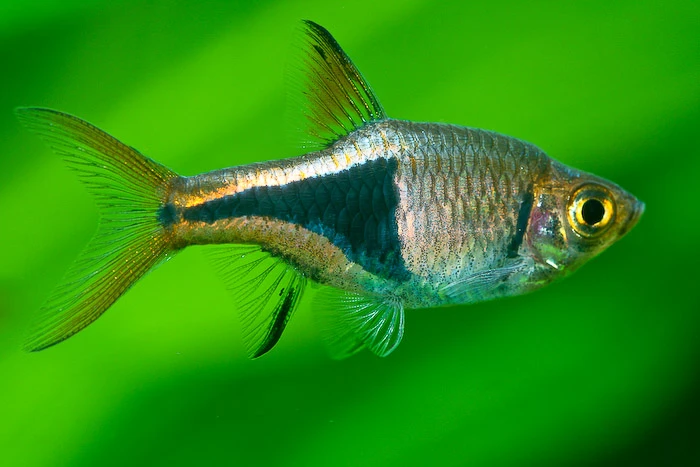
The Harlequin Rasbora, also known as the Wedge-spot Rasbora (Trigonostigma heteromorpha), belongs to the family Cyprinidae. This fish has been popular among aquarists since the early 20th century. Thanks to targeted breeding, today we can observe many of its forms, such as Blue Harlequin, Black Harlequin, and Gold Harlequin, which have significantly enriched the species' diversity.
Despite its modest size, reaching only about 5 cm, the Harlequin Rasbora boasts a striking coloration that can vary from delicate pale pink to rich orange with a beautiful coppery sheen along the upper and lower edges of its body. A distinctive feature of this species is a black, triangular spot, elongated towards the tail, with a possible blue or purple tint. Selective breeding forms, in contrast, have different colorations that gave them names such as Blue Harlequin (with a blue body coloration) or Black Harlequin (with a body color similar to the triangular spot). There are certain differences between males and females. Males are usually slightly smaller, and the black spot on their body has a different shape: it is more rounded, with apices that appear more elongated.
The first description of the Wedge-spot Rasbora dates back to 1904, although earlier mentions likely refer to other species. Its natural habitat spans Southeast Asia, both on the mainland and on islands. In nature, this fish prefers forest streams and channels shaded by trees, as well as peat swamps, where the current is almost absent or very weak. The water in such places often acquires a yellowish or brownish tint due to the decomposition of organic matter such as leaves, grass, and fruits.
Harlequin Rasboras get along well with most peaceful aquarium fish of similar size. They should be kept in groups of at least 10 individuals. In such conditions, males display brighter coloration as they are forced to compete for the attention of females among a large number of their kin. It is worth noting that a small school (less than 10 individuals) may show some anxiety towards other aquarium inhabitants, trying to involve them in their games, which not all fish species are prepared for.
For the successful keeping of these fish, slightly acidic water is necessary, which can be achieved by using a filter with suitable filter media. Note that the filter's power should be chosen considering the aquarium size, as the fish are not adapted to strong currents. Regular partial water changes, at least a quarter of the volume, should be performed weekly. Dim lighting is preferred, mimicking conditions under a forest canopy. Rooted plants with large leaves reaching the surface look excellent in the aquarium's decor. Dense thickets of these plants are recommended along the side walls, and floating plants will provide additional shade. The substrate should be dark-colored and can be adorned with pieces of bogwood or decorative snags.
This omnivorous species feeds on small insects, worms, crustaceans, and zooplankton in its natural environment. In a home aquarium, dry food (in flakes or pellets) is recommended to be supplemented with live foods, such as bloodworms, at least twice a week, or dried bloodworms can be used. Vegetable food, such as finely chopped lettuce or spinach leaves, can also be a useful addition to their diet.
Breeding this species requires a careful approach and the setup of a separate tank. To stimulate spawning, fish should be fed high-protein foods daily for a month. During this period, prepare a separate aquarium of at least 40 L, filling it with no more than 20 cm of water. Optimal water parameters for spawning are: very soft (1–3 dGH), slightly acidic (pH 5.3–6.0), and a temperature of 25–28°C. A simple sponge filter operating at low power is sufficient for equipment, and lighting can be subdued, coming from the room. Live or artificial plants with broad leaves, on which the eggs will be attached, are essential for decor. The substrate should consist of large pebbles. When the males acquire brighter coloration and the female's belly becomes full, the pair should be moved to the prepared tank and continue to be fed high-protein foods. Spawning may begin after a few days. The male performs a courtship dance, circling around the female and pointing to the chosen plant where the eggs will be laid. The eggs attach to the underside of the leaf; those that fall will roll under the pebbles and become inaccessible to the parents, who are not averse to eating their own eggs. After spawning is complete, the fish are returned to the main aquarium. The water level in the spawning tank is lowered to 15 cm, ensuring that the eggs remain submerged. Fry hatch after one day, and after 3–5 days, they begin to swim freely in the tank.
Under favorable conditions, diseases are quite rare. Their occurrence is most often provoked by poor water quality or the introduction of infected fish into the aquarium.
When choosing Harlequin Rasboras, pay attention to the activity of the fish in the school: healthy individuals should be active, brightly colored, and exhibit pronounced schooling behavior. Avoid specimens with signs of emaciation, damaged fins, or visible spots on the body, as these may indicate stress or disease. It is recommended to purchase a group of 8–10 individuals at once, as solitary keeping or too small a group can cause timidity and constant stress in the fish.
The essentials: size, tank volume, water parameters and care
An adult reaches 4–5 cm in length. Plan the tank around the maximum size: the fish quickly outgrows a cramped setup.
The recommended volume is 80 L. A smaller tank speeds up nitrate build-up and raises stress levels.
Temperature 23–28 °C, pH 5–7, hardness 1–12 dGH. Stability matters more than exact values: sudden swings are harder on the fish than a small deviation from the ideal.
Around 6 years when kept properly. Lifespan depends directly on tank volume, water quality and a varied diet.
Temperament: peaceful (regular). Keep this in mind when choosing tank mates.
Recommended setup: schooling (usually from 5–6 individuals and more). Ignoring this is a common cause of stress and disease.
Diet type: any (universal). Feed small portions that are finished within a couple of minutes — overfeeding does more harm than underfeeding.
The scientific name of the species is Trigonostigma heteromorpha, family Cyprinids (Cyprinidae). It also appears in the literature as: Rasbora heteramorpha, Rasbora heteromorpa, Rasbora heteromorpha.
Matched by family, categories and overlapping keeping conditions
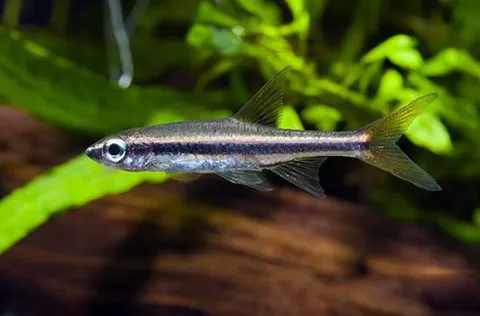
Trigonopoma gracile
The Slender Rasbora, whose Latin name is Trigonopoma gracile, belongs to the Cyprinidae family. This miniature, active fish, kept in a school, can adorn any freshwater aquarium. It is characterized by its undemanding…
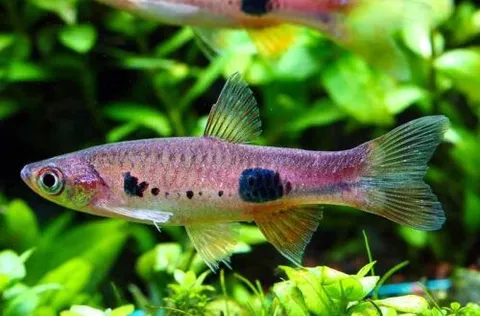
Rasbora kalochroma
A member of the Cyprinidae family, the Clown Rasbora (scientific name Rasbora kalochroma) is characterized by its peaceful nature and relative ease of care, making it a good addition to a freshwater aquarium community.
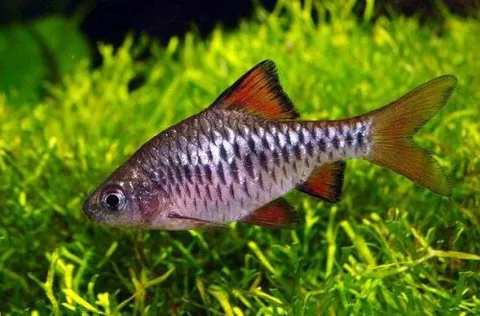
Oliotius oligolepis
Oliotius oligolepis, also known as the Checkerboard Barb (scientific name Oliotius oligolepis), belongs to the Cyprinidae family. This aquarium fish is popular due to its unpretentiousness and ease of care. It coexists…
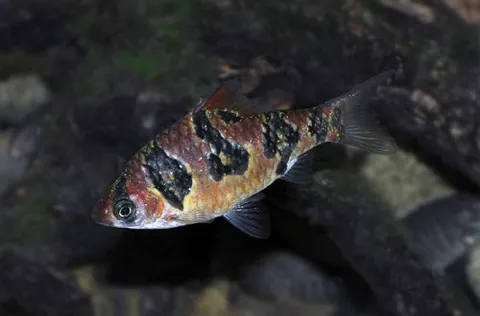
Desmopuntius rhomboocellatus
The Rhombus Barb, scientifically known as Desmopuntius rhomboocellatus, belongs to the family Cyprinidae. This small fish, with its distinctive body coloration and specific water chemistry requirements, thrives in…