Temperature16 – 22 °C
Natural range
- Sri Lanka area
- South Western Sri Lanka area
Labyrinth fishConservation status: Endangered EN
Malpulutta kretseri, also known as Kretser's Paradise Fish, bears the scientific name Malpulutta kretseri and belongs to the family Osphronemidae. It was named in honor of lawyer De Kretser, who first discovered and described this species in 1937. This species is quite easy to keep and breed. It coexists well with other peaceful fish. It is important to note that breeding this fish is of particular importance, as in the wild it is practically on the verge of extinction.
- Required aquarium volume
- 40 L
- Size in aquarium
- 4 – 5 cm
- Temperature
- 16 – 22 °C
- Temperament
- Peaceful (regular)
Parameters
Water pHSlightly acidic (5) – Neutral (7.5)
Water dHVery soft (1) – Medium hardness (9)
Water salinityno salt (freshwater)
Size in aquarium4 – 5 cm
Lifespan3 years
TemperamentPeaceful (regular)
Toward small fishnot a predator
Required aquarium volume40 L
Lightingdimmed
Substrateany (no restrictions)
Water flownone or stagnant (no flow)
FeedingAny (universal)
CareMixed (solitary / pair / group)
Description
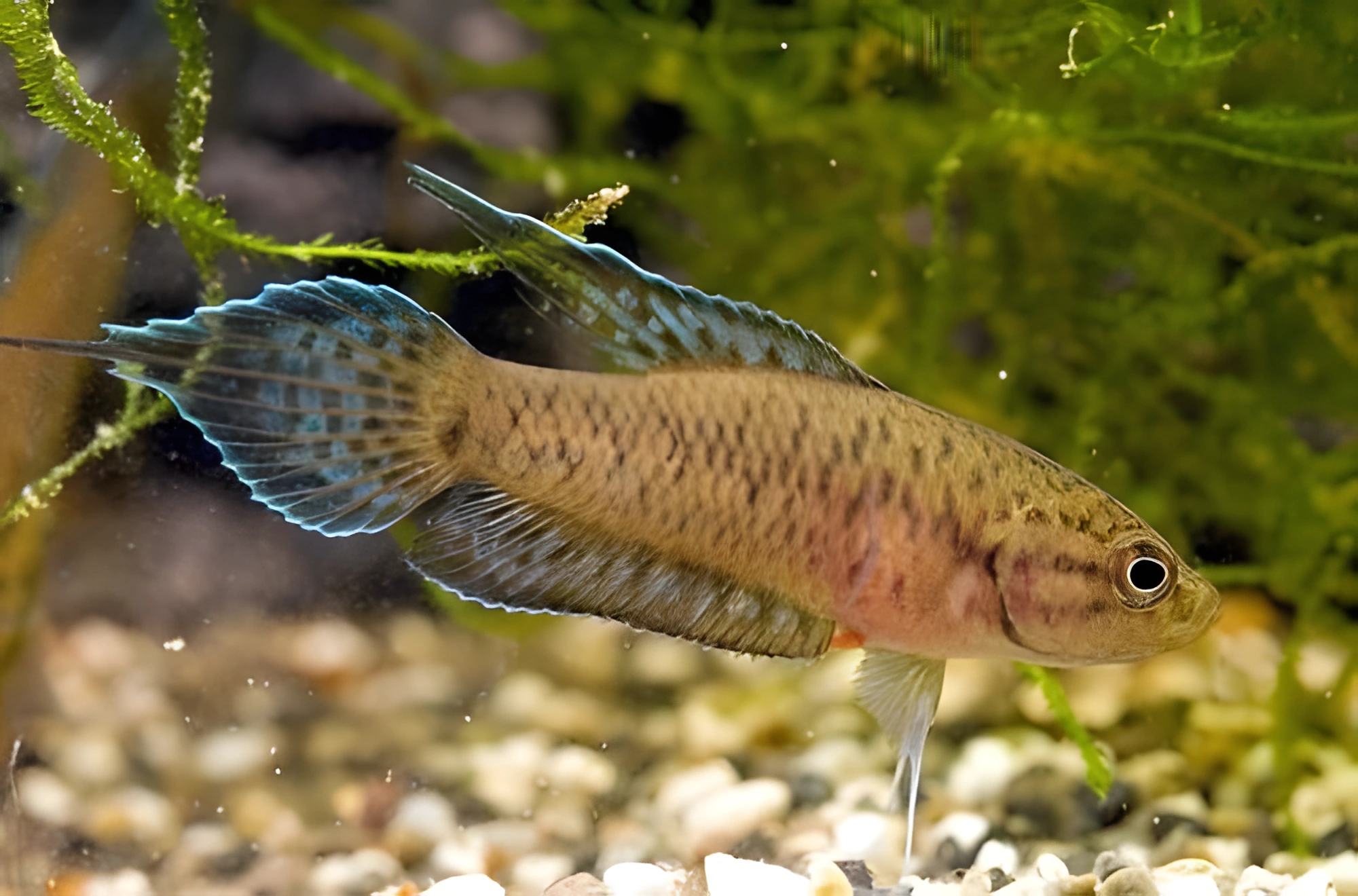
Adults of this fish reach a length of 3 to 5 cm. Males differ from females in being somewhat larger and having brighter coloration; their anal and unpaired fins have elongated outer rays. The body coloration of Malpulutta kretseri is grayish-yellow, with many dark speckles all over the surface. The fins shimmer with bluish hues and have the same edging.
Habitat
This fish originates from Asia, specifically from the island of Sri Lanka, located near the coast of India. In natural conditions, it can only be found in the southwestern part of the island – where tropical rainforest still exists. By the mid-2000s, only about 4% of the original forest area remained. In this area, a significant amount of precipitation, about 2000–3000 mm, falls annually. At the same time, there are no pronounced dry periods here, and the air temperature remains stable, staying within 25–27 °C. The typical habitat for Malpulutta kretseri is small, untouched streams winding through jungle thickets. Due to the dense canopy of trees, almost no sunlight penetrates through it, creating a twilight on the bottom even during the day and keeping the water cool. Aquatic vegetation is rare here and is mainly represented by plants growing along the banks. The sandy bottom is covered with a layer of fallen leaves and branches, and the streambed is permeated with many tree roots.
Behavior and Compatibility
In general, these fish are peaceful, although some individuals may show less than friendly behavior towards their conspecifics. This primarily applies to males. In small aquariums, it is recommended to keep them in pairs. Malpulutta kretseri is well compatible with other non-aggressive fish of similar size.
Care and Maintenance
For a pair of these fish, an aquarium of 40 liters or more will be optimal. Many specimens available for sale today have existed in artificial environments for many generations. This has allowed them to adapt to conditions somewhat different from those in which their wild relatives live. The aquarium decor can be arbitrary, provided that hiding places are ensured, and the lighting is subdued or floating plants are used to create shade. Adding leaves from certain trees will help recreate the chemical composition of water characteristic of natural bodies of water, due to the release of tannins during decomposition. It is extremely important to create and maintain a stable aquatic environment for Malpulutta kretseri, ensuring an acceptable range of temperatures and hydrochemical parameters. This requires installing appropriate equipment and regularly performing necessary aquarium care procedures: removing organic waste, partially replacing water with fresh water while maintaining the same pH and dGH values, and performing other similar manipulations.
Diet
This species is omnivorous and readily accepts most standard commercial foods, whether flakes or granules. They also eagerly eat specialized frozen foods. If desired, live foods such as bloodworms, daphnia, artemia, and small insects like Drosophila flies can be included in their diet.
Breeding and Reproduction
Under favorable conditions, these fish spawn regularly. With the onset of the breeding season, males begin to build a bubble nest among dense plant thickets. If there are not enough plants, snags or other decor elements can be used for construction. After construction is complete, courtship rituals begin. The spawning itself is accompanied by a peculiar embrace-dance, where the fish tightly intertwine around each other. At this moment, the eggs are fertilized. All eggs are immediately moved to the nest. Males remain near the clutch, guarding it until the fry begin to swim freely, which takes approximately one week. If breeding occurs in a community tank, the fry should be transferred to a separate tank to protect them from predation by other fish.
Diseases
Most health problems in fish often arise from unsuitable keeping conditions. Maintaining a stable and comfortable habitat is a key factor for successful keeping. If symptoms of illness appear, the first step is to check the water quality. If deviations are found, it is important to take immediate measures to eliminate them. If the symptoms do not disappear or worsen, medicinal treatment may be required. More detailed information on symptoms and treatment methods can be found in the "Diseases of Aquarium Fish" section.
How to choose
When purchasing, select active individuals with clean fins free of damage, film, or spots. It is important to note that the species is rare and timid, so in the store, fish may exhibit excessive caution, hiding in shelters. It is recommended to avoid specimens with signs of emaciation, sunken bellies, or apathetic behavior, as their adaptation to new conditions is slow. Since the species is protected by the legislation of its country of origin, only captive-bred individuals are sold, so it is worth clarifying the fish's origin with the seller.
Frequently asked questions
The essentials: size, tank volume, water parameters and care
How big does Kretser's Paradise Fish get?
An adult reaches 4–5 cm in length. Plan the tank around the maximum size: the fish quickly outgrows a cramped setup.
What size aquarium does Kretser's Paradise Fish need?
The minimum recommended volume is 40 L. A smaller tank speeds up nitrate build-up and raises stress levels.
What water parameters does Kretser's Paradise Fish need?
Temperature 16–22 °C, pH 5–7.5, hardness 1–9 dGH. Stability matters more than exact values: sudden swings are harder on the fish than a small deviation from the ideal.
How long does Kretser's Paradise Fish live?
Around 3 years when kept properly. Lifespan depends directly on tank volume, water quality and a varied diet.
Is Kretser's Paradise Fish aggressive?
Temperament: peaceful (regular). Keep this in mind when choosing tank mates.
How many Kretser's Paradise Fish should be kept together?
Recommended setup: mixed (solitary / pair / group). Ignoring this is a common cause of stress and disease.
What does Kretser's Paradise Fish eat?
Diet type: any (universal). Feed small portions that are finished within a couple of minutes — overfeeding does more harm than underfeeding.
What is the scientific name of Kretser's Paradise Fish?
The scientific name of the species is Malpulutta kretseri, family Osphronemidae.