Temperature24 – 33 °C
Natural range
- Northern Territory area
- Queensland area
RainbowfishConservation status: Least concern LC
Other scientific names: Rhombosoma trifasciata
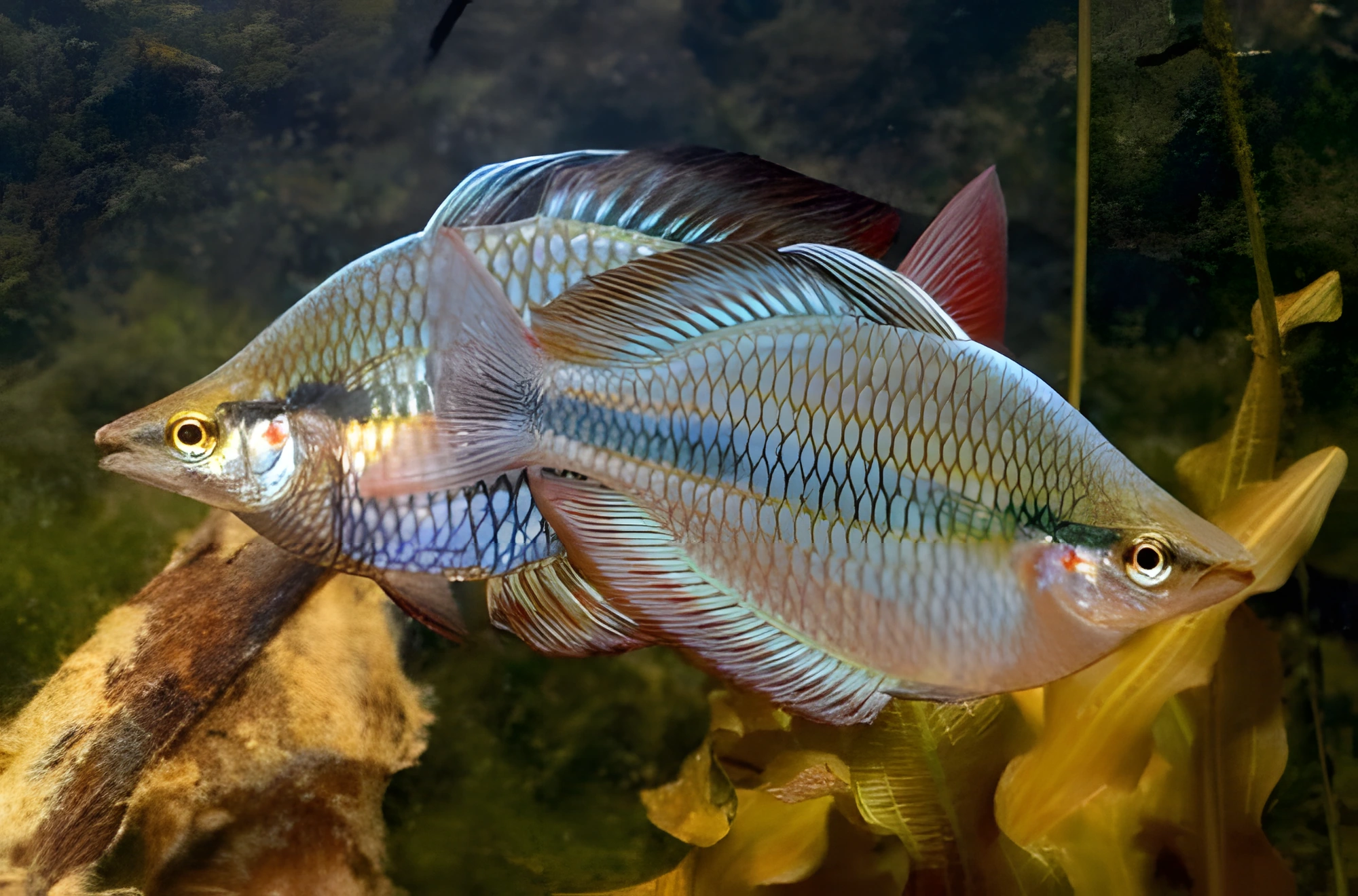
The three-striped rainbowfish, scientifically known as Melanotaenia trifasciata, belongs to the family Melanotaeniidae. This species was first discovered by Norwegian zoologist Knut Dahl in June 1895. The description and the name "three-striped" were given by Hjalmar Rendahl and published in 1922. At first glance, it might seem puzzling where exactly these three stripes are located on the fish's body. The explanation is simple, though not obvious: Rendahl described a museum specimen that had been preserved in alcohol for over 20 years, not a live one, which naturally greatly altered its coloration.
- Required aquarium volume
- 150 L
- Size in aquarium
- 12 cm
- Temperature
- 24 – 33 °C
- Temperament
- Peaceful (regular)
Parameters
Water pHNeutral (6.5) – Slightly alkaline (8)
Water dHMedium hardness (8) – Very hard (20)
Water salinityno salt (freshwater)
Size in aquarium12 cm
Lifespan5 years
TemperamentPeaceful (regular)
Toward small fishnot a predator
Required aquarium volume150 L
Lightingmoderate (regular)
Substrateany (no restrictions)
Water flowweak or moderate
FeedingAny (universal)
CareMedium group (6–8 individuals)
Description
The maximum length of adult individuals reaches 15 cm. The size of the fish is influenced by a number of factors: the quality of nutrition, the amount of free space, the group size, as well as the level of competition and water temperature. In aquarium conditions, these fish typically grow up to 12 cm. Like most other rainbowfish, their coloration can vary significantly depending on the region of habitation and diet. Representatives of the same species can noticeably differ in appearance, for example, if some populations live in rivers and others in swampy areas. Their coloration can be dominated by various shades: blue, green, yellow, and red. However, the characteristic presence of a broad dark stripe that runs from head to tail, as well as red fins, invariably remains. The color palette in males is usually significantly more saturated than in females.
Habitat
These fish originate from the northern regions of Australia. They can be found in almost any freshwater biotope, from swampy areas to fast-flowing rivers. They are particularly common in flowing waters where the bottom is covered with sandy substrates, silt, fallen leaves, and other organic plant debris. They usually inhabit depths of up to two meters, preferring to stay near dense thickets of plants or among snags. Their natural habitat conditions are constantly subject to seasonal changes, which causes noticeable fluctuations in temperature and hydrochemical water parameters.
Behavior and Compatibility
This species demonstrates a peaceful attitude towards other aquarium inhabitants. However, it should be noted that their high activity may not always be to the liking of slower fish. Intraspecific relationships can be more complex. During the breeding season, especially, males compete among themselves for the attention of females. This rivalry is expressed in a "show of strength": males spread their fins and circle, trying to appear larger. They may chase females, so it is important to provide hiding places for the latter. In small aquariums, it is recommended to maintain a significantly larger number of females than males.
Care and Maintenance
Many Australian fish species have developed the ability to survive in diverse and seasonally changing conditions. This makes rainbowfish relatively easy to keep aquarium inhabitants, unlike highly specialized species whose habitats are more stable and predictable. For a group of 5–6 fish, an aquarium of at least 150 liters will be required. The decor can be anything, the main thing is to provide a sufficient number of shelters. These can be dense thickets of plants, snags, or artificial decorations. These fish are very active and often jump out of the water. To prevent accidental jumps, it is recommended to use floating plants and an aquarium lid. Aquarium care is standard: it is necessary to maintain stable warm water within acceptable pH and dGH values, avoiding sharp fluctuations. Weekly, 20–30% of the water volume should be replaced with fresh water, and organic waste, such as food residues and excrement, should be removed.
Diet
In natural conditions, their diet consists of insects and their larvae, aquatic crustaceans, other invertebrates, as well as small particles of plants and algae. Thanks to their omnivorous nature, these fish adapt well to most common aquarium foods, such as flakes, granules, and so on, which should preferably be supplemented with live or frozen products.
Breeding and Reproduction
In aquarium conditions, there is no seasonality in the reproduction of these fish: offspring appear throughout the year. Spawning occurs among dense thickets of plants. The female lays 200 to 500 eggs, doing so in portions of up to 50 eggs at a time, which extends the spawning process over several days. The incubation period lasts 6–7 days. Parental instincts are not developed in them. Although parents usually do not eat the eggs, it is still recommended to transfer them to a separate aquarium with similar water parameters. In the first days of life, fry need micro-food, such as paramecia. As they grow, their diet gradually expands to include Artemia nauplii, crushed dry flakes, granules, and specialized fry foods.
Diseases
The likelihood of developing diseases significantly increases if the habitat conditions do not meet the requirements, the fish receive poor-quality food, or are stressed due to aggression from tank mates. Rainbowfish are particularly susceptible to skin diseases, including parasitic infestations and bacterial infections. More detailed information on symptoms and treatment methods can be found in the "Diseases of Aquarium Fish" section.
How to choose
When choosing a three-striped rainbowfish, it should be noted that young individuals in stores often look dull and inconspicuous; their bright coloration only appears as they mature and with proper care. A healthy fish should be active, have clean fins without signs of damage, coatings, or ulcers, and even scales. Avoid purchasing specimens with signs of emaciation, a sunken belly, or fish that stay separate from the shoal.
- Inspect the fish for fungal infections, especially in the mouth and lip area, to which the species can be susceptible under poor conditions in retail aquariums.
- Make sure there are no sharp decorations in the fish tank, as due to their high mobility, rainbowfish can easily get injured, which can lead to secondary infections.
- Ask the seller about the keeping conditions, as a sharp change in water parameters can cause stress in this species.
Frequently asked questions
The essentials: size, tank volume, water parameters and care
How big does Three-striped Rainbowfish get?
An adult reaches 12 cm in length. Plan the tank around the maximum size: the fish quickly outgrows a cramped setup.
What size aquarium does Three-striped Rainbowfish need?
The minimum recommended volume is 150 L. A smaller tank speeds up nitrate build-up and raises stress levels.
What water parameters does Three-striped Rainbowfish need?
Temperature 24–33 °C, pH 6.5–8, hardness 8–20 dGH. Stability matters more than exact values: sudden swings are harder on the fish than a small deviation from the ideal.
How long does Three-striped Rainbowfish live?
Around 5 years when kept properly. Lifespan depends directly on tank volume, water quality and a varied diet.
Is Three-striped Rainbowfish aggressive?
Temperament: peaceful (regular). Keep this in mind when choosing tank mates.
How many Three-striped Rainbowfish should be kept together?
Recommended setup: medium group (6–8 individuals). Ignoring this is a common cause of stress and disease.
What does Three-striped Rainbowfish eat?
Diet type: any (universal). Feed small portions that are finished within a couple of minutes — overfeeding does more harm than underfeeding.
What is the scientific name of Three-striped Rainbowfish?
The scientific name of the species is Melanotaenia trifasciata, family Rainbowfishes (Melanotaeniidae). It also appears in the literature as: Rhombosoma trifasciata.