Temperature24 – 26 °C
Natural range
- Papua New Guinea area
- New Guinea area
RainbowfishConservation status: Endangered EN
Other scientific names: Nematocentris sexlineatus
The Fly River Rainbowfish, also known as the Fly Rainbowfish, bears the scientific name Melanotaenia sexlineata and belongs to the family Melanotaeniidae. One of its names reflects its habitat — the Fly River basin on the island of New Guinea.
- Required aquarium volume
- 150 L
- Size in aquarium
- 7 cm
- Temperature
- 24 – 26 °C
- Temperament
- Peaceful (regular)
Parameters
Water pHNeutral (7) – Neutral (7.5)
Water dHSoft (5) – Hard (16)
Water salinityno salt (freshwater)
Size in aquarium7 cm
Lifespan5 years
TemperamentPeaceful (regular)
Toward small fishnot a predator
Required aquarium volume150 L
Lightingmoderate (regular)
Substrateany (no restrictions)
Water flowmoderate
FeedingAny (universal)
CareMedium group (6–8 individuals)
Description
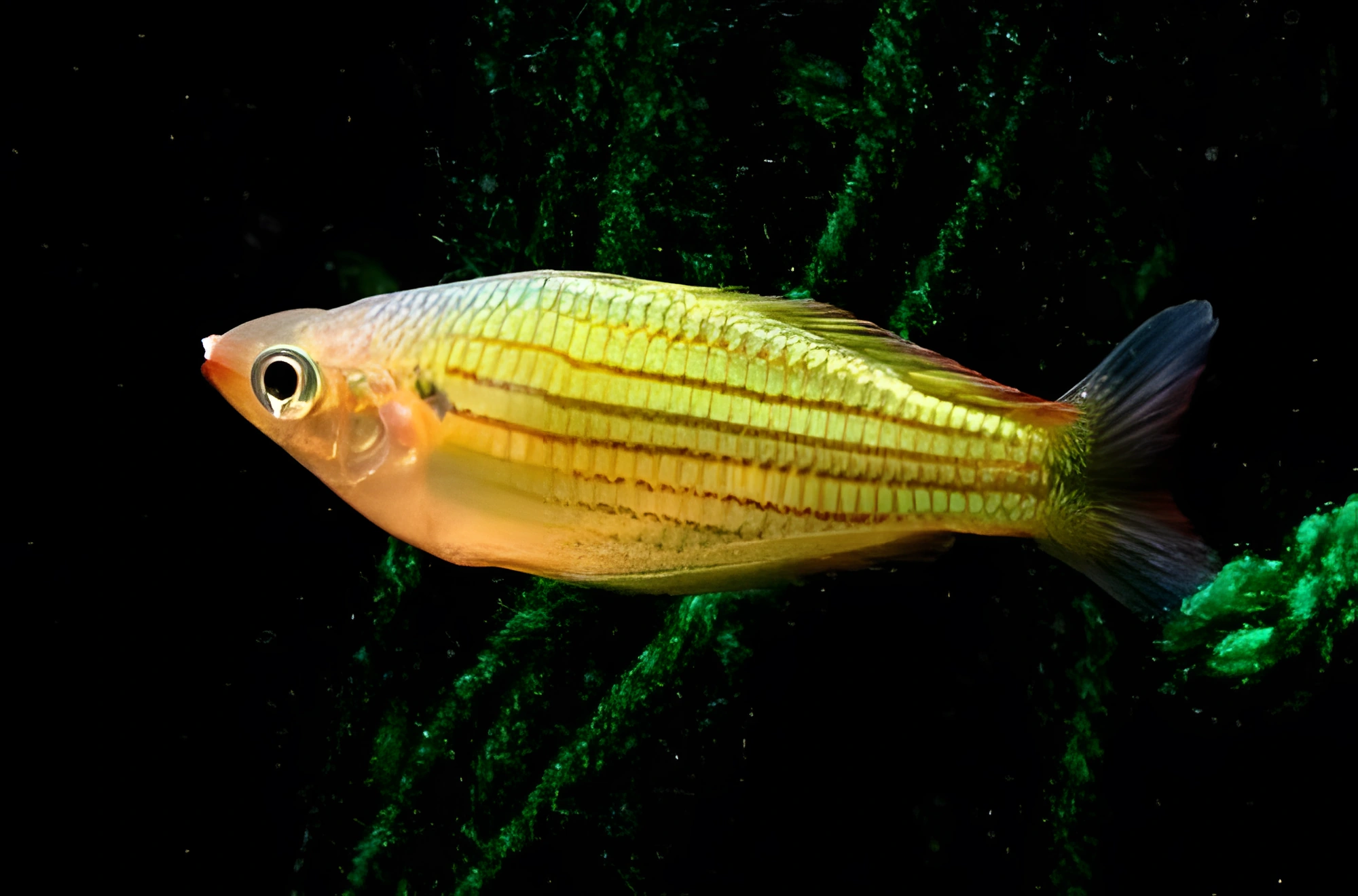
These adults typically grow up to 7 cm in length. Outwardly, this fish resembles Melanotaenia papua but is distinguished by a higher body. Its coloration can be quite diverse: depending on the region, the Fly Rainbowfish sometimes has a bluish back and orange fins, while in other cases, it exhibits a shimmering turquoise-golden sheen. A distinctive feature is the constant presence of 5 to 8 dark horizontal stripes. Females are generally noticeably paler in color than males.
Habitat
The species is endemic to Papua New Guinea, where it is found exclusively in the Fly River system. The fish inhabit small, shallow forest streams with clear or slightly tannin-stained water, and are also found in swampy lagoons and backwaters. Natural conditions are characterized by a tropical climate, water temperatures of about 24–26°C, and neutral to slightly alkaline pH levels.
Behavior and Compatibility
This peaceful and very active fish prefers to live in schools. For this reason, it is recommended to keep them in a group of 6–8 individuals. Rainbowfish get along well with many other non-aggressive species.
Care and Maintenance
To maintain the vitality of these active fish, an aquarium of at least 100 liters is considered optimal. This volume will be sufficient for a comfortable existence for a school of 6–8 individuals. The aquarium decor can include floating plants, which not only create necessary shading but also prevent accidental jumping out. Otherwise, the design can be chosen at the aquarist's discretion, the main thing is to provide enough free swimming space. In their natural habitat, these fish prefer slightly alkaline water, so in a home aquarium, appropriate pH values should be maintained, allowing for a slight decrease to a neutral level. Aquarium care is standard and includes several mandatory procedures: weekly partial water changes with fresh water, regular removal of organic waste, and keeping equipment in working order. It is an omnivorous species. They can be accustomed to common dry foods, and they will also gladly accept frozen and live foods of appropriate size.
Diet
Rainbowfish are an omnivorous species. They can be successfully accustomed to popular dry foods, and they also readily accept frozen or live foods of suitable size.
Breeding and Reproduction
Breeding takes place in separate spawning aquariums, densely planted with fine-leaved plants or mosses, which serve as a substrate for the eggs. Stimulation involves raising the temperature to 26–28°C and providing high-quality live foods. Spawning is paired or in groups, extended over time. After the process, the parents are removed, as they may eat the eggs. Larvae hatch after 7–12 days and immediately begin to swim actively and search for food.
Diseases
The species has moderate disease resistance when water parameters are maintained and cleanliness is upheld. The most common problems arise from the accumulation of organic pollutants, which provoke bacterial infections or fin rot. Prevention includes weekly partial water changes, effective filtration, and avoiding sharp fluctuations in hydrochemical parameters.
How to choose
When purchasing, choose active, lively individuals with clean fins and no spots or film on their bodies. It is important to avoid specimens with signs of emaciation or damaged scales. It is recommended to acquire a group of 6–8 individuals, as fish in a school exhibit natural behavior and brighter coloration. In the store, pay attention to the keeping conditions: the aquarium should be clean, and the fish should show interest in food.
Frequently asked questions
The essentials: size, tank volume, water parameters and care
How big does Fly River Rainbowfish get?
An adult reaches 7 cm in length. Plan the tank around the maximum size: the fish quickly outgrows a cramped setup.
What size aquarium does Fly River Rainbowfish need?
The minimum recommended volume is 150 L. A smaller tank speeds up nitrate build-up and raises stress levels.
What water parameters does Fly River Rainbowfish need?
Temperature 24–26 °C, pH 7–7.5, hardness 5–16 dGH. Stability matters more than exact values: sudden swings are harder on the fish than a small deviation from the ideal.
How long does Fly River Rainbowfish live?
Around 5 years when kept properly. Lifespan depends directly on tank volume, water quality and a varied diet.
Is Fly River Rainbowfish aggressive?
Temperament: peaceful (regular). Keep this in mind when choosing tank mates.
How many Fly River Rainbowfish should be kept together?
Recommended setup: medium group (6–8 individuals). Ignoring this is a common cause of stress and disease.
What does Fly River Rainbowfish eat?
Diet type: any (universal). Feed small portions that are finished within a couple of minutes — overfeeding does more harm than underfeeding.
What is the scientific name of Fly River Rainbowfish?
The scientific name of the species is Melanotaenia sexlineata, family Rainbowfishes (Melanotaeniidae). It also appears in the literature as: Nematocentris sexlineatus.