Temperature24 – 28 °C
Natural range
- Madang Province area
- Papua New Guinea area
RainbowfishConservation status: Vulnerable VU
The Ramu Rainbowfish, scientifically known as Glossolepis ramuensis, belongs to the family Melanotaeniidae, or Rainbowfish. This fish originates from the island of New Guinea. Its natural habitat is the Ramu River basin, located in the northeastern part of the island. Typical biotopes are clear streams with gravel bottoms and sparse aquatic vegetation. It can be assumed that environmental conditions may vary seasonally. The New Guinea Rainbowfish has also been observed in the same areas.
- Required aquarium volume
- 60 L
- Size in aquarium
- 6 cm
- Temperature
- 24 – 28 °C
- Temperament
- Peaceful (regular)
Parameters
Water pHNeutral (7) – Slightly alkaline (7.8)
Water dHHard (12) – Very hard (20)
Water salinityno salt (freshwater)
Size in aquarium6 cm
Lifespan5 years
TemperamentPeaceful (regular)
Toward small fishnot a predator
Required aquarium volume60 L
Lightingdimmed
Substrateany (no restrictions)
Water flowweak
FeedingAny (universal)
CareMedium group (6–8 individuals)
Description
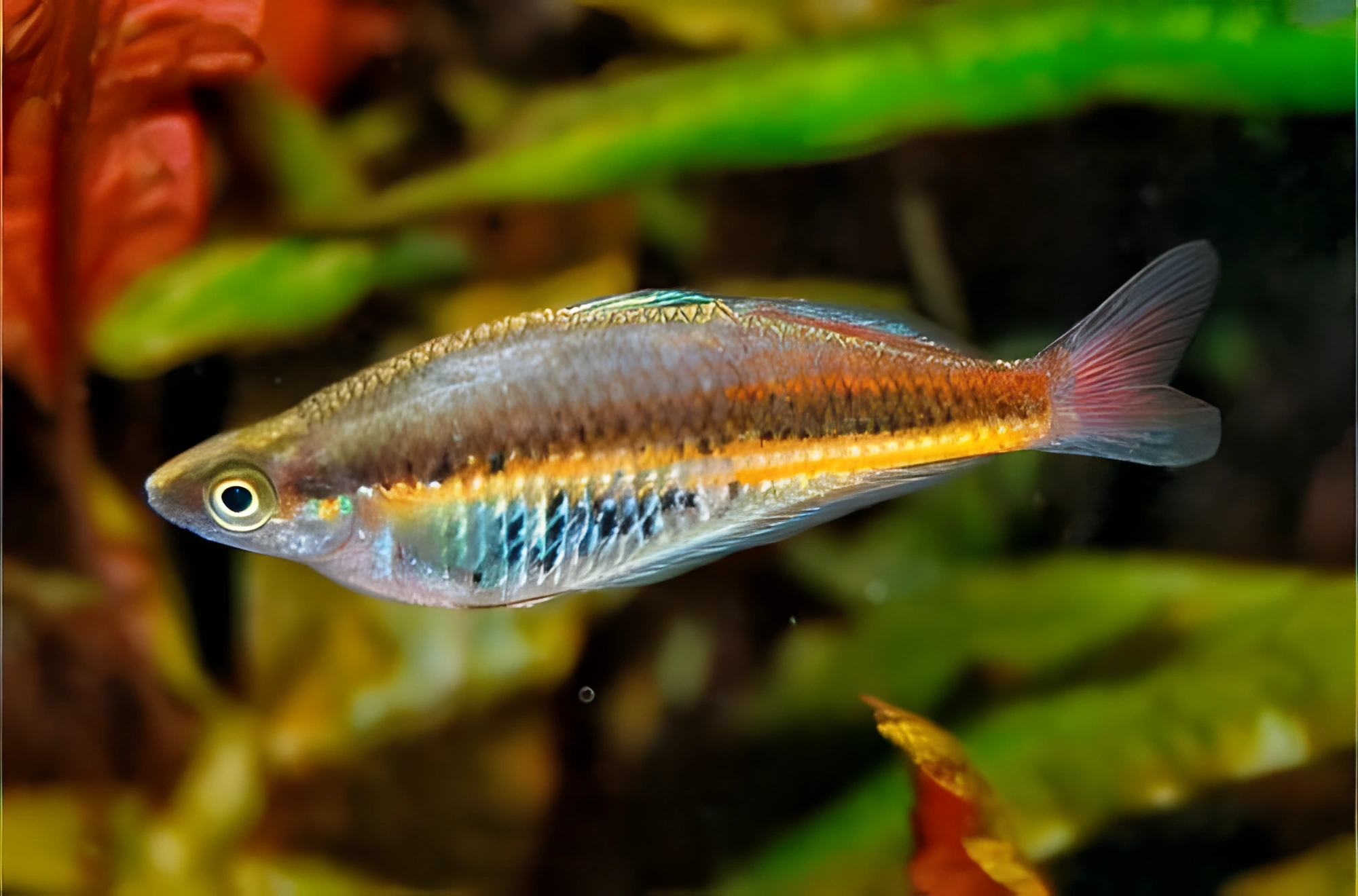
The Ramu Rainbowfish shows a close relationship with the Spotted Rainbowfish, evident in their similar size and some coloration elements. Adult individuals can reach approximately 6 cm in length. The dorsal coloration ranges from greenish-brown to purple hues. Orange stripes run along the lateral line on the sides. A bluish sheen is visible on the belly, and up to a dozen black spots can be seen. With age, these spots become less pronounced. It is important to note that this vibrant coloration is primarily characteristic of males, while females appear more subdued.
Habitat
The species is endemic to Papua New Guinea. In nature, it inhabits tributaries of the Gogol River near Madang, and is also found in the Ramu River basin. The fish inhabit freshwater bodies, primarily small rivers and streams with flowing water, where they prefer areas with dense aquatic vegetation.
Behavior and Compatibility
This fish is distinguished by its peaceful and active nature. It coexists well with its own kind and with other species of similar size and temperament. However, it is advisable to avoid housing them with slow-moving fish, as the more agile Rainbowfish may outcompete them for food.
Care and Maintenance
For a school of 6–8 individuals, an aquarium of 60–80 liters will be optimal. The aquarium setup can be anything, the main thing is to provide enough free swimming space and several shelters. These can be dense thickets of plants, including floating ones. For long-term keeping, maintaining stable water parameters becomes crucial. Medium hardness with a neutral or slightly alkaline pH level is considered the most comfortable. Aquarium maintenance is standard and similar to caring for other freshwater fish. Essential procedures include: weekly partial water changes, removal of organic waste, and regular equipment checks. In terms of feeding, the fish is unpretentious. It will readily accept most common types of food: dry, freeze-dried, frozen, and live.
Diet
This fish is undemanding regarding food. It readily consumes a variety of foods, available in dry, freeze-dried, frozen, or live forms.
Breeding and Reproduction
Breeding occurs through spawning. To stimulate spawning, breeders are fed live or frozen foods abundantly for two weeks. Fine-leaved plants or special synthetic spawning mops are placed in the breeding tank. Eggs are laid in portions over several days. After the process is complete, the parents must be removed to prevent them from eating the offspring. Fry hatch after 48 hours and begin to swim freely, after which they are fed infusoria or micro-food, gradually transitioning to Artemia nauplii.
Diseases
No specific diseases exclusively characteristic of this species have been identified. Like other members of the family, Ramu Rainbowfish are sensitive to water quality and susceptible to common infections if keeping conditions are violated. The main risks are associated with the accumulation of organic compounds, causing bacterial skin and fin lesions, as well as parasitic invasions when new individuals are introduced without prior quarantine.
To prevent diseases, it is necessary to maintain stable environmental parameters and avoid sharp temperature fluctuations. Water purity is a key factor in protecting immunity, so regular water changes and effective filtration are mandatory. If signs of stress or damage appear, the level of nitrogenous compounds should be checked, and the fish should be provided with peace in an aquarium with good aeration.
How to choose
When selecting individuals, attention should be paid to the overall activity of the fish and the cleanliness of their skin. Healthy rainbowfish should show interest in food, have bright coloration without spots, ulcers, or fin damage. Avoid purchasing fish that stay at the surface, breathe heavily, or appear emaciated. It is recommended to acquire a group of 6 or more individuals, as fish kept alone are prone to stress and become timid.
Frequently asked questions
The essentials: size, tank volume, water parameters and care
How big does Ramu Rainbowfish get?
An adult reaches 6 cm in length. Plan the tank around the maximum size: the fish quickly outgrows a cramped setup.
What size aquarium does Ramu Rainbowfish need?
The minimum recommended volume is 60 L. A smaller tank speeds up nitrate build-up and raises stress levels.
What water parameters does Ramu Rainbowfish need?
Temperature 24–28 °C, pH 7–7.8, hardness 12–20 dGH. Stability matters more than exact values: sudden swings are harder on the fish than a small deviation from the ideal.
How long does Ramu Rainbowfish live?
Around 5 years when kept properly. Lifespan depends directly on tank volume, water quality and a varied diet.
Is Ramu Rainbowfish aggressive?
Temperament: peaceful (regular). Keep this in mind when choosing tank mates.
How many Ramu Rainbowfish should be kept together?
Recommended setup: medium group (6–8 individuals). Ignoring this is a common cause of stress and disease.
What does Ramu Rainbowfish eat?
Diet type: any (universal). Feed small portions that are finished within a couple of minutes — overfeeding does more harm than underfeeding.
What is the scientific name of Ramu Rainbowfish?
The scientific name of the species is Glossolepis ramuensis, family Rainbowfish (Melanotaeniidae).