Temperature25 – 30 °C
Natural range
- Lake Kurumoi area
- Bird's Head Peninsula (Vogelkop Peninsula) area
RainbowfishConservation status: Critically endangered CR
The scientific name Melanotaenia parva belongs to the family Melanotaeniidae, commonly known as Rainbowfishes. This fish is also known as the Kurumoi Lake Rainbowfish, named after Lake Kurumoi on the Cenderawasih Peninsula, located in the northwestern part of New Guinea island.
- Required aquarium volume
- 100 L
- Size in aquarium
- 5 cm
- Temperature
- 25 – 30 °C
- Temperament
- Peaceful (regular)
Parameters
Water pHSlightly acidic (6.2) – Slightly alkaline (7.8)
Water dHSoft (5) – Hard (14)
Water salinityno salt (freshwater)
Size in aquarium5 cm
Lifespan5 years
TemperamentPeaceful (regular)
Toward small fishnot a predator
Required aquarium volume100 L
Lightingmoderate or bright
Substrateany (no restrictions)
Water flowweak or moderate
FeedingAny (universal)
CareMedium group (6–8 individuals)
Description
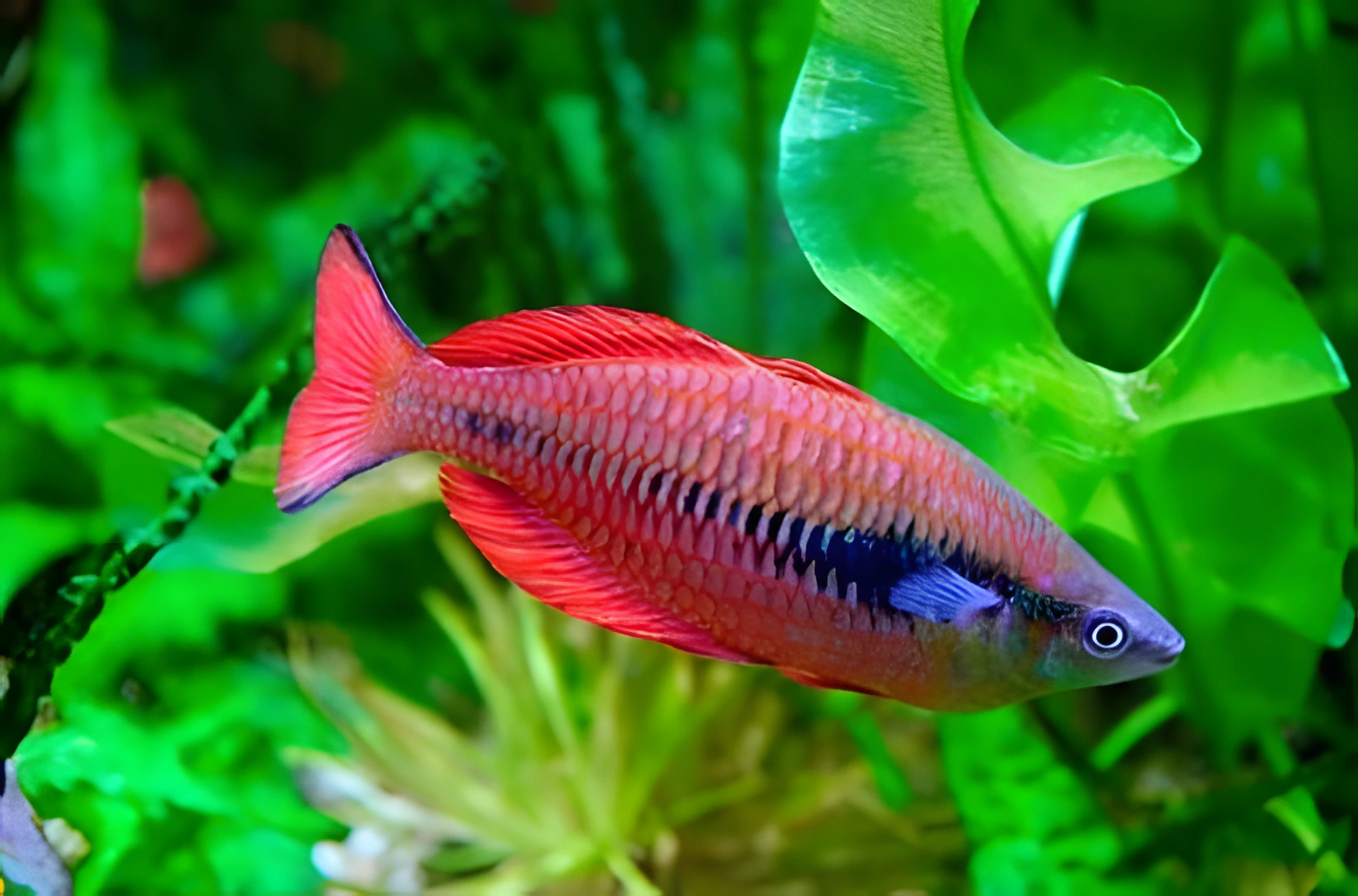
Adults of this fish reach a length of about 5 cm. Compared to other members of the genus Melanotaenia, Melanotaenia parva is distinguished by its modest size, which is reflected in its Latin name: “Parva” translates to “small.” Australian researcher Allen Jerry observed two distinct color forms in the lake. One displays a gradient coloration from bluish to pink tones, complemented by a black lateral line. The other form has a silvery hue with red speckles and thin red or orange margins on its scales. The fins of both varieties are red. Such vibrant coloration is most often seen in adult males. Females and young males are typically much less vibrantly colored. Melanotaenia parva has a close relationship with Melanotaenia angfa, a closely related species that inhabits the river systems flowing into the same lake. Despite their common origin, the fish of these two species differ significantly in size and coloration.
Habitat
The species is endemic to Lake Kurumoi, located on the Cenderawasih Peninsula (Vogelkop) in West Papua, Indonesia. In nature, the fish inhabit coastal areas of the reservoir with muddy bottoms and dense aquatic vegetation. Characteristic water parameters for this biotope include a neutral or slightly alkaline environment and moderate hardness.
Behavior and Compatibility
These active fish prefer to stay in shoals of 6–8 individuals. Competition between males for the attention of females is common, but serious fights or injuries are extremely rare. Melanotaenia parva coexist well with many non-aggressive species, and other Rainbowfishes make excellent tankmates.
Care and Maintenance
For a small group of Melanotaenia parva, the optimal aquarium size starts from 100 liters. In terms of decor, it is recommended to combine open spaces for free swimming with areas for hiding, created by thickets of stiff-leaved plants. Clumps of dark green Hornwort will provide the most natural look. For long-term keeping, it is important to ensure stable water conditions: it should be warm, slightly alkaline, with medium GH values. Standard aquarium maintenance procedures include weekly partial water changes with fresh water and regular removal of organic waste.
Diet
This omnivorous species readily accepts most common dry, frozen, and live foods of appropriate size. However, their tendency to damage soft plant fragments should be considered, so only stiff-leaved plant species are recommended for the aquarium.
Breeding and Reproduction
Spawning is paired or in groups, usually stimulated by increased temperature and frequent water changes. The female lays eggs on fine-leaved plants or special synthetic substrates (spawning mops). The parents tend to eat the eggs, so it is recommended to transfer the substrate with the clutch to a separate incubator. Larvae hatch after 4–7 days, and after becoming free-swimming, they require small starter food such as infusoria or rotifers.
Diseases
The species has moderate immunity but is sensitive to abrupt changes in water parameters and high levels of organic waste. Under poor keeping conditions, fish are susceptible to bacterial infections and skin parasites. To prevent diseases, it is necessary to maintain a stable hydrochemical regime, ensure effective filtration, and avoid overpopulation of the aquarium.
How to choose
When purchasing, choose active, mobile individuals with clean scales and undamaged fins. Avoid fish with signs of emaciation, sunken bellies, or visible coatings on the body. It is important to note that the coloration of young individuals in the store may be pale, so attention should be paid to overall plumpness and the absence of stress behavior.
Frequently asked questions
The essentials: size, tank volume, water parameters and care
How big does Melanotaenia parva get?
An adult reaches 5 cm in length. Plan the tank around the maximum size: the fish quickly outgrows a cramped setup.
What size aquarium does Melanotaenia parva need?
The minimum recommended volume is 100 L. A smaller tank speeds up nitrate build-up and raises stress levels.
What water parameters does Melanotaenia parva need?
Temperature 25–30 °C, pH 6.2–7.8, hardness 5–14 dGH. Stability matters more than exact values: sudden swings are harder on the fish than a small deviation from the ideal.
How long does Melanotaenia parva live?
Around 5 years when kept properly. Lifespan depends directly on tank volume, water quality and a varied diet.
Is Melanotaenia parva aggressive?
Temperament: peaceful (regular). Keep this in mind when choosing tank mates.
How many Melanotaenia parva should be kept together?
Recommended setup: medium group (6–8 individuals). Ignoring this is a common cause of stress and disease.
What does Melanotaenia parva eat?
Diet type: any (universal). Feed small portions that are finished within a couple of minutes — overfeeding does more harm than underfeeding.
What is the scientific name of Melanotaenia parva?
The scientific name of the species is Melanotaenia parva, family Rainbowfishes (Melanotaeniidae).