Temperature26 – 30 °C
Natural range
- Papua New Guinea area
- Milne Bay Province area
RainbowfishConservation status: Near threatened NT
Parkinson's Rainbowfish, scientifically named Melanotaenia parkinsoni, is a member of the family Melanotaeniidae, known as Rainbowfishes. The native home of this fish is the island of New Guinea. Its natural habitat is limited to the southeastern part of the island, where it prefers shallow rivers and streams flowing through tropical forests.
- Required aquarium volume
- 140 L
- Size in aquarium
- 11 cm
- Temperature
- 26 – 30 °C
- Temperament
- Peaceful (regular)
Parameters
Water pHNeutral (7.5) – Slightly alkaline (7.8)
Water dHMedium hardness (8) – Hard (16)
Water salinityno salt (freshwater)
Size in aquarium11 cm
Lifespan7 years
TemperamentPeaceful (regular)
Toward small fishnot a predator
Required aquarium volume140 L
Lightingmoderate or bright
Substrateany (no restrictions)
Water flowweak or moderate
FeedingAny (universal)
CareMedium group (6–8 individuals)
Description
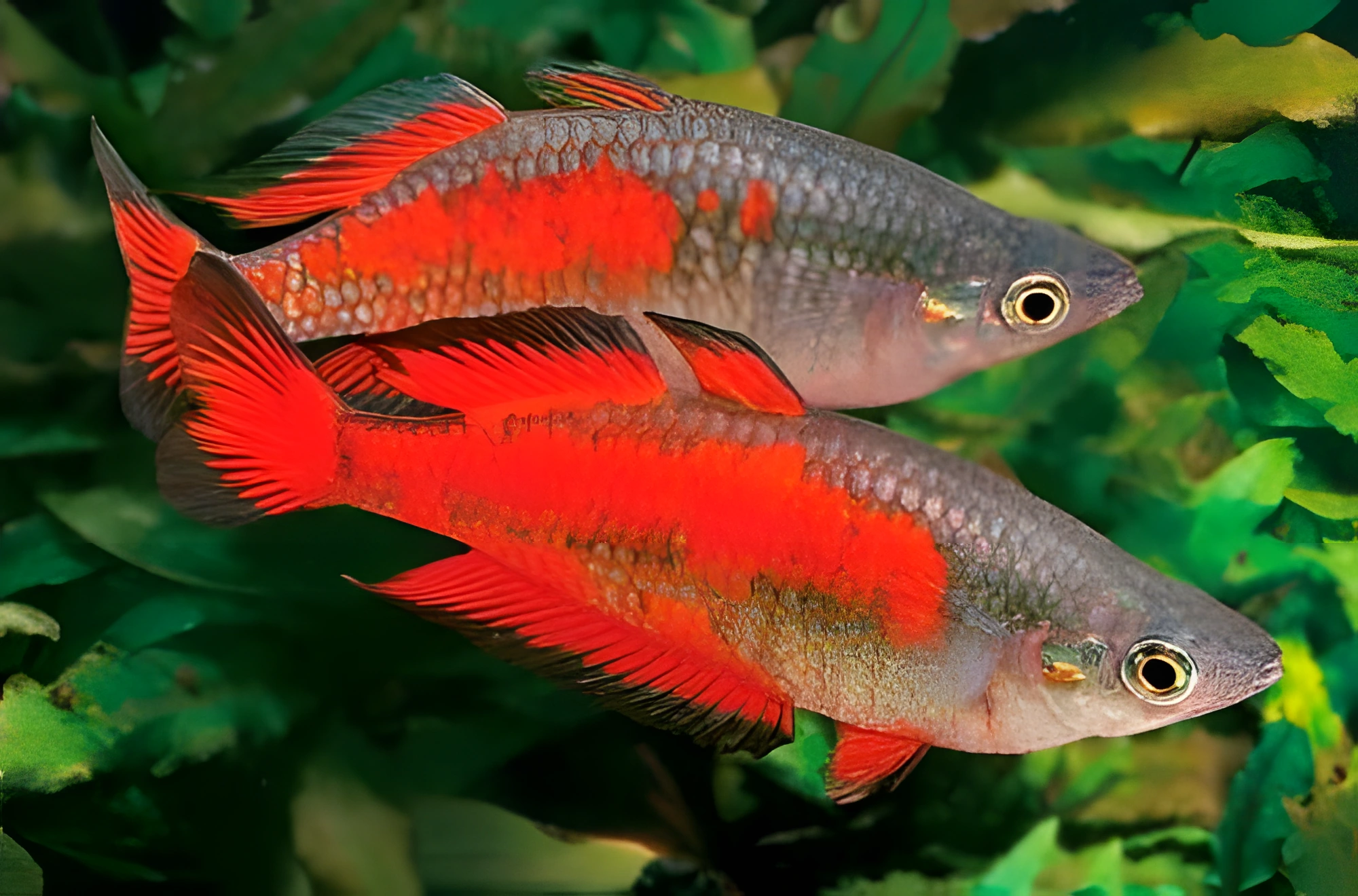
Adults can reach up to 11 cm in length. These fish are characterized by pronounced sexual dimorphism, manifested in differences in coloration. Males are generally more colorful due to the presence of a red-orange pigment that unevenly covers the caudal half of their body. Sometimes, individuals with a predominance of yellowish hues in their coloration are found. Unlike males, females have a more uniform coloration, most often in gray or silver tones. Young fish look similar to females; their bright colors only appear as they mature. In both sexes, rows of stripes may be visible along the lateral line.
Habitat
The species is endemic to Papua New Guinea. In nature, it inhabits river systems located between the Kemp Welch River and Milne Bay. The fish prefer to inhabit lowland areas of tropical rainforests, choosing bodies of water with clear, well-aerated water and moderate current. Typical biotopes are characterized by dense aquatic vegetation and an abundance of shelters.
Behavior and Compatibility
This peaceful and active fish needs the company of its own kind. It is recommended to keep a school of 6–8 individuals. Although males compete with each other for the attention of females, serious injuries are extremely rare. They get along well with many other non-aggressive fish species. However, it should be noted that slow or timid aquarium inhabitants may experience stress due to their high activity.
Care and Maintenance
For comfortable keeping of a group of 6–8 fish, the optimal aquarium volume starts from 140–150 liters. Since Parkinson's Rainbowfish are very active swimmers, the width of the aquarium is more important for them than its height. When decorating, sufficient large open areas for swimming should be left, and excessive overgrowth with aquatic plants should be avoided. Given their tendency to jump out, an aquarium lid would be very useful. These fish adapt well to various conditions, but an environment with high hardness (GH) and pH values is considered most comfortable for them. They prefer high water temperatures, while it is important to ensure a sufficient level of dissolved oxygen. Being omnivores, they readily accept popular dry, live, and frozen foods, such as mosquito larvae and daphnia. Interestingly, these fish can also feed on duckweed.
Diet
This omnivorous species readily accepts a variety of foods: both dry and live or frozen, such as mosquito larvae or daphnia. It has been observed that these fish are not averse to feasting on duckweed. Breeding does not present particular difficulties; the fish can spawn throughout the year in a healthy aquarium. However, the breeding process is complicated by the fact that spawning can last from one day to several weeks. Since Parkinson's Rainbowfish do not exhibit parental care, it is recommended to transfer the eggs to a separate tank to prevent them from being eaten by adult fish. The incubation period is determined by water temperature; at 28°C, it lasts about 8–10 days. After hatching, the fry remain motionless for several hours, and then begin to actively swim in search of food. Their first food can be infusoria or special suspensions for feeding fry. As they grow, they transition to powdered foods, Artemia nauplii, and other suitable types of nutrition.
Breeding and Reproduction
These fish do not require special conditions for breeding. In a thriving aquarium, spawning can occur throughout the year. However, the breeding process is complicated by the fact that the spawning period can last from one day to several weeks. Parkinson's Rainbowfish do not exhibit parental care, so to protect the eggs from being eaten by adult fish, they must be timely transferred to a separate tank. The duration of the incubation period depends on the temperature: at 28°C, it is 8–10 days. After hatching, the fry remain in place for several hours, and then actively begin to swim in search of food. Infusoria or specialized suspensions for fry are suitable as their first food. As they grow, they begin to accept powdered foods, Artemia nauplii, and other appropriately sized foods.
Diseases
The species has a strong immune system when kept in a stable environment. The main dangers are bacterial infections and parasitic infestations arising from stress due to sudden fluctuations in water parameters or poor filtration. For prevention, it is necessary to maintain aquarium cleanliness, avoid overpopulation, and ensure good aeration.
How to choose
When choosing individuals, pay attention to the following signs:
- activity and absence of signs of lethargy or apathy
- clean skin, absence of spots, ulcers, or film
- intact fins and absence of damage
- normal breathing without signs of rapid gill movement
It is recommended to purchase a group of fish, as they experience severe stress when alone, which negatively affects their coloration and behavior.
Frequently asked questions
The essentials: size, tank volume, water parameters and care
How big does Parkinson's Rainbowfish get?
An adult reaches 11 cm in length. Plan the tank around the maximum size: the fish quickly outgrows a cramped setup.
What size aquarium does Parkinson's Rainbowfish need?
The minimum recommended volume is 140 L. A smaller tank speeds up nitrate build-up and raises stress levels.
What water parameters does Parkinson's Rainbowfish need?
Temperature 26–30 °C, pH 7.5–7.8, hardness 8–16 dGH. Stability matters more than exact values: sudden swings are harder on the fish than a small deviation from the ideal.
How long does Parkinson's Rainbowfish live?
Around 7 years when kept properly. Lifespan depends directly on tank volume, water quality and a varied diet.
Is Parkinson's Rainbowfish aggressive?
Temperament: peaceful (regular). Keep this in mind when choosing tank mates.
How many Parkinson's Rainbowfish should be kept together?
Recommended setup: medium group (6–8 individuals). Ignoring this is a common cause of stress and disease.
What does Parkinson's Rainbowfish eat?
Diet type: any (universal). Feed small portions that are finished within a couple of minutes — overfeeding does more harm than underfeeding.
What is the scientific name of Parkinson's Rainbowfish?
The scientific name of the species is Melanotaenia parkinsoni, family Rainbowfishes (Melanotaeniidae).