Temperature26 – 30 °C
Natural range
- New Guinea area
- Irian Jaya area
RainbowfishConservation status: Critically endangered CR
The fish, scientifically known as Glossolepis dorityi, or Dority's Rainbowfish, is a member of the family Melanotaeniidae. This species was first discovered by the renowned German researcher Heiko Bleher in 1999, but he was unable to collect the samples needed for detailed study at that time. A fortunate opportunity arose for other researchers in April 2000: it was then that Dan Dority and David Price collected Glossolepis dorityi, which allowed it to be entered into the international fish catalog as a completely new species.
- Required aquarium volume
- 150 L
- Size in aquarium
- 11 cm
- Temperature
- 26 – 30 °C
- Temperament
- Peaceful (regular)
Parameters
Water pHSlightly acidic (5) – Slightly alkaline (8)
Water dHSoft (5) – Very hard (20)
Water salinityno salt (freshwater)
Size in aquarium11 cm
Lifespan7 years
TemperamentPeaceful (regular)
Toward small fishnot a predator
Required aquarium volume150 L
Lightingweak or moderate
Substrateany (no restrictions)
Water flowstrong
FeedingAny (universal)
CareMedium group (6–8 individuals)
Description
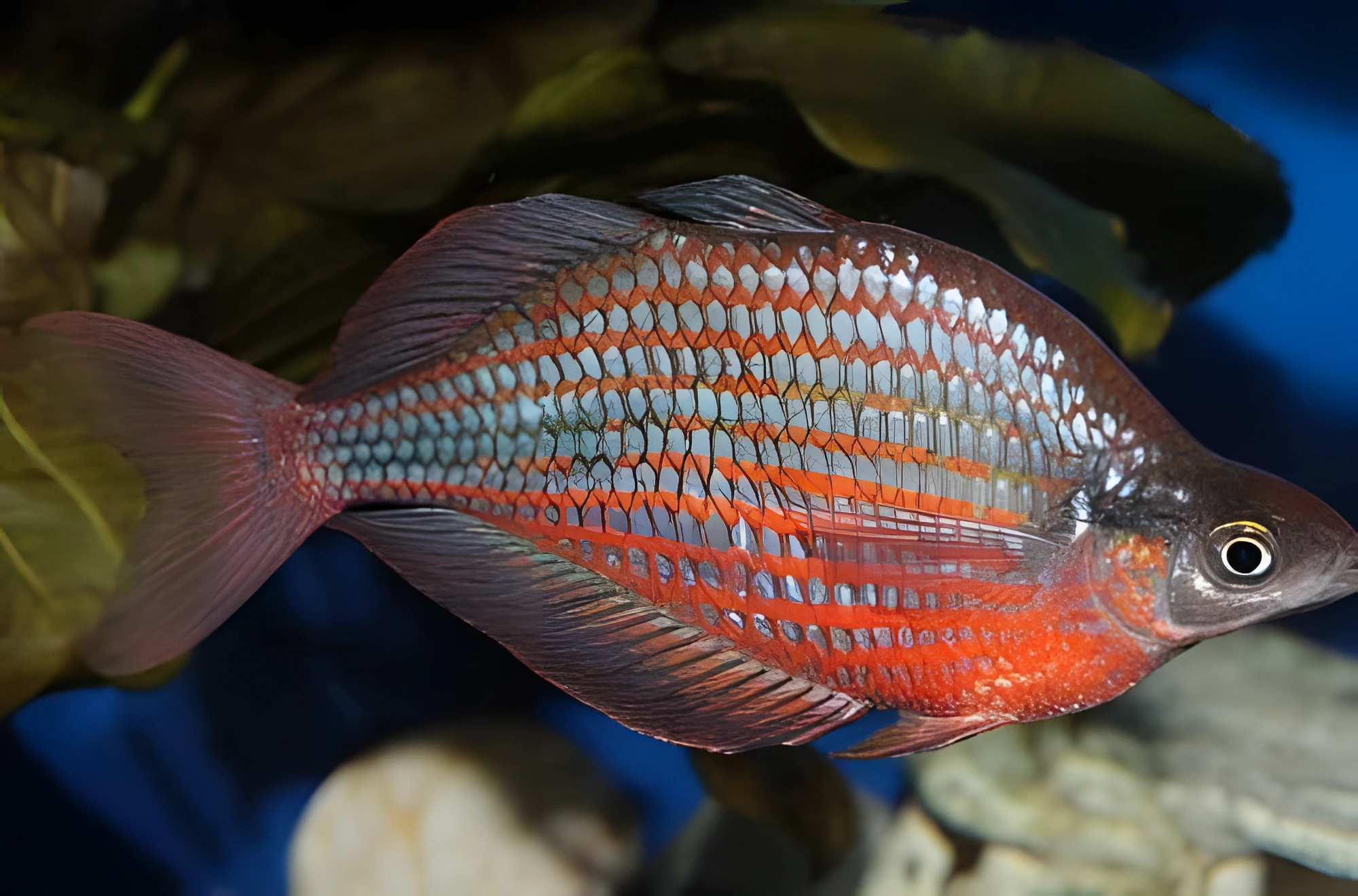
Males can reach a length of 10–11 cm. Their coloration includes greenish body shades with a pronounced silvery sheen. Pale horizontal stripes of orange or bronze are noticeable on the upper part of the body. At the same time, on the lower part, these stripes acquire richer red-orange tones and become more contrasting. The fins can be either greenish or translucent with a slight pinkish tint. Females are generally smaller, measuring about 8–9 cm. Their coloration is less vibrant: the main body color is also greenish, but bright horizontal stripes are absent. In terms of behavior, these schooling fish are quite active. Males may compete with each other for the attention of females, but aggression is generally not displayed. Other species of Rainbowfish make good tank mates. They are also compatible with fish of comparable size and temperament.
Habitat
The origin of this fish is the island of New Guinea, located north of Australia. Its natural range is limited to river systems in the western part of the island. This region, known as Irian Jaya, is characterized by mountainous terrain where lowlands are covered with extensive swamps and dense jungles. A typical habitat is the shallow Lake Nengwambu, which is notable for the absence of inflowing rivers and its connection to other lakes via underground limestone grottoes. Due to the lack of constant inflow from rivers, the water in the lake is exceptionally clean. Many aquatic plants grow luxuriantly along its banks. Despite its rather modest biodiversity, the Fasciata Rainbowfish, popular among aquarists, is found among the fish inhabiting this area.
Behavior and Compatibility
Dority's Rainbowfish is a peaceful and active schooling fish that prefers to stay in the upper layers of the water. For their comfort, it is recommended to keep a group of 6 or more individuals. The species is well-suited for community tanks with other calm, similarly sized fish. Avoid cohabitation with aggressive or significantly larger inhabitants, as this causes stress for rainbowfish.
Care and Maintenance
For keeping 6–8 fish, the recommended aquarium volume should be at least 150 liters. In the aquarium setup, it is desirable to alternate zones with dense thickets of aquatic vegetation and open areas for free swimming. For long-term maintenance of the fish in good condition, the stability of the aquatic environment and maintaining a high temperature of around 28°C are critically important. Optimal water parameters are considered to be medium hardness and a pH level around 7.0. It is important to remember that high temperatures accelerate the decomposition of organic matter, so food scraps and excrement can quickly pollute the water. To prevent this, the aquarium must be equipped with a powerful filtration system. In addition, a portion of the water should be replaced with fresh water weekly, combined with the removal of organic waste. In terms of feeding, these fish are unpretentious. They readily accept most common foods, whether dry, frozen, or live.
Diet
In terms of feeding, the fish are unpretentious. They readily accept a variety of popular foods, including dry, frozen, and live types.
Breeding and Reproduction
Breeding is relatively simple. To stimulate spawning, a separate aquarium with fine-leaved plants or special spawning mops is used, where the fish lay their eggs. It is recommended to reduce the intensity of the water flow. Spawning can continue for several months. Fry are very small and need infusoria in the first days of life; as they grow, they are gradually transitioned to Artemia nauplii.
Diseases
No specific diseases unique to this species have been recorded. Like other members of the Melanotaeniidae family, Dority's Rainbowfish is sensitive to water quality and the level of dissolved oxygen. If sanitary maintenance standards are not met, organic matter accumulates, or hydrochemical parameters fluctuate sharply, the fish become susceptible to bacterial infections and infestations, such as ich or fin rot.
Disease prevention includes regular water changes, maintaining stable pH and hardness levels, and ensuring effective filtration and aeration. It is important to avoid overpopulation of the aquarium, which causes stress and weakens the fish's immune system. New individuals should be quarantined before being introduced into the main aquarium to prevent the introduction of infections.
How to choose
When purchasing, choose active individuals with clean fins and no visible damage to their scales. Healthy fish should show interest in food and have bright coloration characteristic of the species. Avoid specimens that keep to themselves, appear apathetic, or show signs of emaciation, as this may indicate hidden infections or problems with adapting to the keeping conditions.
Frequently asked questions
The essentials: size, tank volume, water parameters and care
How big does Dority's Rainbowfish get?
An adult reaches 11 cm in length. Plan the tank around the maximum size: the fish quickly outgrows a cramped setup.
What size aquarium does Dority's Rainbowfish need?
The minimum recommended volume is 150 L. A smaller tank speeds up nitrate build-up and raises stress levels.
What water parameters does Dority's Rainbowfish need?
Temperature 26–30 °C, pH 5–8, hardness 5–20 dGH. Stability matters more than exact values: sudden swings are harder on the fish than a small deviation from the ideal.
How long does Dority's Rainbowfish live?
Around 7 years when kept properly. Lifespan depends directly on tank volume, water quality and a varied diet.
Is Dority's Rainbowfish aggressive?
Temperament: peaceful (regular). Keep this in mind when choosing tank mates.
How many Dority's Rainbowfish should be kept together?
Recommended setup: medium group (6–8 individuals). Ignoring this is a common cause of stress and disease.
What does Dority's Rainbowfish eat?
Diet type: any (universal). Feed small portions that are finished within a couple of minutes — overfeeding does more harm than underfeeding.
What is the scientific name of Dority's Rainbowfish?
The scientific name of the species is Glossolepis dorityi, family Rainbowfishes (Melanotaeniidae).