Temperature27 – 30 °C
Natural range
- West Papua area
- Indonesia area
RainbowfishConservation status: Endangered EN
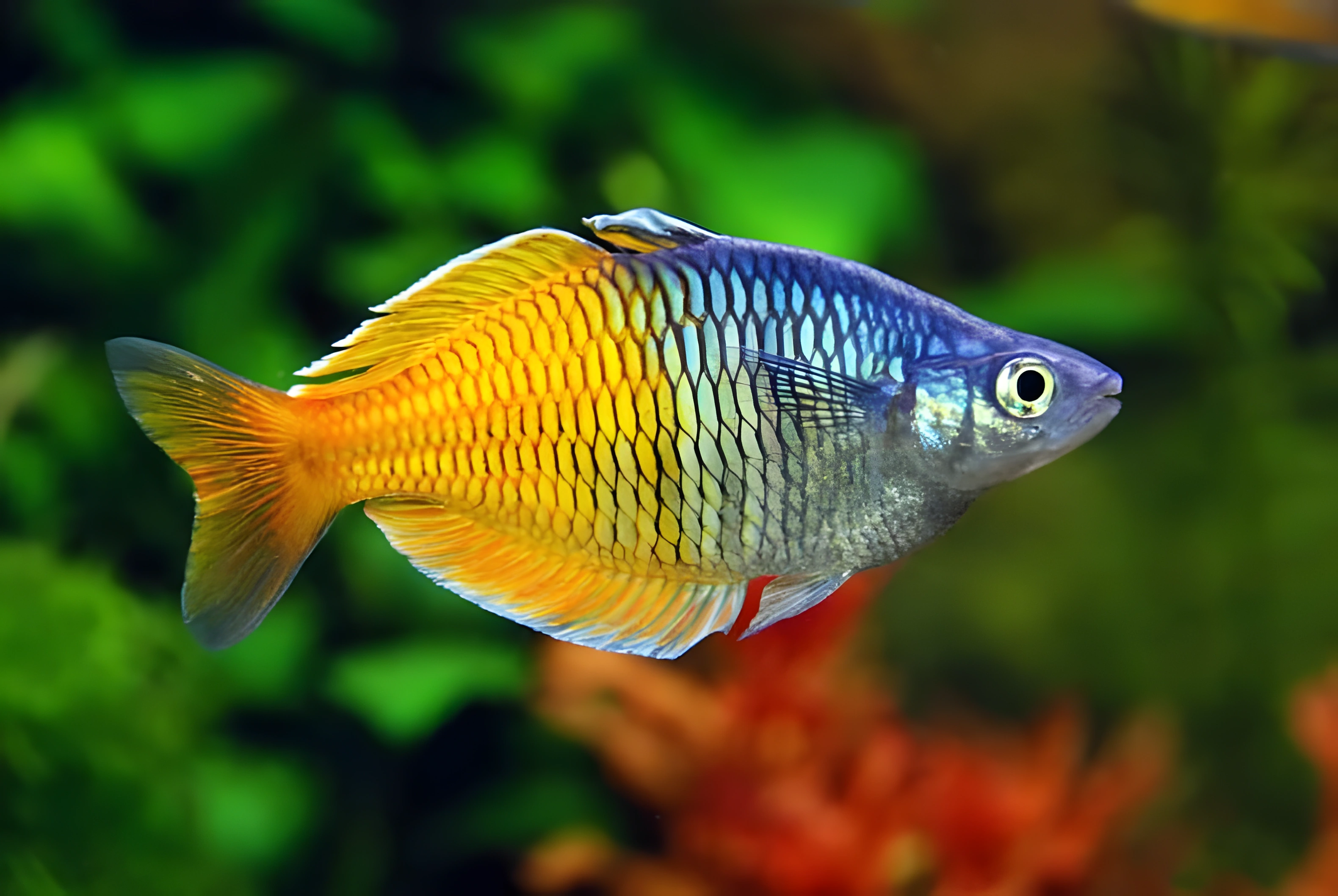
Melanotaenia boesemani, also known as Boeseman's Rainbowfish, is a member of the family Melanotaeniidae. This species has relatively recently appeared in the aquarium hobby but has already gained significant popularity.
- Required aquarium volume
- 110 L
- Size in aquarium
- 8 – 11 cm
- Temperature
- 27 – 30 °C
- Temperament
- Peaceful, active/mobile
Parameters
Water pHNeutral (7) – Slightly alkaline (8)
Water dHMedium hardness (8) – Very hard (20)
Water salinityno salt (freshwater)
Size in aquarium8 – 11 cm
Lifespan8 years
TemperamentPeaceful, active/mobile
Toward small fishnot a predator
Required aquarium volume110 L
Lightingdimmed
Substrateany (no restrictions)
Water flowweak
FeedingAny (universal)
CareMedium group (6–8 individuals)
Description
These individuals, when adult, reach a length of 8 to 11 cm. Their coloration is quite variable: the head area and the front part of the body are blue, smoothly transitioning to yellow-orange tones closer to the tail and on the tail itself. Males are generally larger and have a richer and brighter coloration.
Habitat
The natural habitat of these fish is limited to the western end of New Guinea, a region also known as Irian Jaya or West Irian, located in modern-day Indonesia. In nature, they are found exclusively in three small lakes and their tributaries. Shallow areas with abundant aquatic vegetation are their preferred habitats. Unfortunately, the species is endangered in its natural environment. Most of the fish offered in pet stores are raised on specialized farms.
Behavior and Compatibility
This species is distinguished by its peaceful and active nature, coexisting well with other fish of similar size and temperament that can live in similar conditions. They should be kept in schools, preferably at least 6–8 individuals of both sexes. Interestingly, in the presence of rivals, males display a more expressive and intense coloration.
Care and Maintenance
For keeping a school of Boeseman's Rainbowfish, an aquarium of at least 110 L with a low water level will be required. The decor can be quite simple: dense thickets of rooted and floating plants are sufficient, while leaving enough open space for swimming. Other decorative elements can be chosen at your discretion, as they are not critical for the well-being of the fish. It is important to consider that excessive water movement is undesirable for these inhabitants of still waters. Therefore, when choosing and placing a filtration system, which is the main source of internal current, one should aim for moderate circulation.
Diet
Boeseman's Rainbowfish is not particular about its diet and readily accepts all common types of food, including dry, live, and frozen products. It is worth noting that the quality and composition of the offered food directly affect the brightness of the fish's coloration. Therefore, it is recommended to use food from trusted manufacturers and include live food, such as Artemia or bloodworms, in their diet at least once a week.
Breeding and Reproduction
Optimal conditions for successful breeding include hard and slightly alkaline water (pH around 7.5) with a temperature in the range of 27–29°C, as well as a protein-rich diet. The presence of fine-leaved and low-growing plants or their artificial counterparts is important. Spawning continues for approximately 2 weeks; during this period, the female lays several eggs daily among the vegetation, attaching them to the surface of leaves with adhesive threads. The male is capable of fertilizing eggs from several females. Parental instincts are not developed in these fish: after spawning, they do not care for their offspring. However, importantly, they also do not pose a threat to the eggs and fry. In contrast, tank mates may prey on the young and eggs. To preserve the offspring, the eggs can be carefully transferred to a separate tank with identical water parameters, where they will be completely safe. The incubation period lasts from 7 to 12 days. In the first days after hatching, the fry need micro-food, such as infusoria. As they grow, starting from the first week, specialized powdered foods and/or Artemia nauplii can be introduced.
Diseases
Health problems in these fish arise only as a result of injuries or when kept in unsuitable conditions, which weakens their immune system and provokes the development of various diseases. If the first symptoms appear, it is primarily necessary to check the water quality for any exceeding parameters or dangerous concentrations of toxic substances such as nitrites, nitrates, or ammonium. After detecting deviations, all water parameters should be stabilized to normal, and only then should treatment begin. More detailed information on symptoms and treatment methods can be found in the "Aquarium Fish Diseases" section. Data source: FishBase
How to choose
When purchasing Boeseman's Rainbowfish, it should be noted that young individuals in stores often appear gray and unremarkable, which is normal for this species. Bright coloration only develops as they mature, with quality nutrition and stable living conditions. Avoid purchasing fish with signs of damage, ulcers, or unnatural behavior.
Choose active individuals that show interest in food and swim in a school. Since this species is schooling, it is recommended to purchase a group of 6–8 individuals at once to reduce stress levels in the fish and ensure their normal socialization. Make sure there are no fish with signs of infectious diseases in the seller's aquarium, as rainbowfish can be sensitive to environmental conditions.
Frequently asked questions
The essentials: size, tank volume, water parameters and care
How big does Boeseman's Rainbowfish get?
An adult reaches 8–11 cm in length. Plan the tank around the maximum size: the fish quickly outgrows a cramped setup.
What size aquarium does Boeseman's Rainbowfish need?
The minimum recommended volume is 110 L. A smaller tank speeds up nitrate build-up and raises stress levels.
What water parameters does Boeseman's Rainbowfish need?
Temperature 27–30 °C, pH 7–8, hardness 8–20 dGH. Stability matters more than exact values: sudden swings are harder on the fish than a small deviation from the ideal.
How long does Boeseman's Rainbowfish live?
Around 8 years when kept properly. Lifespan depends directly on tank volume, water quality and a varied diet.
Is Boeseman's Rainbowfish aggressive?
Temperament: peaceful, active/mobile. Keep this in mind when choosing tank mates.
How many Boeseman's Rainbowfish should be kept together?
Recommended setup: medium group (6–8 individuals). Ignoring this is a common cause of stress and disease.
What does Boeseman's Rainbowfish eat?
Diet type: any (universal). Feed small portions that are finished within a couple of minutes — overfeeding does more harm than underfeeding.
What is the scientific name of Boeseman's Rainbowfish?
The scientific name of the species is Melanotaenia boesemani, family Rainbowfishes (Melanotaeniidae).