Temperature24 – 31 °C
Natural range
- West Papua area
- New Guinea area
RainbowfishConservation status: Vulnerable VU
The fish known as Chilatherina or Allen's Rainbowfish, scientifically designated Chilatherina alleni, belongs to the family Melanotaeniidae, or Rainbowfishes. Its natural habitat is the western part of New Guinea island, located north of Australia in the western Pacific Ocean.
- Required aquarium volume
- 150 L
- Size in aquarium
- 10 cm
- Temperature
- 24 – 31 °C
- Temperament
- Peaceful (regular)
Parameters
Water pHSlightly acidic (6) – Slightly alkaline (8.4)
Water dHMedium hardness (10) – Very hard (20)
Water salinityno salt (freshwater)
Size in aquarium10 cm
Lifespan5 years
TemperamentPeaceful (regular)
Toward small fishnot a predator
Required aquarium volume150 L
Lightingmoderate or bright
Substrateany (no restrictions)
Water flowweak or moderate
FeedingAny (universal)
CareMedium group (6–8 individuals)
Description
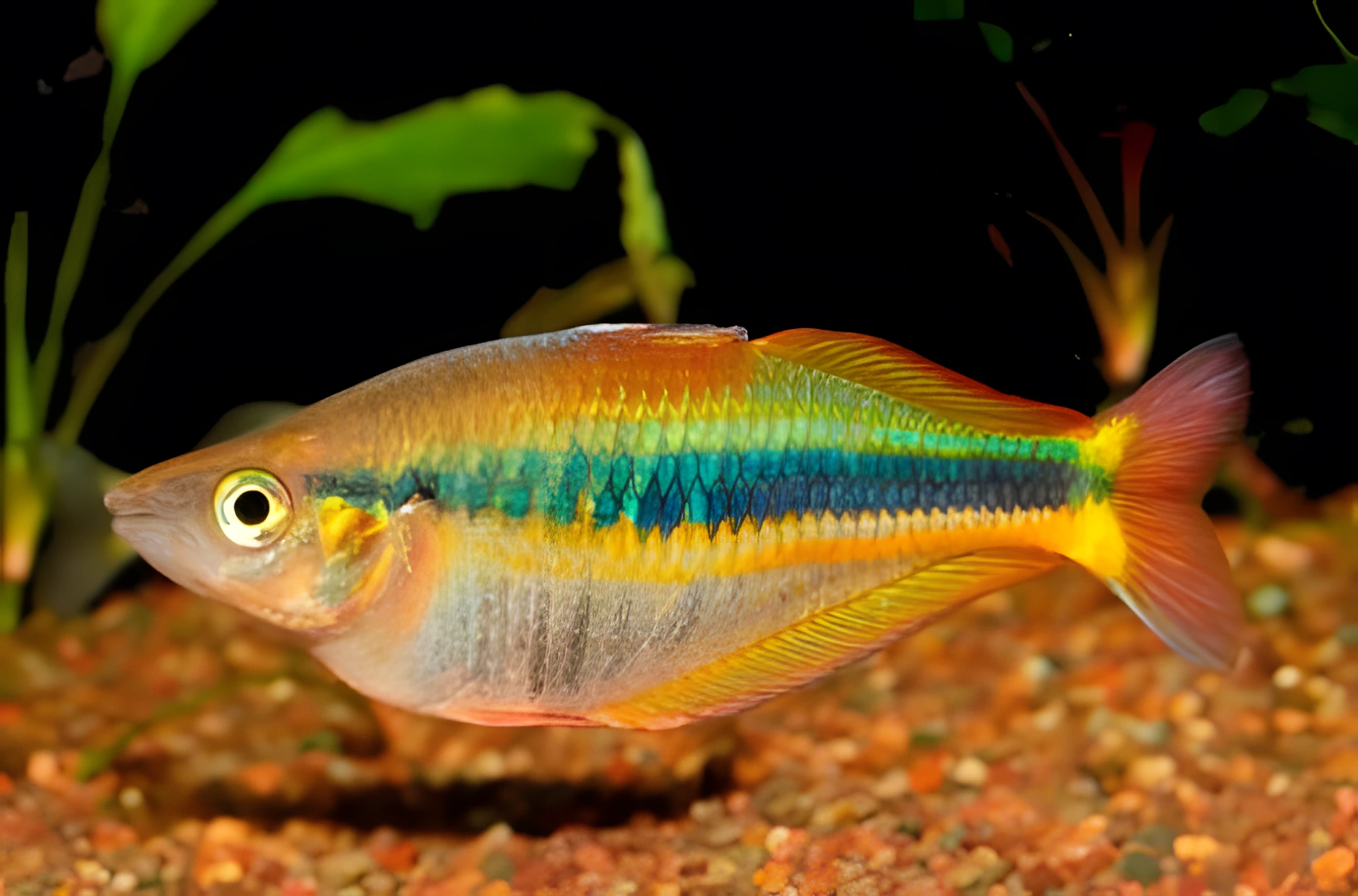
These fish grow up to 10 cm in length as adults. Their coloration displays a wide spectrum of hues: predominantly blue, light blue, red, and orange. A common feature for all variations is a prominent blue stripe running along the lateral line. The dorsal, anal, and caudal fins have red edges.
Habitat
The species is endemic to New Guinea, inhabiting river systems in the West Papua region. Fish are found in small forest streams as well as large rivers, preferring areas with moderate current and abundant sunlight. In their natural habitat, the substrate typically consists of gravel or sand with fallen leaves and snags. Water parameters in nature vary widely: temperatures range from 24–31 °C, and pH levels from 6.0 to 8.4.
Behavior and Compatibility
These fish are quite active and peaceful, and tend to stay in schools. It is recommended to acquire them in groups of 6–8 individuals. They get along well with most other non-aggressive species. However, it is worth noting that slower aquarium inhabitants may struggle to compete for food, so careful consideration should be given to tankmate selection.
Care and Maintenance
For a group of 6–8 individuals, the optimal aquarium volume starts from 150 liters. When arranging decor elements, it is important to provide both open swimming spaces and secluded spots created by plant thickets and snags. The fish easily adapts to various water parameters, simplifying its care, provided that pH and GH levels remain stable. It prefers bright lighting and warm water; prolonged temperature drops below 24°C should be avoided. Aquarium maintenance is standard: weekly partial water changes with simultaneous removal of organic debris. In their natural environment, their diet consists of small insects falling into the water, their larvae, and zooplankton. In home aquariums, the fish readily accept popular foods of all kinds: dry, frozen, and live. Information sources: FishBase, rainbowfish.angfaqld.org.au.
Diet
In natural conditions, the diet of this fish includes small insects and their larvae, as well as zooplankton, which fall into the water. In aquarium conditions, it easily adapts to various types of food, including frozen, live, and dry.
Breeding and Reproduction
For breeding, it is recommended to use a separate spawning tank with fine-leaved plants or a synthetic substrate for egg attachment. Spawning can be in pairs or groups, stimulated by increasing water temperature and abundant feeding with live foods. The female lays eggs in portions over several days. The incubation period at 22–24 °C lasts about 15 days. Fry require small-sized starter food, such as infusoria or specialized dry mixes for juveniles, and show rapid growth with regular water changes.
Diseases
Allen's Rainbowfish has a strong immune system when kept in clean water with high aeration. Like other members of the family, this species is sensitive to the accumulation of organic compounds and nitrogen cycle byproducts, which, if aquarium hygiene rules are not followed, can provoke bacterial infections or fin damage.
Among the most likely problems when keeping conditions are violated are:
- fin rot, manifested by the destruction of fin edges;
- ichthyophthiriasis, occurring with sudden temperature fluctuations or the introduction of pathogens with new individuals;
- skin parasitic diseases caused by deteriorating water quality.
Prevention involves regular water changes, maintaining stable parameters, and mandatory quarantine for new fish. It is important to avoid overpopulation, as stress from territorial competition reduces the body's resistance to infectious diseases.
How to choose
When selecting individuals, attention should be paid to the fish's activity and behavior: healthy rainbowfish should be active, show interest in their surroundings, and stay in a school. It is important to carefully inspect the body for damage, spots, ulcers, or signs of parasite infestation. It is recommended to avoid purchasing fish with signs of emaciation, sunken bellies, or unnaturally clamped fins. In young individuals, coloration may be less pronounced, but the overall body shape should conform to species standards without spinal deformities.
Frequently asked questions
The essentials: size, tank volume, water parameters and care
How big does Allen's Rainbowfish get?
An adult reaches 10 cm in length. Plan the tank around the maximum size: the fish quickly outgrows a cramped setup.
What size aquarium does Allen's Rainbowfish need?
The minimum recommended volume is 150 L. A smaller tank speeds up nitrate build-up and raises stress levels.
What water parameters does Allen's Rainbowfish need?
Temperature 24–31 °C, pH 6–8.4, hardness 10–20 dGH. Stability matters more than exact values: sudden swings are harder on the fish than a small deviation from the ideal.
How long does Allen's Rainbowfish live?
Around 5 years when kept properly. Lifespan depends directly on tank volume, water quality and a varied diet.
Is Allen's Rainbowfish aggressive?
Temperament: peaceful (regular). Keep this in mind when choosing tank mates.
How many Allen's Rainbowfish should be kept together?
Recommended setup: medium group (6–8 individuals). Ignoring this is a common cause of stress and disease.
What does Allen's Rainbowfish eat?
Diet type: any (universal). Feed small portions that are finished within a couple of minutes — overfeeding does more harm than underfeeding.
What is the scientific name of Allen's Rainbowfish?
The scientific name of the species is Chilatherina alleni, family Rainbowfishes (Melanotaeniidae).