Temperature20 – 26 °C
Natural range
- Lake Tebera area
- Papua New Guinea area
RainbowfishConservation status: Vulnerable VU
Melanotaenia herbertaxelrodi, also known as Axelrod's Rainbowfish, belongs to the family Melanotaeniidae. This beautiful and undemanding fish is an excellent choice for a freshwater community aquarium, as it is easy to keep and breed, and coexists well with many other species.
- Required aquarium volume
- 90 L
- Size in aquarium
- 9 cm
- Temperature
- 20 – 26 °C
- Temperament
- Peaceful (regular)
Parameters
Water pHNeutral (7) – Slightly alkaline (8)
Water dHMedium hardness (10) – Hard (15)
Water salinityno salt (freshwater)
Size in aquarium9 cm
Lifespan5 years
TemperamentPeaceful (regular)
Toward small fishnot a predator
Required aquarium volume90 L
Lightingweak or moderate
Substrateany (no restrictions)
Water flowstrong
FeedingAny (universal)
CareMedium group (6–8 individuals)
Description
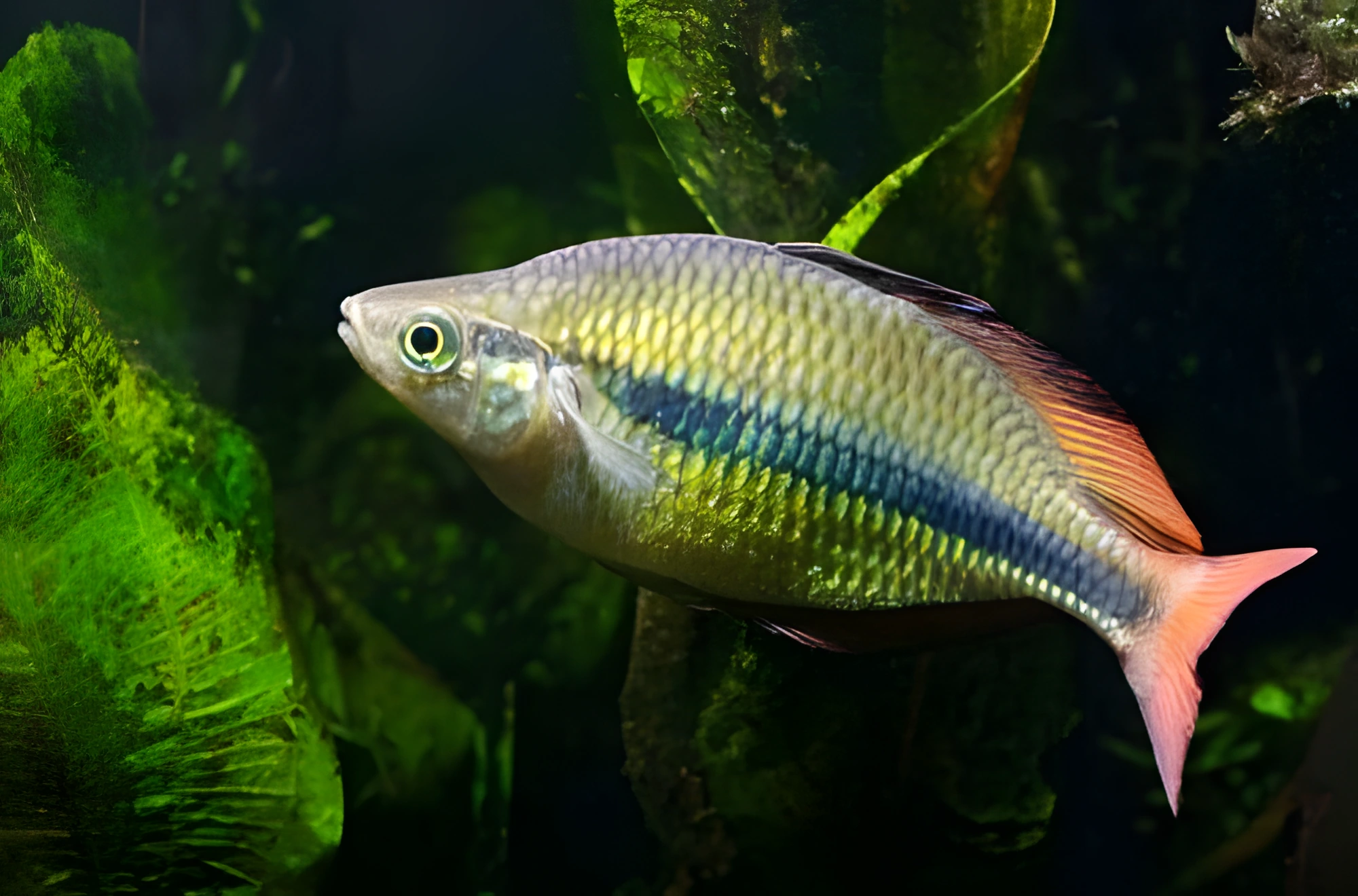
Adults of this fish reach approximately 9 cm in length. Their coloration is predominantly yellow, with a clearly defined dark horizontal stripe. The fins and tail have a red tint. During spawning, males develop a blue or white stripe that runs from the head to the beginning of the dorsal fin. Sexual dimorphism is slight: females are only slightly smaller than males and have less intense coloration.
Habitat
Its natural habitat is the territory of modern Papua New Guinea. This species is endemic to Lake Tebera, located among mountain highlands in the central part of the country. Lake Tebera covers an area of about 20 km², a significant portion of which consists of marshy areas with dense aquatic vegetation, where these fish prefer to reside.
Behavior and Compatibility
These peaceful and active fish get along well with species of similar size and temperament. It is recommended to keep them in a school of at least 6–8 individuals of both sexes. Intraspecific conflicts are not observed.
Care and Maintenance
For a school of 6–8 fish, an aquarium of 90–100 liters will be optimal. The tank's design should include both areas with dense vegetation and open spaces for free swimming. Dim lighting is preferred; with bright light, it is advisable to use floating plants to create the necessary shade. Maintaining high water quality is a key condition for the successful keeping of Axelrod's Rainbowfish. Usually, installing an efficient filtration system and performing weekly 15–20% water changes are sufficient. Another important aspect is minimizing internal current in the aquarium, as strong water movement can cause discomfort to the fish.
Diet
This omnivorous species has no special dietary requirements: it readily accepts popular dry, frozen, and live foods. It is important to remember that a varied diet consisting of quality products directly contributes to maintaining the vibrancy of their coloration.
Breeding and Reproduction
Breeding these fish is not particularly difficult and can even occur successfully in a community tank. For successful spawning, optimal conditions include: slightly alkaline water with medium hardness and a temperature maintained within 22–24°C. It is important to provide dense thickets of fine-leaved, low-growing plants or their artificial imitations. The breeding period lasts approximately two weeks, during which the female lays small portions of eggs daily among the vegetation, and the males fertilize them. Since these fish lack parental instincts, they do not care for their offspring, although they do not pose a direct threat to them. However, to protect the eggs and fry from other aquarium inhabitants who might prey on them, it is recommended to transfer the fertilized eggs to a separate tank with identical water parameters. The incubation period lasts from 7 to 12 days. In the first days after hatching, the fry feed on the contents of their yolk sac, and then switch to microscopic foods, such as infusoria. From the second week, their diet can be supplemented with Artemia nauplii or special powdered foods designed for young fish.
Diseases
Health problems usually arise only as a result of injuries or keeping in unsuitable conditions, which leads to a weakening of the immune system and, as a rule, provokes the development of various diseases. At the first signs of illness, the primary task is to check the water parameters for excesses or dangerous concentrations of toxic substances (nitrates, nitrites, ammonia, etc.). After bringing all indicators back to normal, treatment can begin. More detailed information on symptoms and treatment methods is presented in the "Aquarium Fish Diseases" section.
How to choose
When choosing Axelrod's Rainbowfish at the store, pay attention to the following signs: the fish should be actively swimming in the water column, have clean, tightly pressed fins and smooth scales without visible damage, spots, or film. Avoid individuals showing signs of emaciation, sunken bellies, or unnatural behavior, such as constantly hovering at the surface or bottom. Healthy fish should have clear eyes, without cloudiness. Since this is a schooling species, it is recommended to purchase a group of 6 or more individuals to reduce stress during transport and adaptation to new conditions.
Frequently asked questions
The essentials: size, tank volume, water parameters and care
How big does Axelrod's Rainbowfish get?
An adult reaches 9 cm in length. Plan the tank around the maximum size: the fish quickly outgrows a cramped setup.
What size aquarium does Axelrod's Rainbowfish need?
The minimum recommended volume is 90 L. A smaller tank speeds up nitrate build-up and raises stress levels.
What water parameters does Axelrod's Rainbowfish need?
Temperature 20–26 °C, pH 7–8, hardness 10–15 dGH. Stability matters more than exact values: sudden swings are harder on the fish than a small deviation from the ideal.
How long does Axelrod's Rainbowfish live?
Around 5 years when kept properly. Lifespan depends directly on tank volume, water quality and a varied diet.
Is Axelrod's Rainbowfish aggressive?
Temperament: peaceful (regular). Keep this in mind when choosing tank mates.
How many Axelrod's Rainbowfish should be kept together?
Recommended setup: medium group (6–8 individuals). Ignoring this is a common cause of stress and disease.
What does Axelrod's Rainbowfish eat?
Diet type: any (universal). Feed small portions that are finished within a couple of minutes — overfeeding does more harm than underfeeding.
What is the scientific name of Axelrod's Rainbowfish?
The scientific name of the species is Melanotaenia herbertaxelrodi, family Melanotaeniidae.