Temperature20 – 28 °C
Natural range
- Chocó Department area
- Colombia area
CharacinsConservation status: Data deficient DD
The Rainbow Tetra, also known as the Rainbowfish Tetra, bears the scientific name Nematobrycon lacortei and belongs to the family Characidae. Its name reflects its characteristic iridescent coloration, although the fish are generally silvery. They are easy to keep in an aquarium and breed successfully, coexisting well with other non-aggressive species of similar size.
- Required aquarium volume
- 100 L
- Size in aquarium
- 6 cm
- Temperature
- 20 – 28 °C
- Temperament
- Peaceful (regular)
Parameters
Water pHSlightly acidic (5) – Neutral (7.2)
Water dHVery soft (1) – Medium hardness (10)
Water salinityno salt (freshwater)
Size in aquarium6 cm
Lifespan4 years
TemperamentPeaceful (regular)
Toward small fishnot a predator
Required aquarium volume100 L
Lightingdimmed or moderate
Substratesandy (regular, light)
Water flowweak
FeedingSmall / appropriate size / pieces
CareGroup (8–10 individuals)
Description
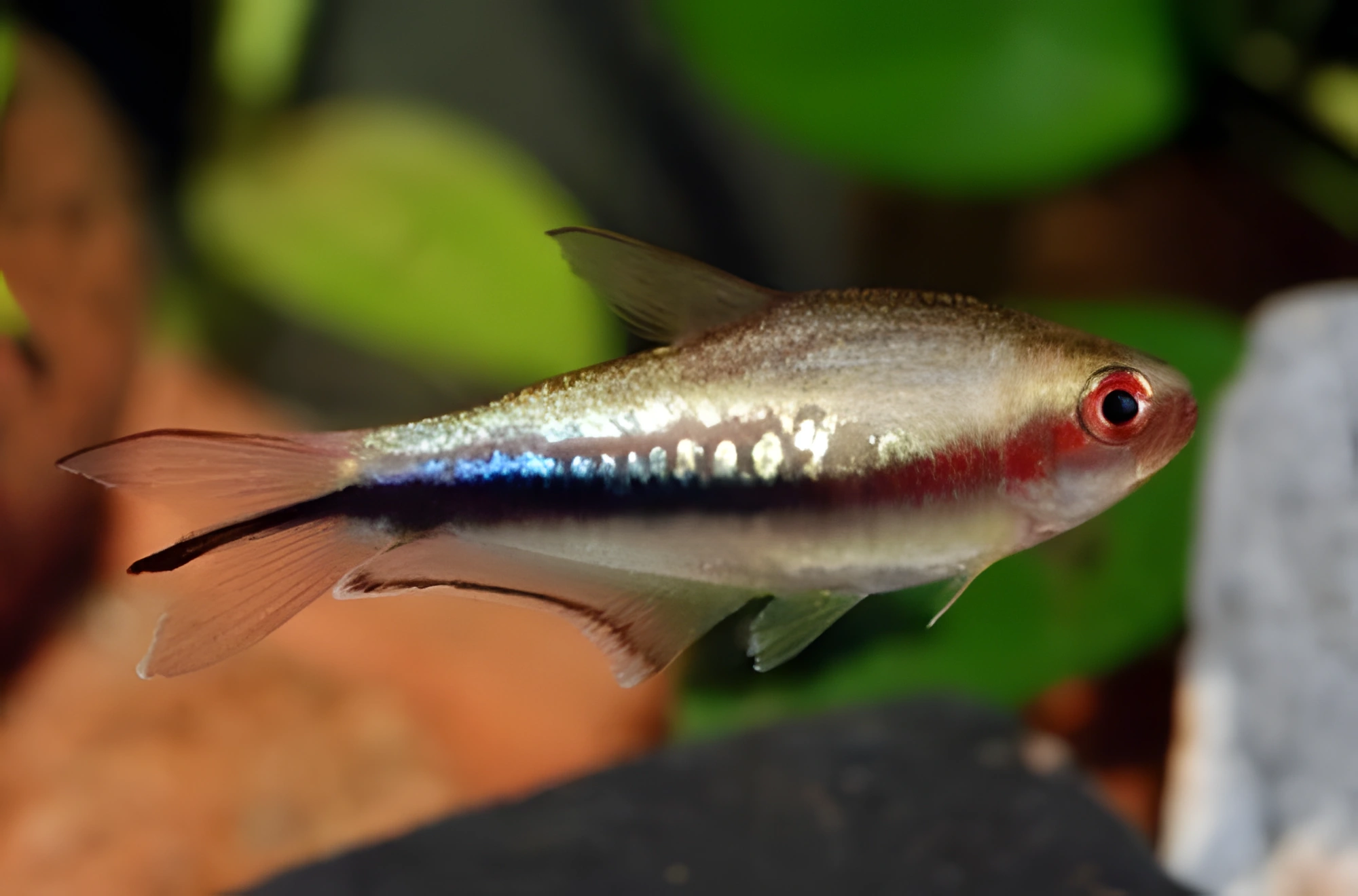
Adult specimens reach a length of up to 6 cm. Males are distinguished by red eyes, as well as elongated anal, dorsal, and caudal fins. The central rays of the tail are greatly extended, creating a 'sword' effect. Females appear more modest; their fins are relatively short, and their eyes have a blue-green hue. The main body coloration is silvery, with iridescent pink, green, and blue tones. A distinct dark stripe runs along the body. The edges of the fins may be bordered with dark or reddish color.
Habitat
The natural waters of South America are the origin of this species. It is believed to be endemic to the San Juan River basin, located in the westernmost part of Colombia. These fish favor the headwaters of rivers that flow through dense equatorial forests.
Behavior and Compatibility
Males exhibit territorial behavior and compete with each other for the attention of females, but this rarely leads to serious clashes, which allows the Rainbow Tetra to be classified as a peaceful species. It is advisable to maintain a group size of at least 8–10 individuals; the principle here is simple – the more, the better. They are well compatible with other non-aggressive fish of similar size.
Care and Maintenance
For the long-term, comfortable keeping of a school of 8–10 individuals, an aquarium of at least 100 liters is optimal. The aquarium's decoration can be arbitrary, at the aquarist's discretion. However, it is worth noting that in conditions closely resembling their natural habitat, the fish display their best coloration. For decoration, it is recommended to use a sandy substrate, several snags, and dense thickets of aquatic plants, including floating ones. Lighting should be subdued. If desired, leaves from certain trees can be added; during decomposition, they release tannins that give the water a chemical composition and brown tint similar to the natural bodies of water where these fish live. Additional information can be found in the article “Which tree leaves can be used in an aquarium.” Furthermore, decomposed leaves serve as an excellent medium for the development of microorganism colonies, such as paramecia, which are a valuable food source for fry. Successful keeping of Rainbow Tetra depends on many factors. In addition to providing a balanced diet, it is crucial to maintain stable water conditions within the permissible range of temperatures and hydrochemical parameters (pH and dGH), as well as to control the concentrations of nitrogen cycle products (ammonia, nitrites, nitrates). Maintaining the necessary stability is largely determined by the quality of the installed equipment and the regular performance of essential aquarium care procedures. These procedures include weekly partial water changes, timely removal of organic waste (food remnants, excrement), and regular monitoring of water parameters.
Diet
These fish are undemanding about food and readily accept almost all types of popular feeds intended for aquarium inhabitants. The daily diet can consist of dry foods, such as flakes and granules, as well as live or frozen brine shrimp, daphnia, and small bloodworms.
Breeding and Reproduction
Under favorable conditions, spawning occurs regularly, without a distinct systemic pattern. Experienced aquarists practice separate keeping of males and females for breeding. After selecting the brightest and largest individuals, they are placed together, awaiting spawning. If it does not occur, another pair is tried. Females scatter their eggs among plants, after which the male fertilizes them. Parental care for the offspring is absent in these fish. Moreover, adult individuals pose a direct threat to their own fry, so fertilized eggs must be removed. The incubation period and subsequent development of the fry should take place in a separate tank, where water conditions are identical to the main aquarium. Usually, such a tank is equipped with a simple air-driven sponge filter and a heater. A separate light source is not required for it. Fry appear after 24–36 hours, and after another 4–5 days, they begin to swim freely in search of food. During the first week, they should be fed microscopic food, such as infusoria or specialized powdered products. As they grow, their diet can be based on brine shrimp nauplii and other similar foods.
Diseases
Specific diseases that affect only this particular fish species have not been identified. When kept in suitable conditions, including high water quality, a balanced diet, and peaceful tank mates, health issues usually do not arise. The most common cause of illness is a deterioration of living conditions, which weakens the immune system and makes the fish susceptible to infections that are always present in their environment. Upon noticing initial signs of sickness (such as lethargy, emaciation, refusal to eat, or clamped fins), it is crucial to immediately check the basic water parameters. Often, restoring acceptable living conditions will lead to self-recovery, but if the fish is too weak or has suffered visible damage, medicinal treatment may be required. For more details on symptoms and treatment methods, consult the section “Diseases of Aquarium Fish.”
How to choose
When selecting individuals, attention should be paid to their activity and fin integrity. Healthy fish should show curiosity, stay in a school, and have no signs of emaciation or scale damage. Avoid specimens with sunken bellies, cloudy eyes, or film on their bodies, as this species is sensitive to transportation and acclimatization conditions. Given the high risk of stress in wild-caught individuals, it is recommended to ask the seller about the duration of the fish's stay in the store and whether they have been quarantined. When purchasing, it is advisable to choose young fish, which adapt more easily to new aquarium conditions.
Frequently asked questions
The essentials: size, tank volume, water parameters and care
How big does Rainbow Tetra get?
An adult reaches 6 cm in length. Plan the tank around the maximum size: the fish quickly outgrows a cramped setup.
What size aquarium does Rainbow Tetra need?
The minimum recommended volume is 100 L. A smaller tank speeds up nitrate build-up and raises stress levels.
What water parameters does Rainbow Tetra need?
Temperature 20–28 °C, pH 5–7.2, hardness 1–10 dGH. Stability matters more than exact values: sudden swings are harder on the fish than a small deviation from the ideal.
How long does Rainbow Tetra live?
Around 4 years when kept properly. Lifespan depends directly on tank volume, water quality and a varied diet.
Is Rainbow Tetra aggressive?
Temperament: peaceful (regular). Keep this in mind when choosing tank mates.
How many Rainbow Tetra should be kept together?
Recommended setup: group (8–10 individuals). Ignoring this is a common cause of stress and disease.
What does Rainbow Tetra eat?
Diet type: small / appropriate size / pieces. Feed small portions that are finished within a couple of minutes — overfeeding does more harm than underfeeding.
What is the scientific name of Rainbow Tetra?
The scientific name of the species is Nematobrycon lacortei, family Characidae.