Temperature20 – 30 °C
Natural range
- Papua New Guinea area
- Australia area
- Northern Australia area
- Southern New Guinea area
RainbowfishConservation status: Least concern LC
Other scientific names: Nematocentris maccullochi, Nematocentrus maccullochi
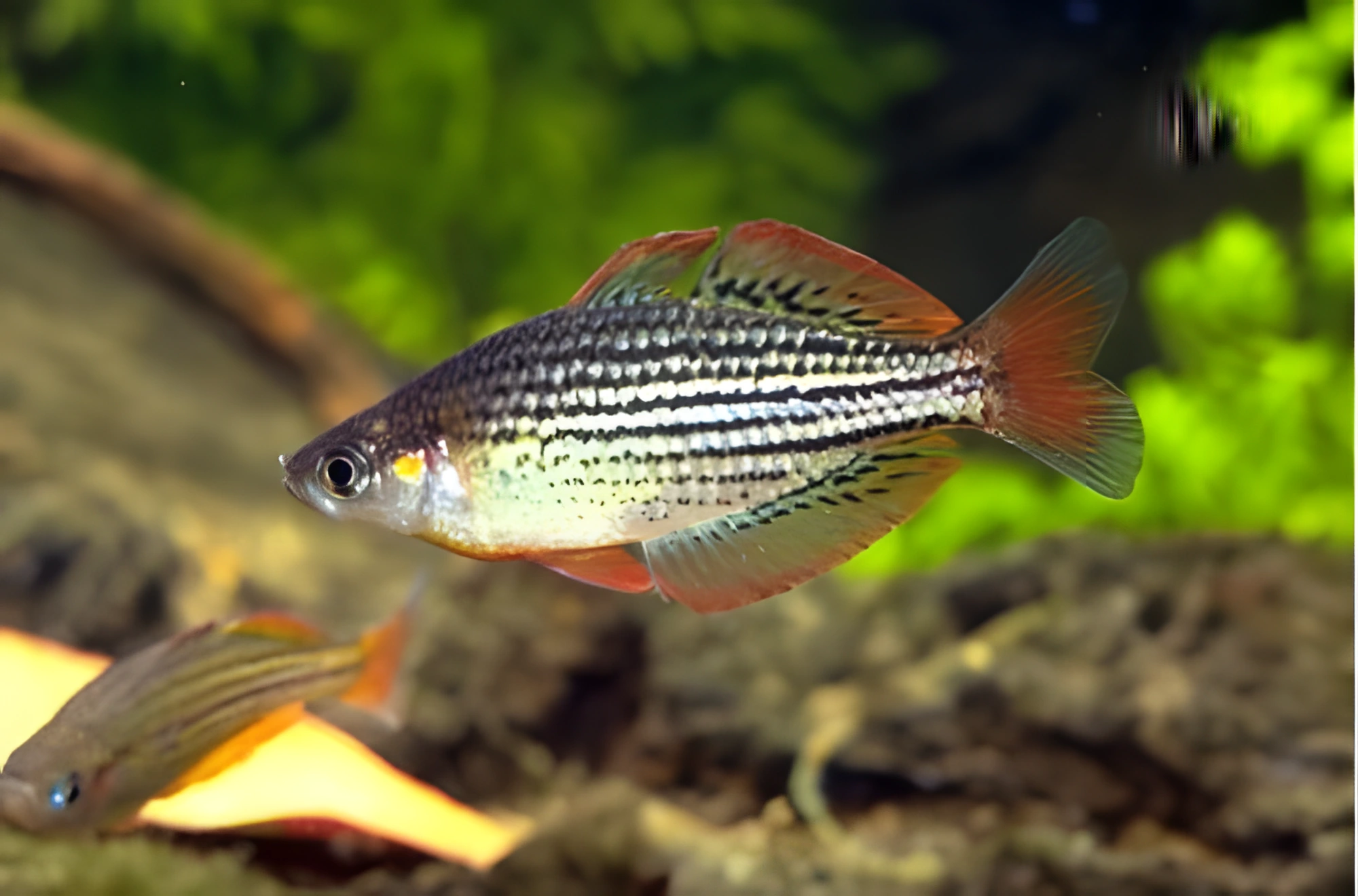
McCulloch's Rainbowfish, or Dwarf Rainbowfish (scientific name Melanotaenia maccullochi), belongs to the family Melanotaeniidae. This Rainbowfish, characterized by its relatively small size among its relatives, is a peaceful species that is easy to keep and breed. Its good compatibility with other inhabitants makes it a suitable candidate for a general freshwater aquarium.
- Required aquarium volume
- 60 L
- Size in aquarium
- 7 cm
- Temperature
- 20 – 30 °C
- Temperament
- Peaceful (regular)
Parameters
Water pHSlightly acidic (5.5) – Slightly alkaline (8)
Water dHMedium hardness (8) – Hard (15)
Water salinityno salt (freshwater)
Size in aquarium7 cm
Lifespan5 years
TemperamentPeaceful (regular)
Toward small fishnot a predator
Required aquarium volume60 L
Lightingweak or moderate
Substrateany (no restrictions)
Water flowweak
FeedingAny (universal)
CareMedium group (6–8 individuals)
Description
Adults can reach a length of up to 7 cm. Their coloration is predominantly silvery, with dark horizontal stripes along the body being a characteristic feature of their pattern. Interestingly, slight color variations are observed between different populations inhabiting various regions: some have red fins, while others have yellow. Females are usually larger than males, but their coloration is less vibrant.
Habitat
The natural habitat of these fish extends across Papua New Guinea and Australia. They can be found in a wide variety of biotopes: from murky, swampy waters to rivers and lakes with crystal clear water. They prefer to stay in dense vegetation, as well as near submerged snags and trees.
Behavior and Compatibility
The Dwarf Rainbowfish has a calm and peaceful disposition, and it coexists well with other species of similar size and temperament. It is recommended to keep them in a school of at least 6–8 individuals of both sexes.
Care and Maintenance
For a group of 6–7 fish, an aquarium of at least 60 liters will be required. The aquascape can be anything, the main thing is to provide areas with dense vegetation and open spaces for swimming. The most important aspect of keeping Rainbowfish is maintaining high water quality. To do this, an efficient filtration system must be installed, and 15–20% of the water volume should be replaced with fresh water weekly. When choosing a filter, opt for models that do not create a strong current, as this species is not adapted to powerful water flows. Otherwise, the fish are quite undemanding and feel great in a wide range of hydrochemical parameters and temperatures.
Diet
An unpretentious and omnivorous species, these fish readily accept dry, frozen, and meaty foods. It is recommended to offer the latter regularly, at least once a week, which helps maintain good overall tone and brighter coloration of the fish.
Breeding and Reproduction
Although keeping these fish in a home aquarium will not cause much trouble, the process of raising fry can be quite challenging. For successful breeding and the onset of the spawning period, the following conditions are optimal: the water should be moderately alkaline (pH 7.5) and have medium hardness, the temperature should be maintained in the range of 26 to 29°C, and feeding should be regular and with high-quality foods. In the spawning tank setup, it is recommended to use thickets of low, fine-leaved plants or mosses, as the female will lay her eggs among them. The spawning process takes about two weeks, with one male capable of fertilizing the eggs of several females. Parental instincts are absent in these fish, however, adults usually do not pose a danger to eggs and fry, unlike other aquarium inhabitants. To ensure the safety of future offspring, they should be transferred to a separate tank. This tank should have water parameters identical to the main aquarium and be equipped with a simple air-driven sponge filter, a light, and a heater. Live or artificial plants are also welcome. The incubation period is 7 to 12 days. In the first days of their lives, the fry feed on the remnants of the yolk sac, after which they need micro-food, such as infusoria. As they grow, the juveniles can be transitioned to Artemia nauplii and other appropriately sized foods. It is important to note that these fish spend most of their time near the water surface, so sinking foods are not suitable for them. Such foods will simply not be eaten and will only pollute the water.
Diseases
Health problems usually arise only as a result of injuries or keeping in unsuitable conditions, which leads to a weakening of the immune system and, as a rule, provokes the development of various diseases. At the first signs of illness, the primary task is to check the water parameters for excesses or dangerous concentrations of toxic substances (nitrates, nitrites, ammonia, etc.). After bringing all indicators back to normal, treatment can begin. More detailed information on symptoms and treatment methods is presented in the "Aquarium Fish Diseases" section.
How to choose
When selecting individuals, pay attention to the fish's activity: healthy rainbowfish should be active and show interest in their surroundings. Avoid specimens with visible scale damage, film, sores, or an unnaturally bloated belly. It is important to assess the cleanliness of the fins – they should be intact, without signs of deterioration or white spots.
- purchase only active individuals that stay in a school
- carefully inspect the fish for parasites and signs of infection
- prefer individuals with bright, rich coloration characteristic of the species
- make sure there are no dead individuals in the aquarium with the fish, as this indicates poor keeping conditions
Frequently asked questions
The essentials: size, tank volume, water parameters and care
How big does Rainbowfish get?
An adult reaches 7 cm in length. Plan the tank around the maximum size: the fish quickly outgrows a cramped setup.
What size aquarium does Rainbowfish need?
The minimum recommended volume is 60 L. A smaller tank speeds up nitrate build-up and raises stress levels.
What water parameters does Rainbowfish need?
Temperature 20–30 °C, pH 5.5–8, hardness 8–15 dGH. Stability matters more than exact values: sudden swings are harder on the fish than a small deviation from the ideal.
How long does Rainbowfish live?
Around 5 years when kept properly. Lifespan depends directly on tank volume, water quality and a varied diet.
Is Rainbowfish aggressive?
Temperament: peaceful (regular). Keep this in mind when choosing tank mates.
How many Rainbowfish should be kept together?
Recommended setup: medium group (6–8 individuals). Ignoring this is a common cause of stress and disease.
What does Rainbowfish eat?
Diet type: any (universal). Feed small portions that are finished within a couple of minutes — overfeeding does more harm than underfeeding.
What is the scientific name of Rainbowfish?
The scientific name of the species is Melanotaenia maccullochi, family Rainbowfishes (Melanotaeniidae). It also appears in the literature as: Nematocentris maccullochi, Nematocentrus maccullochi.