Temperature22 – 26 °C
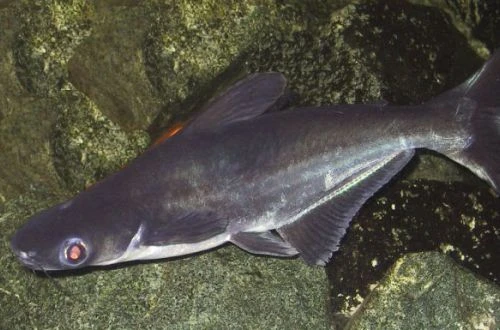
Other scientific names: Helicophagus hypophthalmus, Pangasius hypophthalmus, Pangasius sutchi
This fish, known scientifically as Pangasianodon hypophthalmus and belonging to the family Pangasiidae, is widely known as the Iridescent Shark. Other names include Siamese Pangasius, Shark Catfish, and Sutchi Catfish. Its shark-like appearance attracts many aquarists who wish to have a small "white shark" in their home.
Adults of these catfishes can reach a meter (100 cm) in length, though their size is more modest in aquarium conditions. In their natural habitat, specimens over 130 cm are not uncommon, and the related Mekong giant catfish grows to 3 metres. The catfish's body shape resembles that of a marine shark: it has a laterally compressed body and a prominent, large caudal fin. It has a short dorsal fin with one or two spines, and similar spines are present on its pectoral fins. A distinctive feature of this catfish is the absence of bony protective plates or other "armor" on its skin, making it vulnerable to injury and, consequently, prone to infections. The fish's coloration is silvery, with two distinct dark stripes running along its body: one along the lateral line, the other below it. With age, the coloration becomes more uniform, acquiring a dark gray hue. There are various color variations, including albino pangasius; artificially bred forms of this fish with a shorter and more massive body can also be found on the market.
Although Pangasianodon hypophthalmus was described in 1878, this catfish has been known to people for many centuries, being an important commercial fish in Southeast Asia. It originates from the Mekong and Chao Phraya river basins, occurring in Thailand, Laos, Cambodia and Vietnam. For fishing purposes, this species is also artificially bred in other rivers of the region. Young individuals usually gather in schools and can be found in large numbers at the mouths of large rivers. In their natural habitat, they feed on fish, shrimp, various crustaceans, insect larvae, as well as fruits and other vegetation. The Iridescent Shark is widely available in retail, especially in Southeast Asian countries like Thailand and Laos, where it serves as an important food source. In Thailand, it is also popular among aquarists, but young specimens are supplied to European and American markets, which do not reach their maximum size in aquarium conditions.
Young individuals prefer to stay in schools, but with age, the catfishes become more solitary. Despite this, the need for the company of their own kind persists, so it is recommended to keep 3–4 fish in an aquarium. An important behavioral feature is the fish's poor eyesight: when startled, it begins to dart chaotically around the aquarium, colliding with other inhabitants, walls, and decorations. Often, as a result of such collisions, the catfish sustains serious injuries. Although this fish is peaceful and compatible with other large species, it poses a direct danger to smaller species.
The Iridescent Shark demonstrates unpretentiousness to water chemistry but prefers a neutral pH level. In aquariums not equipped with sufficiently powerful filters, it is recommended to replace 25% of the water weekly. This species is not suited to a home aquarium. Adults outgrow a metre: the long-term care of even a single fish calls for a tank of at least 2000 litres, and with a 450 × 180 cm footprint about 14,500 litres. Juveniles are sold everywhere, making this one of the most consistently mis-sold fish in the hobby: in cramped quarters it panics, crashes into the glass and dies. The aquarium decoration should mimic its natural habitat, including driftwood, grottoes, or caves made of river rocks. Structures should not rise too high above the bottom so as not to impede swimming, as the catfish prefers the middle water layers. Unlike adults, juveniles need hiding places and conceal themselves under driftwood. The fish is prone to jumping out of the aquarium, so a lid is essential. Furthermore, due to its size, the catfish can damage internal equipment such as filters or heaters, so care should be taken to secure them reliably. Large fish produce a significant amount of waste, making the use of powerful filters highly desirable to facilitate maintenance, and low-lying plants with strong root systems will help minimize the load on the biological filter.
The Iridescent Shark is omnivorous and, if given the opportunity, can catch small fish. With age, it loses its teeth and transitions to a predominantly vegetarian diet. In a home aquarium, the catfish will readily consume all types of live, meaty, and plant-based foods, as well as dry commercial foods such as pellets and flakes. To maintain a good balance, it is recommended to feed high-quality foods two to three times a day, in an amount the fish can eat within 5–10 minutes. Earthworms, brine shrimp, and crickets, both live and frozen, will be an excellent addition to the main diet.
In adulthood, it is almost impossible to distinguish males from females; only young females show more distinct dark stripes in their coloration. Breeding these fish in home aquariums is impossible, as they are migratory species. During spawning, which occurs in late spring to early summer, the catfishes travel long distances upstream, and such conditions cannot be recreated in aquariums. Catfish breeding takes place in large ponds in Southeast Asia, for example, in Thailand and Singapore, or through the capture of juveniles in their natural environment.
Pangasius are susceptible to many common fish diseases, particularly fungal infections. As with most catfishes, treating ichthyophthiriasis in them is difficult due to the absence of external protection in the form of scales. Therefore, when using medications, their concentration should be halved.
When selecting individuals, attention should be paid to their activity and the integrity of their skin. Since pangasius lack scales, they are extremely sensitive to mechanical damage and infections, so any signs of wounds, ulcers, or fungal growth on the body indicate ill health. A healthy fish should exhibit natural species-specific mobility and show no signs of emaciation. Keep in mind that pangasius are prone to severe stress when changing environments, which can cause them to panic, dart around the aquarium, and injure themselves on decorations or walls. In the store, choose individuals that appear calm and do not show signs of fright when a person approaches. Avoid buying fish that lie motionless at the bottom for long periods or, conversely, make chaotic dashes in a confined space.
The essentials: size, tank volume, water parameters and care
An adult reaches 100–130 cm in length. Plan the tank around the maximum size: the fish quickly outgrows a cramped setup.
The recommended volume is 2000 L. A smaller tank speeds up nitrate build-up and raises stress levels.
Temperature 22–26 °C, pH 6.5–7.5, hardness 2–15 dGH. Stability matters more than exact values: sudden swings are harder on the fish than a small deviation from the ideal.
Around 20 years when kept properly. Lifespan depends directly on tank volume, water quality and a varied diet.
Temperament: semi-peaceful (dangerous to smaller ones). Not a predatory species, but small fish that fit in its mouth will eventually be eaten.
Recommended setup: schooling (usually from 5–6 individuals and more). Ignoring this is a common cause of stress and disease.
Diet type: any (universal). Feed small portions that are finished within a couple of minutes — overfeeding does more harm than underfeeding.
The scientific name of the species is Pangasianodon hypophthalmus, family Shark Catfishes (Pangasiidae). It also appears in the literature as: Helicophagus hypophthalmus, Pangasius hypophthalmus, Pangasius sutchi.
Matched by family, categories and overlapping keeping conditions
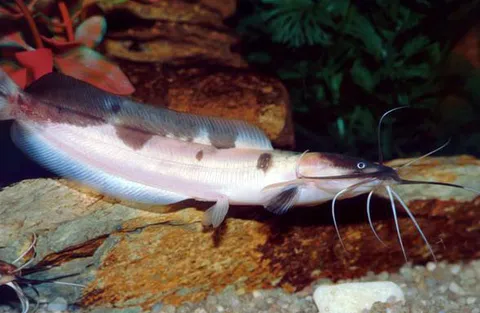
Clarias batrachus
The marbled African sharptooth catfish, also known as the spotted or Angolan walking catfish, bears the scientific name Clarias angolensis and belongs to the family Clariidae. Its name originates from the Latin word…
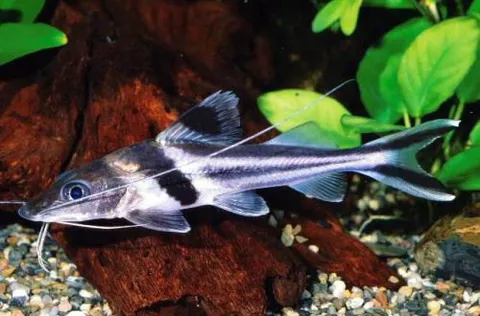
Pimelodus ornatus
The Ornate Pimelodus, also known as the Ornate Catfish (scientific name Pimelodus ornatus), belongs to the family Pimelodidae. This species is one of the most picturesque representatives of catfish, distinguished by its…
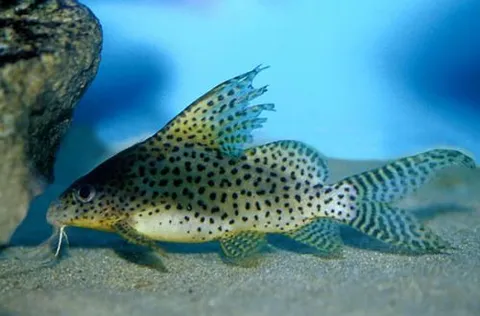
Synodontis eupterus
The Featherfin Synodontis, also known as Synodontis eupterus, belongs to the category of catfish that sometimes adopt an unusual upside-down swimming position. It is important to note that this behavior is not constant,…
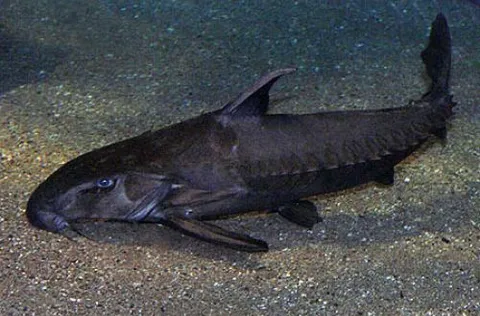
Oxydoras niger
Oxydoras niger, also known as the Black Thorny Catfish or Blue-Eyed Catfish, belongs to the family Doradidae. This fish is a unique “gentle giant”: it is characterized by impressive size and a peaceful disposition.…