Temperature20 – 26 °C
Natural range
- Amazon River Basin
- Bolivia area
- Brazil area
- Colombia area
CatfishConservation status: Least concern LC
Other scientific names: Doras flavopictus, Doras pectinifrons
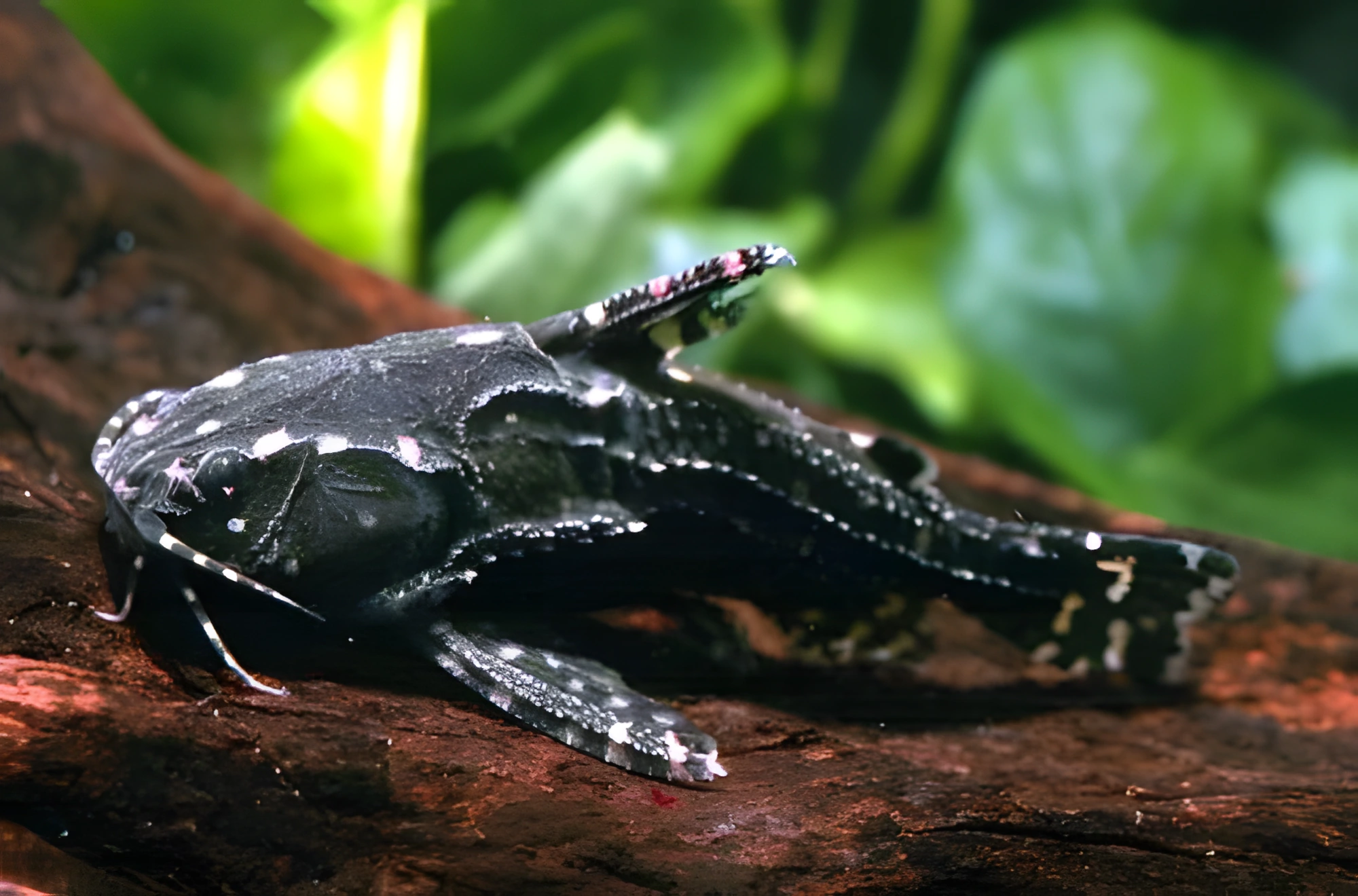
Agamyxis pectinifrons is the scientific name for the Spotted Raphael Catfish, also known as the Spotted Doradid or White-spotted Agamyxis. This member of the Doradidae family earned its other common name, "Talking Catfish," due to its unusual ability to make creaking sounds when removed from the water. In addition to its attractive appearance, this peaceful fish can be quite useful in an aquarium, as it helps clean decorative elements of unwanted buildup.
- Required aquarium volume
- 130 L
- Size in aquarium
- 15 cm
- Temperature
- 20 – 26 °C
- Temperament
- Semi-peaceful (dangerous to smaller ones)
Parameters
Water pHSlightly acidic (5.8) – Neutral (7.5)
Water dHVery soft (2) – Very hard (20)
Water salinityno salt (freshwater)
Size in aquarium15 cm
Lifespan15 years
TemperamentSemi-peaceful (dangerous to smaller ones)
Toward small fishnot a predator
Required aquarium volume130 L
Lightingmoderate (regular)
Substratecoarse sand / gravel / pebbles
Water flowmoderate
FeedingMeat / protein (live, frozen, fresh)
CareSmall group (5–6 individuals)
Description
A distinctive feature of the catfish is its expressive appearance: its body is reliably protected by numerous bony plates, and sharp spines, located even on its fins, save it from predators. The fish's coloration is a dark base with contrasting white speckles, which are often just the tips of these very spines. Although a spine puncture is not venomous, it can be quite painful. Such "armor" dictates special transport conditions: the catfish cannot be transported in ordinary bags; only strong plastic or glass containers are suitable for this purpose. This catfish prefers a sedentary, mostly nocturnal, lifestyle. It spends most of its time at the bottom of the reservoir, hiding among plant thickets, snags, or grottoes. In case of danger, it can quickly burrow into sandy substrate.
Habitat
The Spotted Doradid inhabits the Amazon River basin, covering territories in Bolivia, Brazil, Colombia, and Peru [en.aqua-fish.net]. In nature, it prefers calm, slow-flowing areas of water bodies with a soft silty or sandy bottom, abundant snags, roots, and fallen leaves, which serve as shelters [aquamir-za-steklom.com.ua]. The water in its habitat usually has a temperature of 20–26 °C, a pH of 5.8–7.5, and varying hardness [en.wikipedia.org].
Behavior and Compatibility
Despite being a carnivorous species, the Spotted Doradid can be kept with most fish of similar or slightly smaller size. This catfish prefers to be in a group of its own kind. Thanks to its reliable protection, as mentioned earlier, it can even coexist with some aggressive fish, such as certain cichlid species.
Care and Maintenance
This fish species does not show particular requirements for water chemistry and can tolerate significant fluctuations in hardness. However, the absence of ammonia in the water, which is a product of organic decomposition, is critically important for it. Regular weekly partial water changes (approximately 10% of the total volume) and siphoning the substrate will help maintain optimal conditions. A favorable habitat is also created by a large number of shelters and dense plant thickets in the aquarium decor. It is important to use coarse sand or fine, smooth gravel for the substrate so that the catfish does not injure itself or clog its gills when burrowing into the substrate.
Diet
Since the Spotted Raphael Catfish is a carnivorous species, its diet should primarily consist of protein-rich food. Suitable foods include bloodworms, earthworms, or tubifex worms; this species also readily consumes frozen meat products. Dry commercial foods, such as flakes or pellets, should only be used as a supplementary addition to the main diet. The catfish can pose a danger to aquarium invertebrates, happily eating snails, for example. Feeding is recommended daily, shortly before turning off the aquarium lights.
Breeding and Reproduction
Reliable information on breeding this species in aquarium conditions is unavailable [en.aqua-fish.net]. Existing descriptions of spawning in literature are unconfirmed, so successful home breeding is considered unlikely [en.aqua-fish.net].
Diseases
The Agamyxis catfish is considered a hardy species, but due to its lack of scales and unique body structure, it is sensitive to water quality. The main threats to health are the accumulation of ammonia, nitrites, and nitrates, which occur with poor filtration or an excess of organic waste. If water parameters are not maintained and regular water changes are not performed, fish can suffer from bacterial skin infections, manifesting as ulcers or skin lesions.
Disease prevention involves maintaining stable conditions, using quality filtration, and regular substrate siphoning. It is important to avoid sudden temperature fluctuations and water parameter changes. If treatment is necessary, it should be noted that many fish species are sensitive to certain chemical preparations, so dosage must be chosen carefully. Fin and skin trauma from improper netting during transport can also be an entry point for secondary infections.
How to choose
When purchasing, pay attention to the fish's activity at night and the absence of visible skin damage. It is important to remember that Agamyxis have sharp, serrated spines on their fins, which can easily snag on a net, so plastic containers or glass vessels must be used for transport and transfer [aquamir-za-steklom.com.ua]. A healthy specimen should have clean skin, a robust build, and the species' characteristic bright spotted coloration [en.aqua-fish.net].
Frequently asked questions
The essentials: size, tank volume, water parameters and care
How big does Spotted Raphael Catfish get?
An adult reaches 15 cm in length. Plan the tank around the maximum size: the fish quickly outgrows a cramped setup.
What size aquarium does Spotted Raphael Catfish need?
The minimum recommended volume is 130 L. A smaller tank speeds up nitrate build-up and raises stress levels.
What water parameters does Spotted Raphael Catfish need?
Temperature 20–26 °C, pH 5.8–7.5, hardness 2–20 dGH. Stability matters more than exact values: sudden swings are harder on the fish than a small deviation from the ideal.
How long does Spotted Raphael Catfish live?
Around 15 years when kept properly. Lifespan depends directly on tank volume, water quality and a varied diet.
Is Spotted Raphael Catfish aggressive?
Temperament: semi-peaceful (dangerous to smaller ones). Keep this in mind when choosing tank mates.
How many Spotted Raphael Catfish should be kept together?
Recommended setup: small group (5–6 individuals). Ignoring this is a common cause of stress and disease.
What does Spotted Raphael Catfish eat?
Diet type: meat / protein (live, frozen, fresh). Feed small portions that are finished within a couple of minutes — overfeeding does more harm than underfeeding.
What is the scientific name of Spotted Raphael Catfish?
The scientific name of the species is Agamyxis pectinifrons, family Doradidae (Thorny Catfishes). It also appears in the literature as: Doras flavopictus, Doras pectinifrons.