Temperature22 – 26 °C
Natural range
- Guyana area
- Suriname area
- French Guiana area
- Guiana Shield area
CorydorasConservation status: Least concern LC
Other scientific names: Corydoras wotroi
Corydoras melanistius, also known as the Spotted Corydoras or Black Sail Corydoras, belongs to the family Callichthyidae. These fish are native to northeastern South America, specifically the coastal regions of Guyana, Suriname, and French Guiana. Their natural habitat includes slow-flowing waters, ponds, backwaters, and tributaries of larger rivers. It is important to note that despite inhabiting coastal areas, this species is not adapted to brackish or saltwater.
- Required aquarium volume
- 50 L
- Size in aquarium
- 5 – 6 cm
- Temperature
- 22 – 26 °C
- Temperament
- Peaceful (regular)
Parameters
Water pHSlightly acidic (6) – Neutral (7)
Water dHVery soft (2) – Hard (15)
Water salinityno salt (freshwater)
Size in aquarium5 – 6 cm
Lifespan5 years
TemperamentPeaceful (regular)
Toward small fishnot a predator
Required aquarium volume50 L
Lightingdimmed or moderate
Substratesandy (regular, light)
Water flowweak or moderate
FeedingSinking (any)
CareSmall group (3–4 individuals)
Description
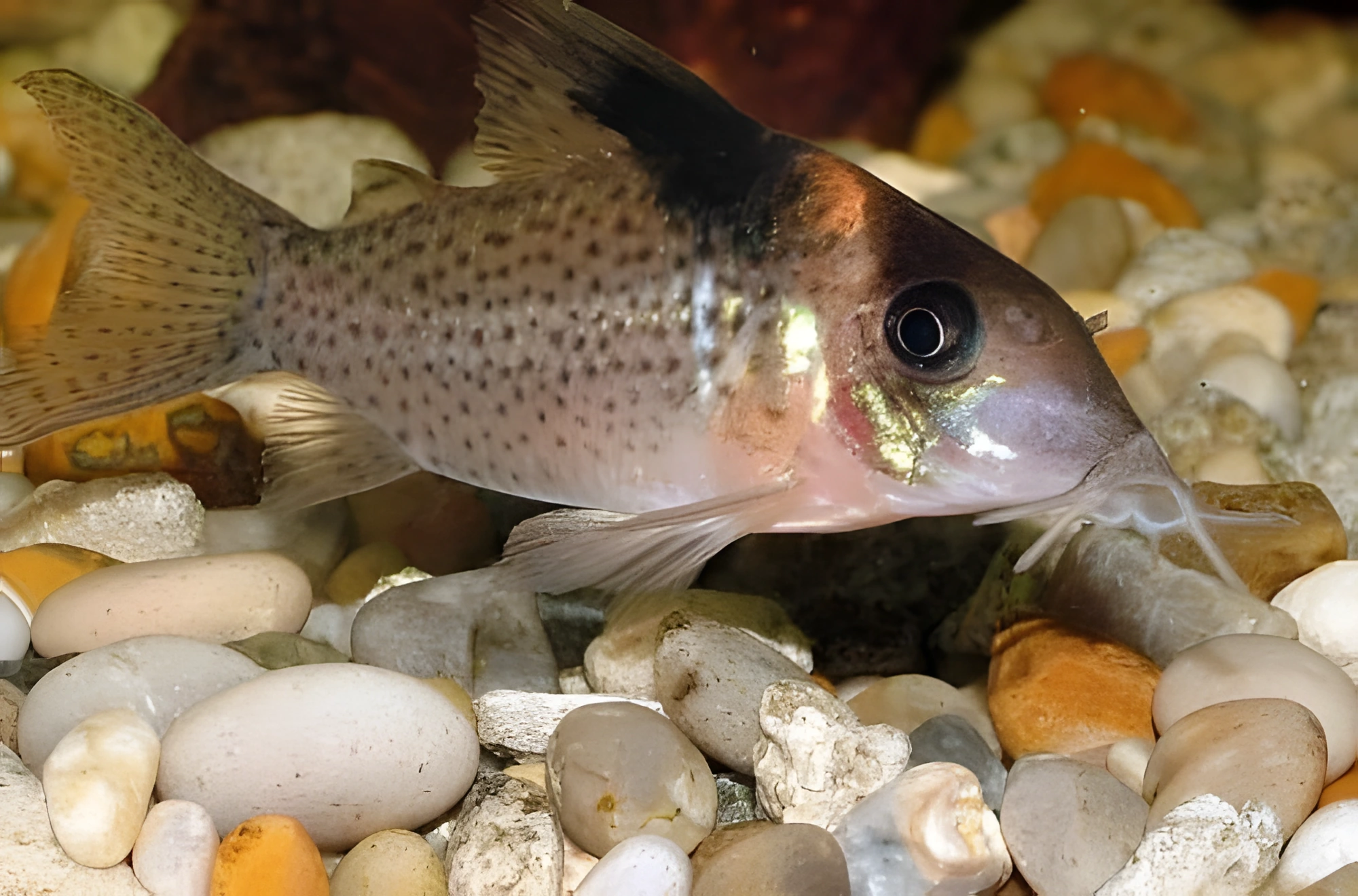
Adult fish of this species can grow up to 6 cm in length. The main body color is silvery, often with a yellowish tint, which can change depending on lighting conditions. The body, as well as the caudal and other fins, are adorned with numerous small dark speckles. A characteristic feature is the broad black stripes on the head and dorsal fin, with the latter being almost entirely dark in color.
Habitat
The species inhabits water bodies in South America: in Guyana, Suriname, and French Guiana. It populates coastal areas of rivers, tributaries, backwaters, and small lakes with slow currents. In nature, it prefers areas with sandy bottoms, with typical water parameters: temperature 22–26 °C, pH 6.0–7.0, general hardness 2–15 dGH.
Behavior and Compatibility
A peaceful, schooling fish that is active during the day. It is recommended to keep them in groups of 6–8 individuals, as solitary keeping leads to stress and increased susceptibility to diseases. Compatible with most non-aggressive fish species that inhabit other water layers.
Care and Maintenance
For a group of 6–8 individuals, an aquarium of at least 100 L is required, with a soft sandy substrate to prevent injury to their sensitive barbels. It is important to provide hiding places in the form of driftwood or rocks. Effective filtration, aeration, and weekly water changes of 20–30% of the volume are necessary. Lighting should be moderate or subdued.
Diet
An omnivorous species. In the aquarium, it accepts all types of quality sinking foods: specialized dry granules, tablets for bottom feeders, and frozen foods. The diet should be varied to avoid nutrient deficiencies.
Breeding and Reproduction
Spawning is paired or in groups, occurring on a prepared substrate. The female lays eggs, which she then carries between her pelvic fins to attach to plants or glass. Fry begin to swim freely after a few days and require feeding with small live foods, such as Artemia nauplii.
Diseases
Fish are prone to bacterial infections with poor water quality and high organic content. Main symptoms include fin rot, body ulcers, or cloudy eyes. Prevention involves maintaining substrate cleanliness, regular water changes, and avoiding overpopulation.
How to choose
When purchasing, choose active individuals with clean fins, without visible ulcers, film, or skin damage. It is important to ensure the integrity of the barbels, as their absence indicates improper keeping conditions. A healthy fish should show interest in searching for food on the bottom.
Frequently asked questions
The essentials: size, tank volume, water parameters and care
How big does Spotted Corydoras get?
An adult reaches 5–6 cm in length. Plan the tank around the maximum size: the fish quickly outgrows a cramped setup.
What size aquarium does Spotted Corydoras need?
The minimum recommended volume is 50 L. A smaller tank speeds up nitrate build-up and raises stress levels.
What water parameters does Spotted Corydoras need?
Temperature 22–26 °C, pH 6–7, hardness 2–15 dGH. Stability matters more than exact values: sudden swings are harder on the fish than a small deviation from the ideal.
How long does Spotted Corydoras live?
Around 5 years when kept properly. Lifespan depends directly on tank volume, water quality and a varied diet.
Is Spotted Corydoras aggressive?
Temperament: peaceful (regular). Keep this in mind when choosing tank mates.
How many Spotted Corydoras should be kept together?
Recommended setup: small group (3–4 individuals). Ignoring this is a common cause of stress and disease.
What does Spotted Corydoras eat?
Diet type: sinking (any). Feed small portions that are finished within a couple of minutes — overfeeding does more harm than underfeeding.
What is the scientific name of Spotted Corydoras?
The scientific name of the species is Corydoras melanistius, family Callichthyidae. It also appears in the literature as: Corydoras wotroi.