Temperature26 – 32 °C
Natural range
- Venezuela area
CichlidsConservation status: Least concern LC
Geophagus abalios, also known as the Spotted Geophagus, belongs to the Cichlidae family. It is rarely found under its true name in retail outlets; more often, it is mistakenly offered as the Surinam Geophagus. This species is easy to keep and coexists well with many other fish. Perhaps the only difficulty in keeping it might be the need for a rather large aquarium.
- Required aquarium volume
- 600 L
- Size in aquarium
- 20 cm
- Temperature
- 26 – 32 °C
- Temperament
- Peaceful (regular)
Parameters
Water pHAcidic (4) – Neutral (7)
Water dHVery soft (1) – Medium hardness (10)
Water salinityno salt (freshwater)
Size in aquarium20 cm
Lifespan9 years
TemperamentPeaceful (regular)
Toward small fishnot a predator
Required aquarium volume600 L
Lightingdimmed
Substratesandy (regular, light)
Water flowweak
FeedingSinking (any)
CareMedium group (6–8 individuals)
Description
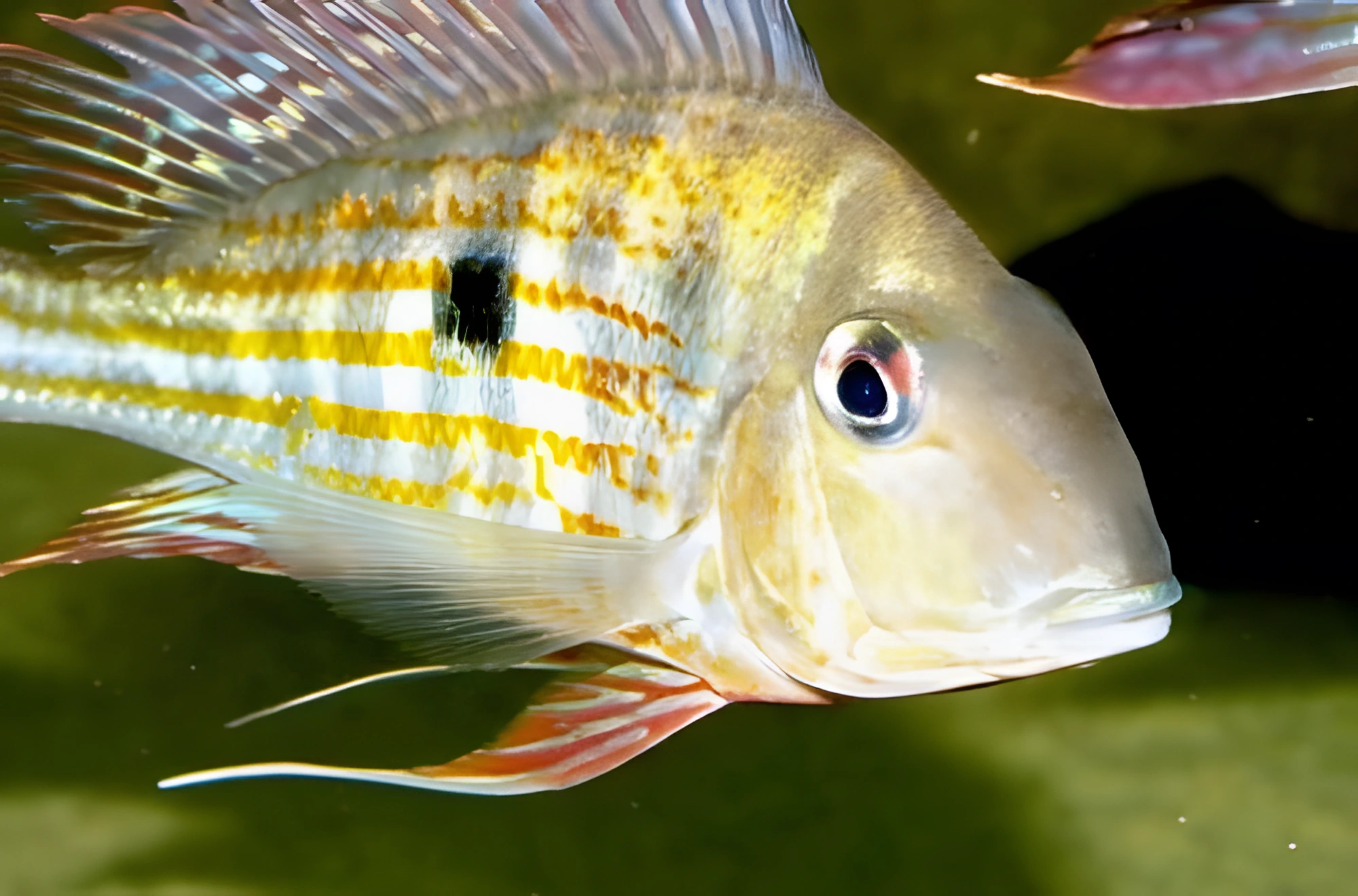
Adult specimens reach a length of 20 cm and can even be larger. Sexual dimorphism is weakly expressed, so males and females are almost impossible to distinguish by external signs. The coloration of the fish can vary from yellow to pale green hues, depending on their region of origin. Golden horizontal stripes run across the body, and a prominent dark spot is located in the central part. The fins and tail have a reddish tint with turquoise specks.
Habitat
The natural habitat of this species is in South America, specifically in Venezuela, in the Orinoco River basin. The fish inhabit floodplain lakes and sections of rivers with slow currents or backwaters. They can be found in areas with sandy bottoms, where rocks, snags, and various plant detritus are also present. The inhabited bodies of water are characterized by changing conditions due to the alternation of wet and dry seasons.
Behavior and Compatibility
Except during spawning periods, this fish has a peaceful and calm disposition. During breeding, Geophagus become intolerant of other aquarium inhabitants, striving to protect their offspring. Otherwise, they coexist perfectly with other non-aggressive freshwater species. Intraspecific relationships are based on a hierarchy, where alpha males dominate. It is recommended to keep a group of at least 5–8 individuals, as with fewer numbers, weaker fish may be subjected to aggression from stronger and larger relatives.
Care and Maintenance
The optimal aquarium volume for a group of 5–8 fish starts from 600 liters. The decor can be anything, at the discretion of the aquarist, but a sandy substrate is an essential element of the design. It is important to avoid small pebbles in the substrate, as they can get stuck in the fish's mouth. Although the Spotted Geophagus is not very demanding on its environment, it will be more comfortable and aesthetically pleasing in an aquarium that mimics its natural environment. Experienced aquarists often add leaves from certain trees, which is characteristic of the natural environment of these fish. Leaves do not so much decorate the aquarium as they contribute to the creation of a special chemical composition of the water due to the release of tannins during decomposition. However, it is not recommended for beginner aquarists and hobbyists to use leaves. During feeding, the fish can create suspended matter from decomposing material, which not only looks unaesthetic but can also clog the filtration system. For successful and long-term keeping, it is necessary to maintain stable water parameters. These fish are sensitive to the accumulation of organic waste. It is important to avoid sharp fluctuations in temperature, pH, and dGH, as well as dangerous concentrations of nitrogen cycle products. For this, the aquarium should be equipped with effective filters and regularly serviced, including weekly partial water changes with fresh water, timely removal of waste (food remnants, excrement), and equipment maintenance.
Diet
These fish forage for food in the bottom layers, sifting the substrate with their mouths in search of small invertebrates. Thus, the presence of a sandy substrate plays an important role in their diet. It is recommended to feed them sinking dry foods, such as flakes and pellets, in combination with artemia, daphnia, and pieces of bloodworms.
Breeding and Reproduction
Under favorable conditions, including a balanced diet and high water quality, spawning occurs quite frequently. At the beginning of the breeding season, the alpha male forms a temporary pair with a female, occupying a specific area on the bottom of the aquarium. After a short courtship, spawning occurs. The female lays up to 200 eggs on a flat surface, such as a stone, and then collects them into her mouth, where they, and then the hatched fry, will spend several weeks. The fry will periodically leave their "shelter" to feed, and each time their free-swimming period will increase until they become completely independent. In some cases, the male also participates in caring for the offspring, sharing the mouthbrooding with the female. However, often immediately after the appearance of the young, he begins to court another female.
Diseases
The main cause of diseases often lies in the keeping conditions: if they go beyond acceptable limits, immunity decreases, making the fish vulnerable to various infections inevitably present in the environment. At the first suspicion of illness, it is important first of all to check the water parameters and ensure there are no dangerous concentrations of nitrogen cycle products. Often, restoring normal, suitable conditions promotes recovery. However, in some cases, medication may be required. Detailed information on symptoms and treatment methods is presented in the "Aquarium Fish Diseases" section.
How to choose
When choosing a Spotted Geophagus, attention should be paid to the overall activity of the fish and the condition of its skin. Healthy individuals should show curiosity, actively move along the bottom, and have no visible damage, sores, or film on their scales. It is important to avoid buying fish with severely sunken bellies, which may indicate chronic emaciation or parasitic diseases.
Since the species is often supplied under incorrect names, it is recommended to clarify the origin of the batch with the seller. In the store, the fish should be kept in spacious tanks with clean water, as they are sensitive to water quality. When inspecting, pay attention to the following signs:
- absence of signs of ruffled scales or an unnaturally bloated abdomen
- clean fins without signs of rot or white spots
- normal breathing without rapid gill movements
Frequently asked questions
The essentials: size, tank volume, water parameters and care
How big does Spotted Geophagus get?
An adult reaches 20 cm in length. Plan the tank around the maximum size: the fish quickly outgrows a cramped setup.
What size aquarium does Spotted Geophagus need?
The minimum recommended volume is 600 L. A smaller tank speeds up nitrate build-up and raises stress levels.
What water parameters does Spotted Geophagus need?
Temperature 26–32 °C, pH 4–7, hardness 1–10 dGH. Stability matters more than exact values: sudden swings are harder on the fish than a small deviation from the ideal.
How long does Spotted Geophagus live?
Around 9 years when kept properly. Lifespan depends directly on tank volume, water quality and a varied diet.
Is Spotted Geophagus aggressive?
Temperament: peaceful (regular). Keep this in mind when choosing tank mates.
How many Spotted Geophagus should be kept together?
Recommended setup: medium group (6–8 individuals). Ignoring this is a common cause of stress and disease.
What does Spotted Geophagus eat?
Diet type: sinking (any). Feed small portions that are finished within a couple of minutes — overfeeding does more harm than underfeeding.
What is the scientific name of Spotted Geophagus?
The scientific name of the species is Geophagus abalios, family Cichlids (Cichlidae).