Temperature21 – 28 °C
Natural range
- Northern Australia area
- Southern New Guinea area
RainbowfishConservation status: Least concern LC
Pseudomugil gertrudae, also known as the Spotted Blue-eye, belongs to the family Pseudomugilidae. This species was named in honor of Gertrude, the wife of Dr. Hugo Merton, a German naturalist who first discovered it in 1907 during his research in eastern Indonesia. This fish is undemanding to keep and causes no trouble, and its small size allows it to be kept even in nano-aquariums.
- Required aquarium volume
- 40 L
- Size in aquarium
- 4 cm
- Temperature
- 21 – 28 °C
- Temperament
- Peaceful (regular)
Parameters
Water pHAcidic (4.5) – Neutral (7.5)
Water dHSoft (5) – Hard (12)
Water salinityno salt (freshwater)
Size in aquarium4 cm
Lifespan2 years
TemperamentPeaceful (regular)
Toward small fishnot a predator
Required aquarium volume40 L
Lightingweak or moderate
Substrateany (no restrictions)
Water flownone or stagnant (no flow)
FeedingHigh protein (predominantly meat)
CareGroup (8–10 individuals)
Description
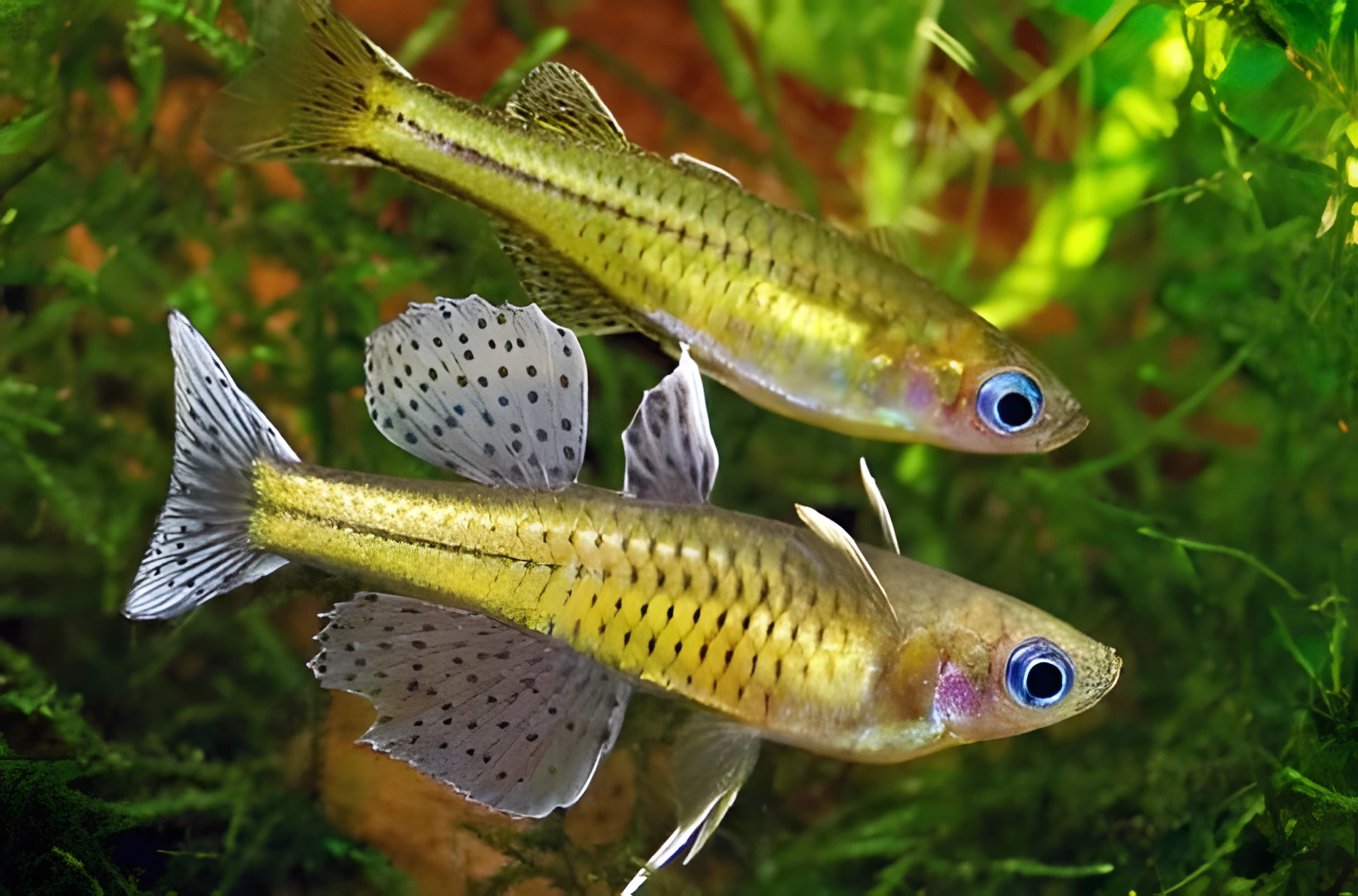
Adults of this fish reach a length of approximately 4 cm. Their coloration is predominantly yellow, and their translucent fins have a whitish tint and are adorned with black speckles. One of their most striking features is their bright blue eyes, which gave the fish its second name. Sexual dimorphism is not very pronounced: males are generally slightly larger and their coloration is more intense than that of females.
Habitat
The natural habitat of these fish covers northern Australia, the southern regions of New Guinea, as well as numerous islands located in the Arafura and Timor Seas. They prefer to live in shallow, slow-flowing rivers, swamps, and lakes. Spotted Blue-eyes have a particular fondness for areas with abundant aquatic vegetation and plenty of driftwood. Often, the water in these biotopes has a brownish tint due to the saturation of organic matter.
Behavior and Compatibility
These fish are distinguished by their calm and peaceful nature. They get along well with other species of similar size and temperament. It is recommended to keep them in shoals of at least 8–10 individuals of both sexes. It is believed that the best results in keeping them are achieved in a species-specific aquarium, where the only neighbors are small freshwater shrimp.
Care and Maintenance
For comfortable keeping of a shoal of 8–10 Spotted Blue-eyes, an aquarium of at least 40 liters is required. For decoration, it is recommended to use dense groups of plants, while leaving open areas for swimming. The presence of additional shelters, for example, in the form of driftwood, will be very useful. The choice of substrate depends on the needs of the plants. It is important to note that these fish do not like bright light and strong currents, so the lighting and filtration system should be chosen with these features in mind. Water parameters for Pseudomugil gertrudae should be slightly acidic in pH and have low hardness. To maintain stable water quality, it is necessary to change 15–20% of the volume weekly and ensure an effective filtration system.
Diet
Any appropriately sized food, whether dry, frozen, or live, fits well into the diet of Spotted Blue-eyes. However, preference should be given to live foods such as daphnia, artemia, or small bloodworms.
Breeding and Reproduction
Breeding the Spotted Blue-eye does not present any particular difficulties and does not require special preparations, as spawning can occur year-round. Spawning behavior can be triggered by raising the water temperature to the upper limits of the acceptable range (26–28°C). Females attach their eggs among dense plant thickets. Fine-leaved and low-growing species, such as Java moss, or special artificial spawning substrates, are excellent for this purpose. The dominant male typically fertilizes several clutches of eggs from different females. It is important to note that these fish lack parental instincts and may eat their own eggs immediately after spawning. To preserve the offspring, fertilized eggs should be promptly transferred to a separate incubator, where the water parameters will be identical to the main aquarium. The fry will remain there until they reach a sufficiently large size, which usually takes about six months. The incubator is equipped with the same equipment as the main aquarium, with the exception of the filtration system. It is preferable to use a simple air-driven sponge filter, which will provide sufficient water purification and prevent accidental suction of the fry. The incubation period lasts approximately 10 days; the duration depends on the temperature. In the first days after hatching, the fry will need micro-food, such as infusoria. After about a week, they can begin to be fed artemia nauplii.
Diseases
Health problems in these fish arise only in the presence of injuries or keeping in unsuitable conditions, which leads to a weakening of the immune system and the subsequent occurrence of various diseases. At the first signs of illness, it is necessary first to check the water parameters for exceeding permissible values or the presence of toxic substances (such as nitrites, nitrates, ammonia). If deviations are found, all indicators should be normalized, and then treatment should begin. More detailed information on symptoms and treatment methods is available in the "Diseases of Aquarium Fish" section.
How to choose
When selecting individuals, attention should be paid to their activity and the integrity of their fins, which should be spread out in healthy fish. Avoid specimens with signs of emaciation, damaged scales, or body film. It is important to assess the behavior of the shoal in the store: healthy fish show curiosity, swim actively, and demonstrate species-specific interactions, rather than hiding in corners or near the surface. Since the species is sensitive to sudden changes in conditions, it is recommended to ask the seller about the water parameters in which the fish are kept to minimize stress during adaptation to a new aquarium.
Frequently asked questions
The essentials: size, tank volume, water parameters and care
How big does Spotted Blue-eye get?
An adult reaches 4 cm in length. Plan the tank around the maximum size: the fish quickly outgrows a cramped setup.
What size aquarium does Spotted Blue-eye need?
The minimum recommended volume is 40 L. A smaller tank speeds up nitrate build-up and raises stress levels.
What water parameters does Spotted Blue-eye need?
Temperature 21–28 °C, pH 4.5–7.5, hardness 5–12 dGH. Stability matters more than exact values: sudden swings are harder on the fish than a small deviation from the ideal.
How long does Spotted Blue-eye live?
Around 2 years when kept properly. Lifespan depends directly on tank volume, water quality and a varied diet.
Is Spotted Blue-eye aggressive?
Temperament: peaceful (regular). Keep this in mind when choosing tank mates.
How many Spotted Blue-eye should be kept together?
Recommended setup: group (8–10 individuals). Ignoring this is a common cause of stress and disease.
What does Spotted Blue-eye eat?
Diet type: high protein (predominantly meat). Feed small portions that are finished within a couple of minutes — overfeeding does more harm than underfeeding.
What is the scientific name of Spotted Blue-eye?
The scientific name of the species is Pseudomugil gertrudae, family Pseudomugilidae.