Temperature24 – 28 °C
Natural range
- Congo River Basin
- Republic of the Congo area
- Democratic Republic of the Congo area
- Central African Republic area
Predators Labyrinth fishConservation status: Least concern LC
Other scientific names: Anabas oxyrhynchus, Anabas weeksii, Ctenopoma oxyhynchus, Ctenopoma oxyrhynchus
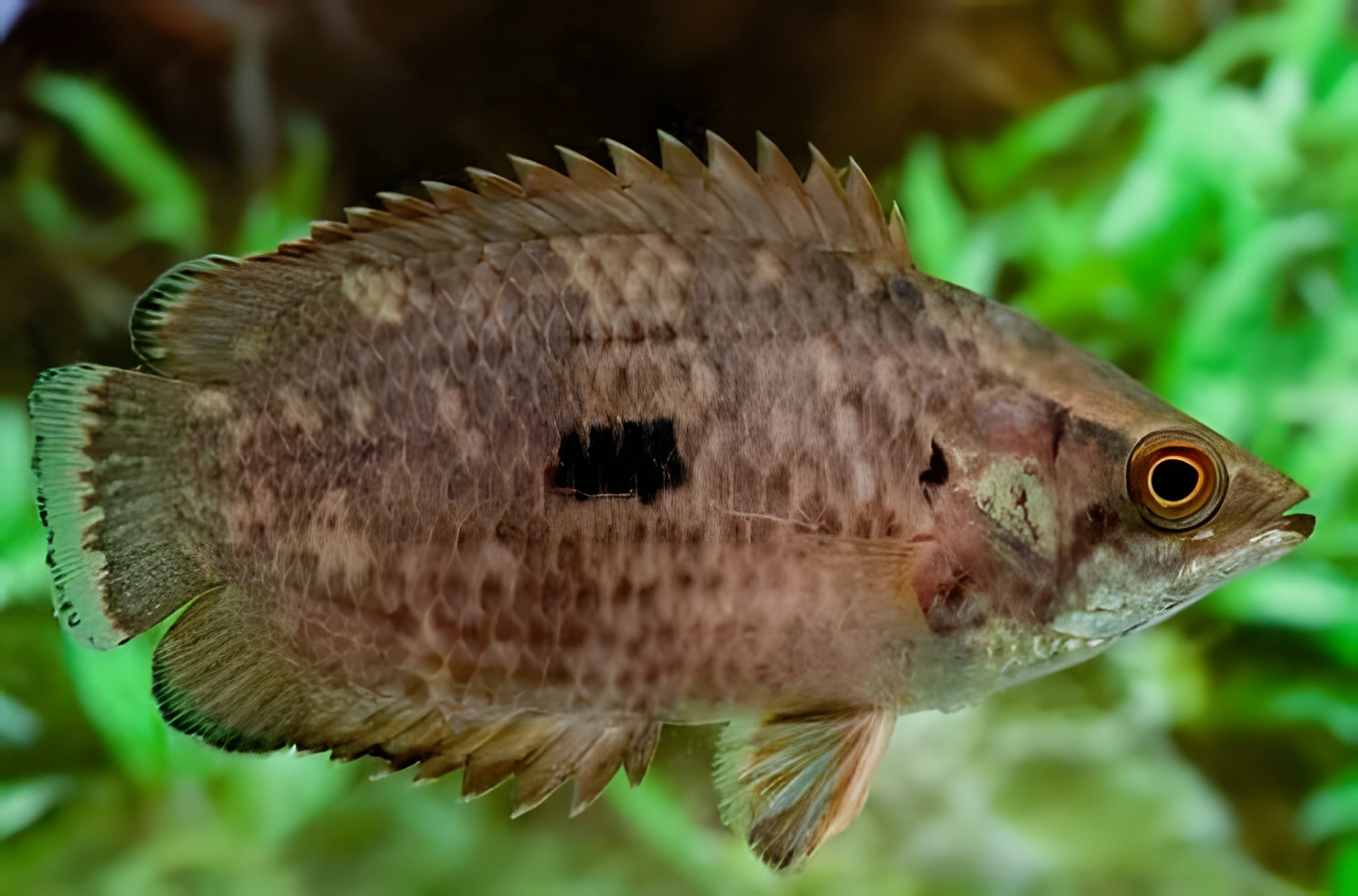
Ctenopoma weeksii, or the Spotted Ctenopoma, belongs to the suborder Labyrinth fish and is a member of the family Anabantidae (Climbing Perches). This fish originates from Africa, where it inhabits the Congo River basin, in territories belonging to the Republic of the Congo and the Democratic Republic of the Congo. Its natural habitat includes river backwaters, lakes, lagoons, and swamps—that is, bodies of water with still or very slow-moving currents. These fish are most often found in coastal areas, among dense thickets of aquatic vegetation.
- Required aquarium volume
- 70 L
- Size in aquarium
- 12 cm
- Temperature
- 24 – 28 °C
- Temperament
- Semi-peaceful (including aggression during spawning / intraspecific conflicts)
Parameters
Water pHSlightly acidic (6.2) – Neutral (7.2)
Water dHSoft (5) – Hard (15)
Water salinityno salt (freshwater)
Size in aquarium12 cm
Lifespan15 years
TemperamentSemi-peaceful (including aggression during spawning / intraspecific conflicts)
Toward small fishpredator
Required aquarium volume70 L
Lightingdimmed
Substrateany, but dark
Water flownone or stagnant (no flow)
FeedingHigh protein (predominantly meat)
CareMixed (solitary / pair / group)
Description
Adults can reach approximately 12 cm in length. Distinctive features of the fish include a laterally compressed body and a large head. The dorsal and anal fins are shifted towards the caudal part. The coloration is usually gray with dark pigmentation spots or brownish, and two expressive black spots are located on the sides of the body. Due to inhabiting waters where oxygen content is extremely low, this group of fish has developed the ability to breathe atmospheric air. They periodically rise to the surface to gulp a bubble of air, and then a special organ located in the gill area extracts oxygen from it. This organ, permeated by a dense network of capillaries, has a structure resembling a complex labyrinth. It is this unique adaptation that gave the name to the entire order—Labyrinth fish.
Habitat
The species inhabits the Congo River basin in the Republic of the Congo, the Democratic Republic of the Congo, and the Central African Republic. In nature, it lives in slow-moving or stagnant waters, including swamps, lagoons, and river sections with dense riparian vegetation. It prefers biotopes with abundant shelters and is often found in conditions of low oxygen concentration in the water.
Behavior and Compatibility
This fish is characterized by a calm, non-aggressive disposition. However, being a predator by nature, the Spotted Ctenopoma perceives any small fish as potential food. Its hunting method is similar to that of the Leaf Fish: the ctenopoma freezes motionless among dense algae, slowly swaying like a fallen leaf, and then instantly attacks prey swimming by. In an aquarium environment, it selects a specific territory that it considers its hunting grounds, which should be taken into account when choosing tank mates. If several ctenopomas are introduced simultaneously, they will distribute themselves throughout the aquarium, each occupying its own area. However, if fish are introduced gradually, territorial conflicts may arise, as the first established individual will perceive newcomers as intruders. In general, Spotted Ctenopomas are well compatible with other fish species of comparable size. These include, for example, schools of Congo Tetras or Golden Congo Tetras, various types of Barbs, Synodontis catfish, as well as exotic fish such as Polypterus or African Butterflyfish.
Care and Maintenance
For keeping a single Spotted Ctenopoma, an aquarium of at least 70 L is required. The aquarium decor should include an abundance of aquatic vegetation, as well as driftwood, branches, and natural elements such as leaves and tree bark. Lighting should be subdued, so shade-loving plant species are preferred. The substrate should be dark and slightly silty. It is important to remember that these fish are capable of jumping, so the aquarium must be covered with a lid or other protective measures should be provided. The species is considered hardy and quite undemanding. Living in tropical swamps has developed their adaptation to oxygen deficiency and high concentrations of decaying plant matter. Nevertheless, regular aquarium maintenance remains a mandatory condition. It is important to perform weekly partial water changes, promptly remove uneaten food, clean the substrate, and carry out equipment maintenance. Ctenopomas prefer live foods. However, they can be accustomed to alternative options: freeze-dried, fresh, or frozen bloodworms, pieces of mussels, shrimp, earthworms, and others. Dry foods are generally not accepted by them. Sources: fishbase.se, seriouslyfish.com
Diet
Feeding these fish is preferably done with live foods. Nevertheless, Spotted Ctenopomas can be successfully accustomed to various alternative products. The list of such foods includes freeze-dried, fresh, or frozen bloodworms, small pieces of mussels and shrimp, as well as earthworms. It is important to note that dry foods are generally not accepted by them.
Breeding and Reproduction
These fish are egg-laying species that do not build bubble nests. Spawning occurs in the water column, after which the eggs rise to the surface and accumulate among floating plants. The parents do not care for their offspring and may eat the eggs, so adult fish are recommended to be removed immediately after spawning. Fry become free-swimming after a few days and require fine starter food, such as infusoria, with a subsequent transition to Artemia nauplii.
Diseases
No specific diseases unique to this species have been identified. The fish are susceptible to common aquarium infections, including ich (Ichthyophthirius multifiliis) and bacterial skin or fin lesions, often arising from poor water parameters or stress. Essential conditions for maintaining health include clean water, regular aeration, and access to the surface for breathing atmospheric air through their labyrinth organ.
How to choose
When purchasing, choose active individuals with clean skin without visible spots, sores, or film on the fins. It is important to ensure there are no signs of emaciation and that the fish shows interest in food. Since the species is predatory, consider the risk of acquiring individuals with damaged fins due to intraspecific aggression when kept in overcrowded retail tanks.
Frequently asked questions
The essentials: size, tank volume, water parameters and care
How big does Spotted Ctenopoma get?
An adult reaches 12 cm in length. Plan the tank around the maximum size: the fish quickly outgrows a cramped setup.
What size aquarium does Spotted Ctenopoma need?
The minimum recommended volume is 70 L. A smaller tank speeds up nitrate build-up and raises stress levels.
What water parameters does Spotted Ctenopoma need?
Temperature 24–28 °C, pH 6.2–7.2, hardness 5–15 dGH. Stability matters more than exact values: sudden swings are harder on the fish than a small deviation from the ideal.
How long does Spotted Ctenopoma live?
Around 15 years when kept properly. Lifespan depends directly on tank volume, water quality and a varied diet.
Is Spotted Ctenopoma aggressive?
Temperament: semi-peaceful (including aggression during spawning / intraspecific conflicts). This is a predatory species — any fish small enough to fit in its mouth will eventually be eaten.
How many Spotted Ctenopoma should be kept together?
Recommended setup: mixed (solitary / pair / group). Ignoring this is a common cause of stress and disease.
What does Spotted Ctenopoma eat?
Diet type: high protein (predominantly meat). Feed small portions that are finished within a couple of minutes — overfeeding does more harm than underfeeding.
What is the scientific name of Spotted Ctenopoma?
The scientific name of the species is Ctenopoma weeksii, family Anabantidae (Climbing Perches). It also appears in the literature as: Anabas oxyrhynchus, Anabas weeksii, Ctenopoma oxyhynchus.