Temperature21 – 26 °C
Natural range
- Borneo area
- Malaysia area
CyprinidsConservation status: Least concern LC
Other scientific names: Barbus pentazona, Capoeta pentazona, Puntius pentazona, Systomus pentazona
The Five-banded Barb, scientifically known as Desmopuntius pentazona, belongs to the carp family (Cyprinidae). This active and attractive fish is not overly demanding to keep, provided the aquarium is set up according to its needs and water parameters are within optimal limits. Specimens offered for sale are usually bred in commercial aquarium farms, where they adapt well to new environments.
- Required aquarium volume
- 80 L
- Size in aquarium
- 5 cm
- Temperature
- 21 – 26 °C
- Temperament
- Peaceful, calm/shy/inactive
Parameters
Water pHAcidic (4) – Neutral (7)
Water dHVery soft (1) – Soft (5)
Water salinityno salt (freshwater)
Size in aquarium5 cm
Lifespan6 years
TemperamentPeaceful, calm/shy/inactive
Toward small fishnot a predator
Required aquarium volume80 L
Lightingdimmed
Substratesoft silted
Water flownone or stagnant (no flow)
FeedingAny (universal)
CareLarge group (10+ individuals)
Description
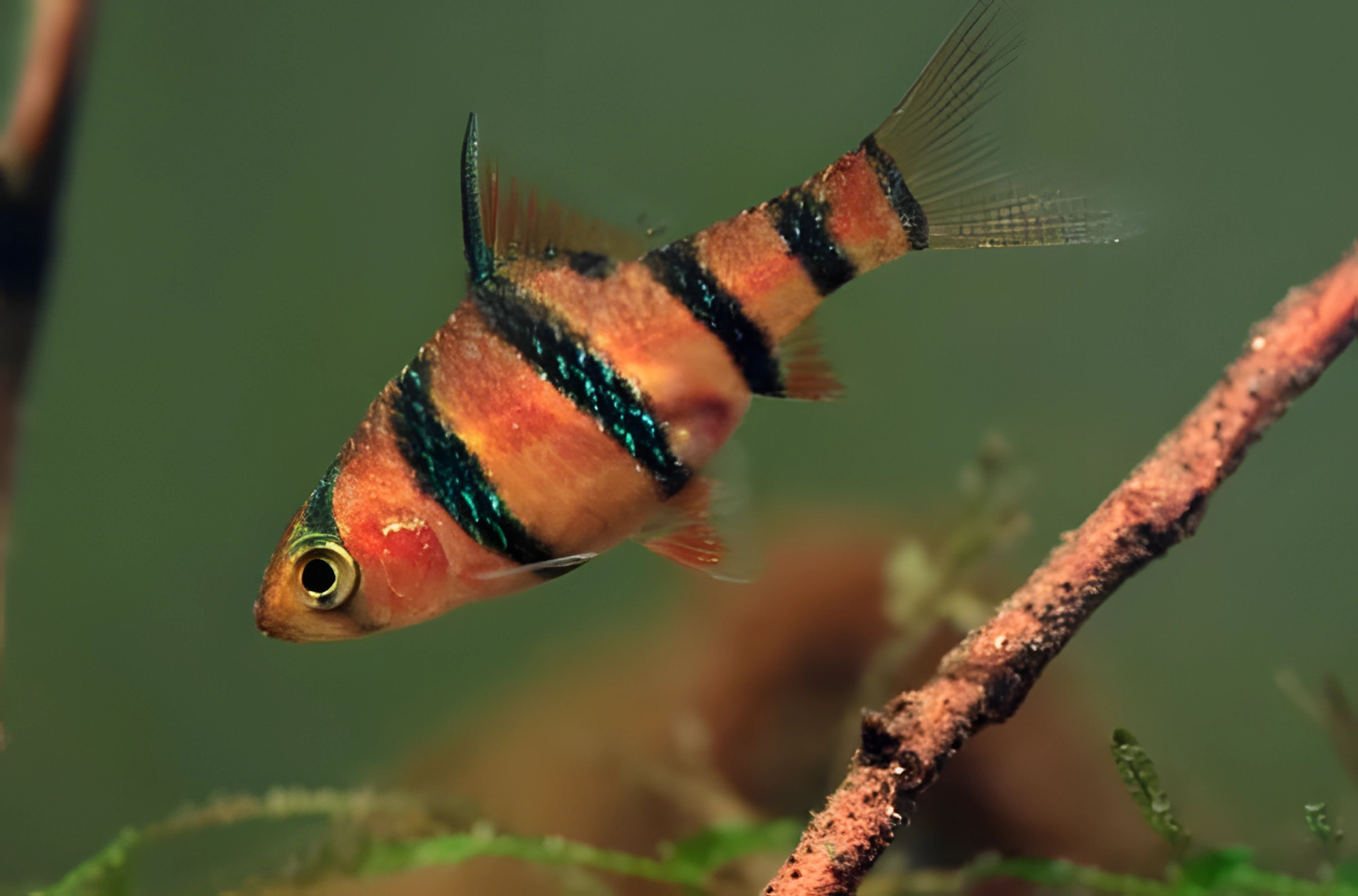
Adults reach approximately 5 cm in length. Females are noticeably somewhat larger, while males are distinguished by a more slender and elegant physique, as well as more vibrant coloration. Their primary color is coppery-red, with five dark vertical bands on the body. The first band passes through the eye, and the last is located near the base of the caudal fin. It is worth noting that there is a closely related species, the Six-banded Barb, whose body pattern is almost identical with a slight difference.
Habitat
The natural habitat of this species is the island of Borneo in Southeast Asia, including territories of modern Malaysia. They prefer peat swamps, as well as streams and rivers that flow into or out of them. A characteristic feature of their habitat is abundant aquatic and riparian vegetation, and the water has a rich tea-like hue due to the high concentration of humic acids and other organic compounds resulting from plant decomposition. The bottom of these bodies of water is often covered with fallen leaves, branches, and submerged tree roots.
Behavior and Compatibility
This fish is distinguished by its peaceful and relatively calm disposition. It prefers to be kept in schools; a group of 8–10 individuals helps Five-banded Barbs feel less timid, and males display brighter coloration when competing for the attention of females. They get along well with most fish species of similar size and temperament, but it is advisable to avoid cohabitation with boisterous or overly active species that might disturb them.
Care and Maintenance
For a comfortable existence of a shoal of Five-banded Barbs, an aquarium of at least 80 liters will be required, which will mimic the conditions and decor of their natural environment. The decor includes a peat substrate, abundant aquatic vegetation, including floating species, as well as numerous shelters made of snags, branches, or tree roots. Pre-dried and then soaked leaves (so they sink) can be placed on the bottom, which, as they decompose, will give the water a natural tea tint. The same effect can be achieved by placing a fabric bag with prepared peat in the aquarium, which is purchased exclusively in specialized pet stores. Detailed information on aquarium decoration can be found in the article “How to create a biotope of Southeast Asian river systems.” The standard set of aquarium equipment includes a filtration system, a heater, an aerator, and low-power lighting fixtures. Peat fillers are preferred as filter material. It is important to maintain a slightly acidic pH value with a low concentration of dissolved calcium and magnesium salts (dGH parameter) and the absence of strong internal current. Aquarium care includes weekly water changes of approximately 10% of the volume with fresh water, as well as regular cleaning of the substrate from organic residues and the walls from plaque.
Diet
These fish readily accept all types of dry, frozen, and live foods of appropriate size. A varied diet is especially important as it enhances their natural coloration. It is recommended to feed them 2–3 times a day, offering an amount of food that will be eaten within five minutes. It is necessary to promptly remove food remnants to avoid excessive pollution of the aquarium water.
Breeding and Reproduction
This species is an egg-layer: females scatter eggs in the water column, which are immediately fertilized by males. Their parental instincts are weakly expressed, so immediately after spawning, the fish may eat their own eggs and hatched fry. For successful breeding, it is recommended to use a separate spawning aquarium to ensure the safety of the offspring. The decor of such an aquarium is quite simple; special attention is paid to the substrate, which should consist of sufficiently large particles forming many voids, such as pebbles or decorative glass beads. When the eggs sink to the bottom, most of them fall into these voids, becoming inaccessible to adult fish. A similar effect is also achieved by using a fine mesh net fixed to the bottom. Another way to preserve the eggs is dense planting of low-growing, small-leaved plants or mosses, such as Riccia fluitans or Java moss, which cover most of the substrate (in this case, the substrate can be any). Dense thickets of plants serve as reliable shelter for the eggs no worse than a special substrate. The spawning aquarium usually has a volume of 20–30 liters. Equipment used includes an aerator, a heater, and a simple low-power sponge filter to prevent accidental suction of eggs and fry. Spawning occurs in dim lighting, so no light source is required at the beginning. The breeding period begins when the females become noticeably rounded and the males actively show attention to them. By this time, a separate tank should be prepared, filled with water from the main aquarium, then several females and the brightest males should be transferred there. The end of spawning is easily determined by the females – they become slender. After this, the fish are returned. Fry appear after 24–48 hours, and after another 3–4 days, they begin to swim freely. Young fish should be fed specialized microscopic food.
Diseases
Balanced nutrition and properly selected keeping conditions are the best prevention of diseases in freshwater fish. If the first signs of illness appear, such as changes in coloration or behavior, the first step should be to check the water parameters and quality. If necessary, all values should be brought back to normal, and only then should treatment begin. More detailed information on symptoms and treatment methods can be found in the "Diseases of Aquarium Fish" section.
How to choose
When choosing a Five-banded Barb, it is important to ensure that you are acquiring Desmopuntius pentazona and not a similar species, such as the Six-banded Barb. A key distinguishing feature is the presence of a small dark spot at the base of the posterior part of the dorsal fin, which is absent in related species. Carefully inspect the fish for any fin damage, ulcers, or white film on the scales, as these signs indicate stress or infectious diseases.
Healthy individuals should be active, curious, and stay in a tight shoal in the water column. Avoid purchasing fish that appear apathetic, stay alone at the bottom or surface, show signs of emaciation, or have an unnaturally bloated abdomen. It is advisable to purchase a group of 6–10 individuals at once, as this reduces stress during transportation and adaptation to a new aquarium.
Frequently asked questions
The essentials: size, tank volume, water parameters and care
How big does Five-banded Barb get?
An adult reaches 5 cm in length. Plan the tank around the maximum size: the fish quickly outgrows a cramped setup.
What size aquarium does Five-banded Barb need?
The minimum recommended volume is 80 L. A smaller tank speeds up nitrate build-up and raises stress levels.
What water parameters does Five-banded Barb need?
Temperature 21–26 °C, pH 4–7, hardness 1–5 dGH. Stability matters more than exact values: sudden swings are harder on the fish than a small deviation from the ideal.
How long does Five-banded Barb live?
Around 6 years when kept properly. Lifespan depends directly on tank volume, water quality and a varied diet.
Is Five-banded Barb aggressive?
Temperament: peaceful, calm/shy/inactive. Keep this in mind when choosing tank mates.
How many Five-banded Barb should be kept together?
Recommended setup: large group (10+ individuals). Ignoring this is a common cause of stress and disease.
What does Five-banded Barb eat?
Diet type: any (universal). Feed small portions that are finished within a couple of minutes — overfeeding does more harm than underfeeding.
What is the scientific name of Five-banded Barb?
The scientific name of the species is Desmopuntius pentazona, family Cyprinids (Cyprinidae). It also appears in the literature as: Barbus pentazona, Capoeta pentazona, Puntius pentazona.