Temperature25 – 35 °C
Natural range
- Lower Colorado River Basin
- California area
- Arizona area
- Nevada area
KillifishConservation status: Vulnerable VU
Other scientific names: Cyprinodon browni, Cyprinodon californiensis, Cyprinodon sonoytae, Lucania browni
The Desert Pupfish, scientifically known as Cyprinodon macularius, belongs to the family Cyprinodontidae. This species is unique as a "living fossil," representing one of the oldest known bony fish. Its exceptional hardiness allows it to adapt to conditions that are lethal to most other fish. Remarkably, it can withstand temperatures up to 45°C and water salinity three times that of the ocean.
- Required aquarium volume
- 80 L
- Size in aquarium
- 7 cm
- Temperature
- 25 – 35 °C
- Temperament
- Territorial (often aggressive)
Parameters
Water pHNeutral (7.5) – Slightly alkaline (8)
Water dHHard (13) – Very hard (19)
Water salinityincreased (10–15 g/L)
Size in aquarium7 cm
Lifespan2 years
TemperamentTerritorial (often aggressive)
Toward small fishnot a predator
Required aquarium volume80 L
Lightingmoderate (regular)
Substratesandy (regular, light)
Water flowmoderate
FeedingAny (universal)
CareMixed (solitary / pair / group)
Description
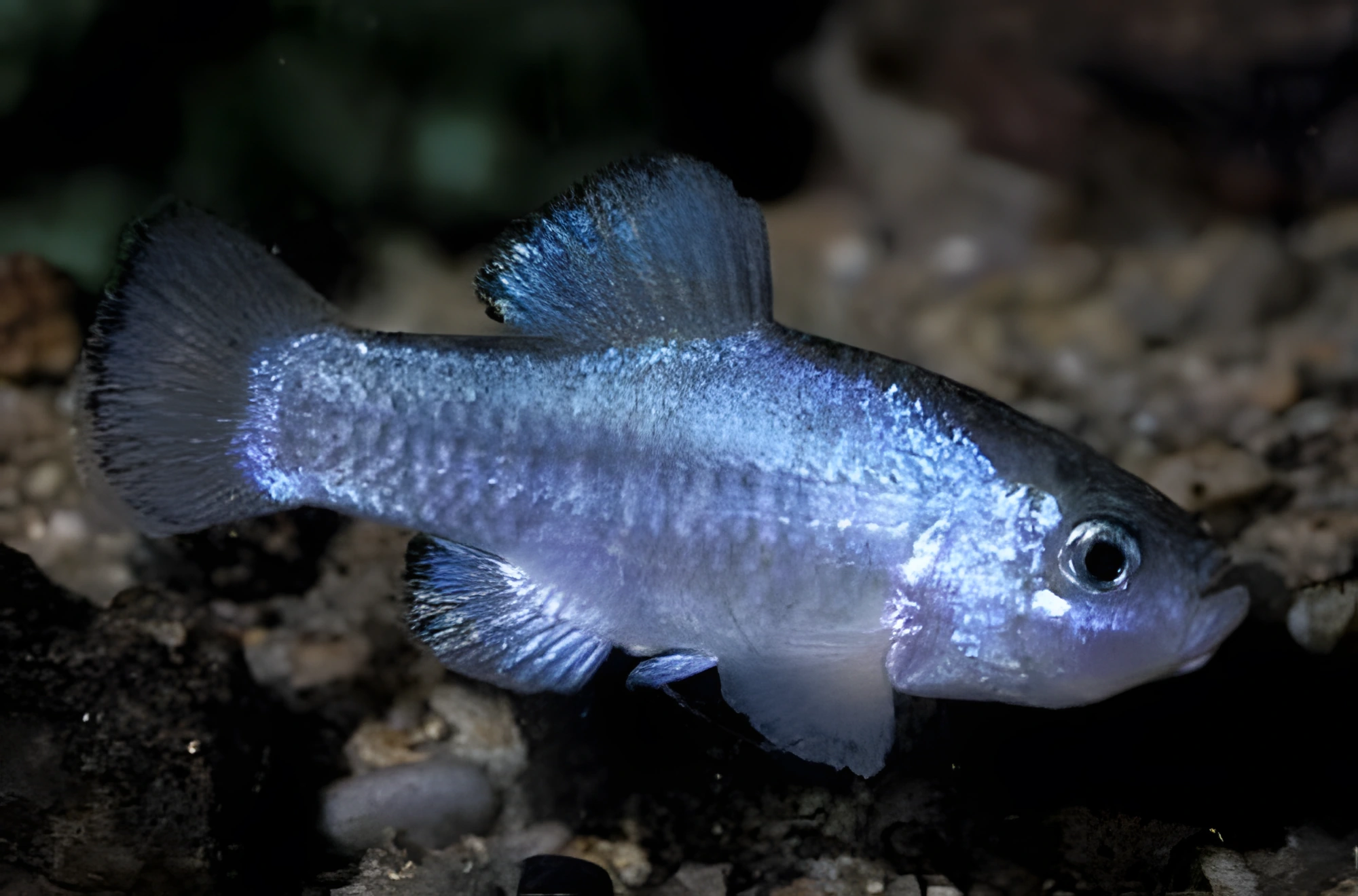
This fish has a short, rather stout body with a characteristically large head. The structure of its mouth allows it to easily collect food from the water surface. The fins are large and rounded, with the dorsal fin positioned closer to the caudal part of the body. The coloration is usually inconspicuous – an olive hue with several dark vertical stripes. However, during the spawning season, the male transforms, acquiring a striking iridescent blue shade.
Males are larger than females and have a bluish tint to their coloration. During the spawning season, this color becomes an intense blue.
Habitat
The homeland of this species is swamps, lakes and other bodies of water in the desert areas of the “Wild West” of the United States in the lower reaches of the Colorado River in the modern states of California, Arizona, Nevada, as well as the northern part of Mexico.
Behavior and Compatibility
Due to the specific water composition requirements, only members of the same species group are suitable as tank mates. Successful cohabitation is possible with other Pupfish. Females are peaceful and can live in groups of several individuals. Males, on the other hand, prefer solitude or a male/female pair, exhibiting territorial behavior, especially actively during the breeding season.
Care and Maintenance
Since these fish originate from waters with constantly changing conditions, keeping them in a home aquarium does not present difficulties. To maintain a consistently high temperature above 25°C, a single heater is sufficient, but it is recommended to install a backup in case of failure to prevent the fish from going into hibernation if the temperature drops. High water quality is ensured by a high-performance filter and weekly renewal of one-third of the volume. The aquarium must be equipped with a lid to prevent fish from accidentally jumping out. Brackish water is mandatory, with a marine salt concentration of 3 teaspoons (level) per 10 liters. The aquarium setup should ideally mimic natural conditions as closely as possible. The fish will appreciate a soft substrate of coarse sand, into which they can burrow. Several stones and plants (rooted and floating) adapted to brackish water are suitable as decor. Lighting should be dim to moderate.
Diet
Being omnivorous, these fish readily accept all types of food: this can include dry flakes, granules, as well as various frozen and live foods. Among the latter, bloodworms, mosquito larvae, tubifex, and Artemia are particularly popular, especially for young individuals.
Breeding and Reproduction
The breeding period lasts from February to October. The male's readiness to spawn is indicated by a change in coloration. During this time, he begins to aggressively defend his territory from everyone except females. After a brief courtship ritual, the female lays eggs one by one. Several eggs can be laid within a few hours, and over the entire period, their number exceeds a hundred. Spawning is recommended in a separate tank with water conditions identical to the main aquarium. To protect the eggs, fine rooted plants that form a dense cover and can tolerate brackish water should be provided. It is in these thickets that the eggs will be laid. After courtship is complete and egg-laying ceases, the female must be immediately removed from the spawning tank, as these fish are prone to eating their offspring. Fry hatch after 6–10 days, and by the next day, they can be fed infusoria, gradually transitioning to Artemia as they grow. They demonstrate rapid growth, reaching full maturity by 2–3 months.
Diseases
These fish possess high endurance. Health problems are extremely rare, occurring predominantly in unfavorable keeping conditions. Detailed information on symptoms and treatment methods can be found in the "Aquarium Fish Diseases" section.
How to choose
Acquiring desert pupfish in private collections is challenging, as the species is rare and protected in several regions. When selecting individuals, attention should be paid to their activity and absence of external damage, such as ulcers, film, or fin erosion. Healthy fish should be curious, actively swim in the water column, and show no signs of emaciation.
- Avoid purchasing fish that appear lethargic or stay near the water surface, unless this is due to specific lighting conditions.
- Ensure that there are no signs of other fish deaths or the presence of parasites in the aquarium with the fish.
- Note that the species requires specific keeping conditions, so before purchasing, you must ensure that you can provide the appropriate temperature regime and water parameters.
Frequently asked questions
The essentials: size, tank volume, water parameters and care
How big does Desert Pupfish get?
An adult reaches 7 cm in length. Plan the tank around the maximum size: the fish quickly outgrows a cramped setup.
What size aquarium does Desert Pupfish need?
The minimum recommended volume is 80 L. A smaller tank speeds up nitrate build-up and raises stress levels.
What water parameters does Desert Pupfish need?
Temperature 25–35 °C, pH 7.5–8, hardness 13–19 dGH. Stability matters more than exact values: sudden swings are harder on the fish than a small deviation from the ideal.
How long does Desert Pupfish live?
Around 2 years when kept properly. Lifespan depends directly on tank volume, water quality and a varied diet.
Is Desert Pupfish aggressive?
Temperament: territorial (often aggressive). Keep this in mind when choosing tank mates.
How many Desert Pupfish should be kept together?
Recommended setup: mixed (solitary / pair / group). Ignoring this is a common cause of stress and disease.
What does Desert Pupfish eat?
Diet type: any (universal). Feed small portions that are finished within a couple of minutes — overfeeding does more harm than underfeeding.
What is the scientific name of Desert Pupfish?
The scientific name of the species is Cyprinodon macularius, family Killifish (Cyprinodontidae). It also appears in the literature as: Cyprinodon browni, Cyprinodon californiensis, Cyprinodon sonoytae.