Temperature20 – 24 °C
Natural range
- South America area
KillifishConservation status: Least concern LC
Other scientific names: Gnatholebias zonatus
Pterolebias zonatus, belonging to the family Rivulidae, is an annual fish whose habitat covers the Orinoco River basin in South America. Its lifespan is determined by the alternation of rainy and dry seasons, which is why it is considered a hardy and unpretentious species capable of adapting to adverse conditions. These fish can sometimes be found in home aquariums.
- Required aquarium volume
- 50 L
- Size in aquarium
- 11 cm
- Temperature
- 20 – 24 °C
- Temperament
- Peaceful (regular)
Parameters
Water pHNeutral (6.5) – Neutral (7.5)
Water dHSoft (5) – Medium hardness (8)
Water salinityno salt (freshwater)
Size in aquarium11 cm
Lifespan1 years
TemperamentPeaceful (regular)
Toward small fishnot a predator
Required aquarium volume50 L
Lightingany
Substratesoft peat-based
Water flownone or stagnant (no flow)
FeedingHigh protein (predominantly meat)
CareSchooling (usually from 5–6 individuals and more)
Description
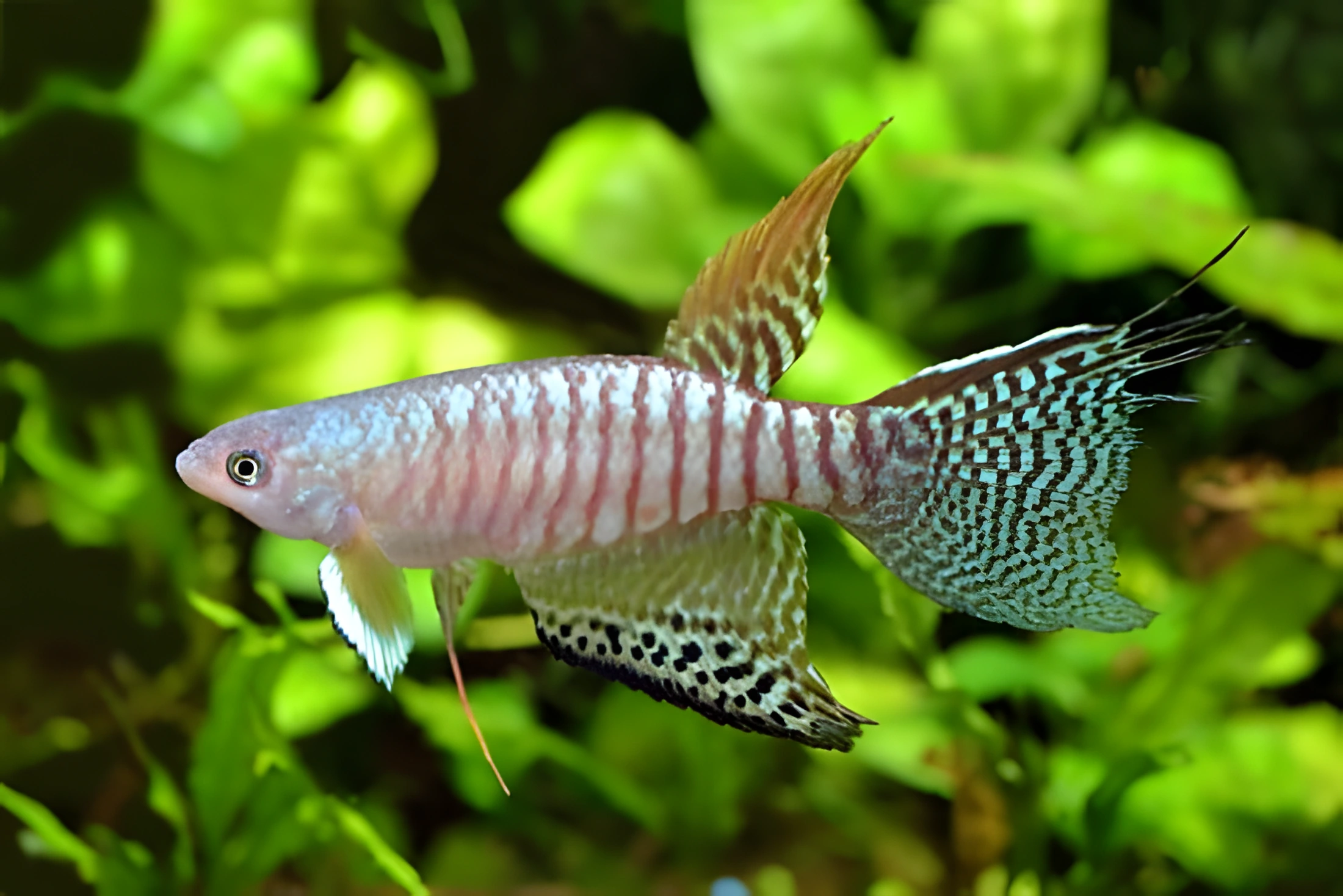
Adults of this species can reach 10 cm in length. These fish received their scientific name "zonatus" due to the characteristic numerous vertical stripes, which are contrasting color zones on their body. Their main coloration varies from turquoise and greenish to blue. These stripes have a rich burgundy hue. Females show a similar pattern and body coloration, but their colors are usually less pronounced. Males are characterized by very large fins relative to their body size. In their natural environment, the lifespan of Pterolebias zonatus is usually about 6–7 months. During this short period, the fish rapidly go through all stages of development, from fry to sexually mature individuals. In aquarium conditions, they can live for more than a year. This species has a close relative — Pterolebias orinocensis, which is often found in the same bodies of water. It is similar in size and coloration, but its pattern lacks the stripes characteristic of Pterolebias zonatus.
Habitat
As mentioned, these fish live in small bodies of water. Such bodies of water form during river floods in the rainy season, when vast territories are inundated. These flowing puddles can be well-lit by the sun surrounded by dense aquatic vegetation, or be in the shade of trees under the canopy of the tropical forest. Bottom sediments are usually represented by mud, clay, and silt. The water in such places is typically murky.
Behavior and Compatibility
These are peaceful and active fish. Although males may compete for the attention of females, aggressive behavior between them is usually not observed. It is recommended to keep them in groups where both males and females are present. They get along well with other species of comparable size, including Killifish.
Care and Maintenance
For keeping Pterolebias zonatus, an aquarium of at least 50 L is required. A layer of peat or coconut substrate is recommended as a substrate, as the fish tend to burrow into it, especially during spawning. It is important to provide shelters and subdued lighting, although in nature they are also found in open areas. Optimal water parameters: temperature 18–23°C, pH 6.5–7.0, hardness 5–8 dH. Effective filtration is necessary, but strong currents should be avoided.
Diet
In their natural habitat, the fish feed on small invertebrates. In aquarium conditions, the diet should consist of high-quality live or frozen foods, such as bloodworms, Daphnia, Artemia, or glassworms. A varied diet is recommended to maintain health and readiness for breeding. Feeding should be regular, preferably several times a day in small portions.
Breeding and Reproduction
For a group of 3–4 individuals, the optimal aquarium volume starts from 50 L. The decoration can be arbitrary, but, given the short lifespan of the fish, the main goal of keeping them should be breeding to obtain new offspring. In nature, eggs are laid deep in the soft substrate, where the fish temporarily burrow. Thanks to this, the eggs are preserved in the substrate layer after the water body dries out, awaiting the onset of a new rainy season. The diapause period can last up to 6–7 months. For successful egg development, their temporary removal from water is necessary. To ensure this in the aquarium, easily removable substrates should be used, for example, coconut fiber or a layer of aquatic ferns and mosses, which can be easily removed and dried. Comfortable conditions for keeping include soft acidic water with a temperature range of 20°C – 24°C. This temperature is maintained for the first 5–6 months, until the fish reach sexual maturity. The stimulus for spawning is created by a gradual increase in temperature to 28–33°C. Aquarium equipment should include a heater, a lighting system, and a simple air-driven filter. An important condition for successful breeding is a balanced diet, the basis of which should be frozen or live foods, such as bloodworms, Daphnia, Artemia, mosquito larvae, and others. If breeding is not planned, the temperature should not be raised, as this accelerates the fish's metabolism and shortens their lifespan. After the fish lay their eggs, the substrate is removed. The most difficult task is the removal of organic waste, which can subsequently provoke mold growth. The substrate should be very carefully rinsed with the same aquarium water. Slightly moist substrate is placed in a container equipped with a perforated lid. The optimal degree of humidity is determined experimentally and depends on many factors. If the rinsing and storage process was successful, after 6 months the substrate can be placed back in the water, awaiting the appearance of fry.
Diseases
Like other annual killifish species, this species is sensitive to abrupt changes in water parameters and habitat quality. The main threats are bacterial and fungal infections, often arising from the accumulation of organic matter in the substrate or a violation of the temperature regime. Prevention consists of weekly partial water changes, maintaining substrate cleanliness, and monitoring the fish's condition.
How to choose
When purchasing, choose active fish with clean fins and no visible body damage. It is important to ensure there are no signs of emaciation or unnatural behavior, such as apathy or attempts to stay at the surface with normal oxygen levels. It is recommended to purchase individuals from the same group, considering that in captivity there is often a predominance of males, so it is desirable to select a proportion with more females.
Frequently asked questions
The essentials: size, tank volume, water parameters and care
How big does Pterolebias zonatus get?
An adult reaches 11 cm in length. Plan the tank around the maximum size: the fish quickly outgrows a cramped setup.
What size aquarium does Pterolebias zonatus need?
The minimum recommended volume is 50 L. A smaller tank speeds up nitrate build-up and raises stress levels.
What water parameters does Pterolebias zonatus need?
Temperature 20–24 °C, pH 6.5–7.5, hardness 5–8 dGH. Stability matters more than exact values: sudden swings are harder on the fish than a small deviation from the ideal.
How long does Pterolebias zonatus live?
Around 1 years when kept properly. Lifespan depends directly on tank volume, water quality and a varied diet.
Is Pterolebias zonatus aggressive?
Temperament: peaceful (regular). Keep this in mind when choosing tank mates.
How many Pterolebias zonatus should be kept together?
Recommended setup: schooling (usually from 5–6 individuals and more). Ignoring this is a common cause of stress and disease.
What does Pterolebias zonatus eat?
Diet type: high protein (predominantly meat). Feed small portions that are finished within a couple of minutes — overfeeding does more harm than underfeeding.
What is the scientific name of Pterolebias zonatus?
The scientific name of the species is Pterolebias zonatus, family Rivulidae. It also appears in the literature as: Gnatholebias zonatus.