Temperature17 – 22 °C
Natural range
- South America area
KillifishConservation status: Least concern LC
Other scientific names: Pterolebias bokermanni, Pterolebias luelingi, Rivulichthys luelingi
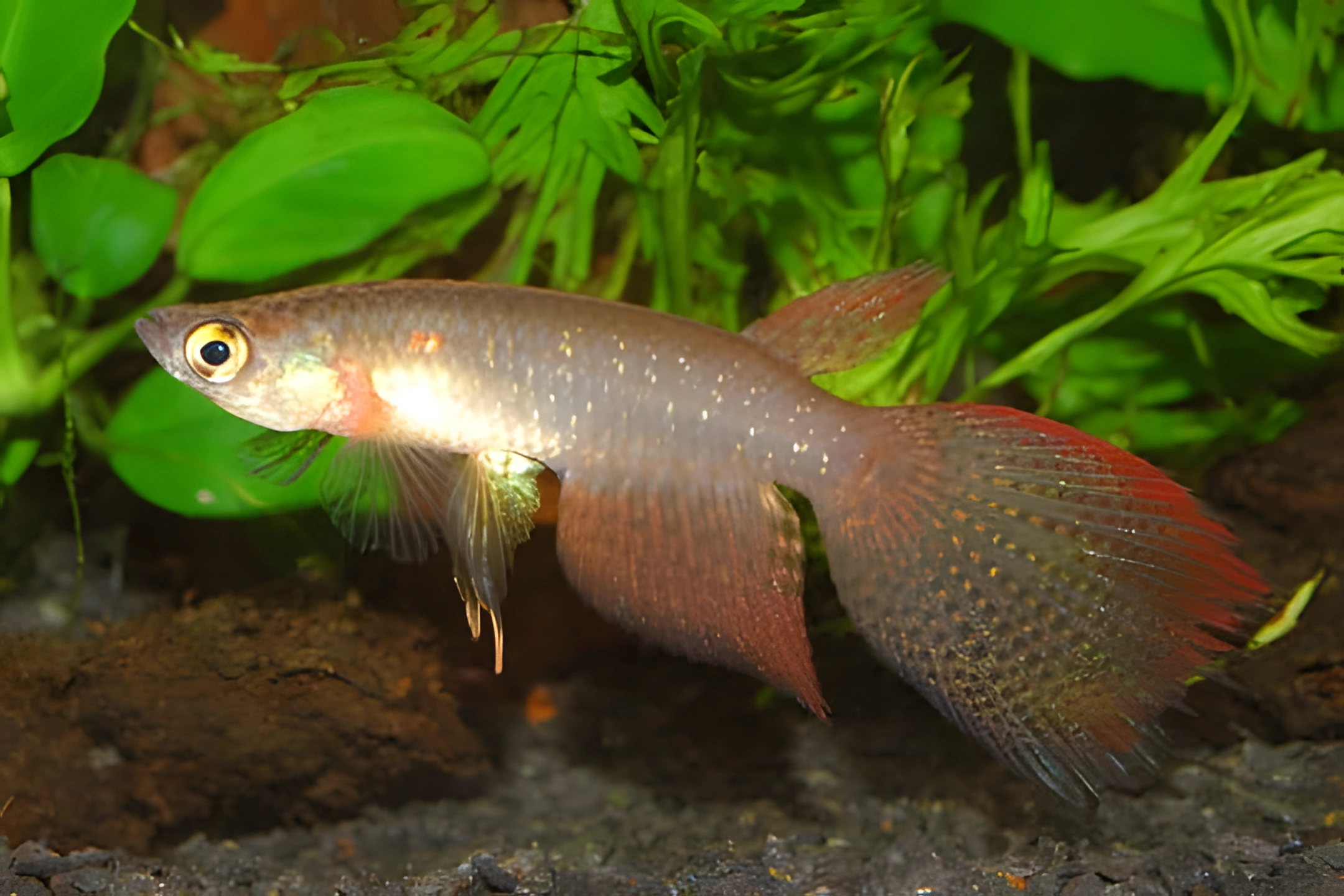
Pterolebias longipinnis, known as the Golden Pterolebias, belongs to the family Rivulidae. These fish are rarely found outside their natural habitat. The reason for this is their very short lifespan, usually not exceeding one year. However, it is convenient to acquire eggs instead of adult fish, as they can remain viable out of water for months, which greatly simplifies their long-distance transportation.
- Required aquarium volume
- 80 L
- Size in aquarium
- 12 cm
- Temperature
- 17 – 22 °C
- Temperament
- Peaceful (regular)
Parameters
Water pHNeutral (6.5) – Neutral (7)
Water dHVery soft (1) – Medium hardness (10)
Water salinityno salt (freshwater)
Size in aquarium12 cm
Lifespan1 years
TemperamentPeaceful (regular)
Toward small fishnot a predator
Required aquarium volume80 L
Lightingdimmed
Substrateany, but dark
Water flownone or stagnant (no flow)
FeedingMeat / protein (live, frozen, fresh)
CareHarem (1 male and several females)
Description
Adults grow up to 12 cm in length. Due to their wide distribution in nature, many local color variations can be found. Males are invariably distinguished by brighter coloration and larger fins adorned with speckles that harmonize with the main color. Their coloration varies from silvery to yellow, pink, and red hues. Females usually have a gray coloration. In the wild, these fish live for only one season, the duration of which ranges from several months to half a year. Their lifespan directly depends on the duration of the temporary body of water. During this short time, the fish manage to complete a full life cycle: to be born, grow, and leave offspring. Fertilized eggs remain in the silt layer of the dried-up body of water for several months, awaiting the return of the rainy season. In aquarium conditions, their lifespan increases, usually exceeding one year.
Habitat
The natural habitats of this fish are located in the vast floodplains of South American rivers, such as the Amazon and Paraguay basins. The Golden Pterolebias inhabits temporary bodies of water and puddles that form during the rainy season.
Behavior and Compatibility
Due to the specifics of life in drying-up bodies of water, these fish rarely have neighbors. Occasionally, representatives of other killifish species are found in their surroundings. For this reason, it is recommended to keep them in a species-specific aquarium. Males compete for the attention of females and may engage in clashes with each other, but this usually does not cause serious injuries. Nevertheless, to maintain harmony in the aquarium, it is advisable to form a group of one male and several females, as the latter exhibit a very peaceful disposition.
Care and Maintenance
The Golden Pterolebias has proven to be a rather unpretentious and hardy species. Usually, the keeping of these annual fish is aimed at their breeding and population preservation. For this purpose, soft fibrous substrate, such as coconut fiber or similar materials, is used in the aquarium setup. The main purpose of such a substrate is to ensure the preservation of the eggs and allow for its complete removal from the aquarium. The rest of the decor may include driftwood, branches, floating plants, and a layer of fallen leaves. A simple air-lift filter with a sponge is usually used for water filtration; the use of other purification systems is impractical. Artificial lighting is not mandatory; ambient light from the room will be quite sufficient. The diet should consist of live or frozen foods, such as bloodworms, Artemia, or Daphnia.
Diet
The diet of these fish should be based on live or frozen foods, for example, bloodworms, Artemia, or Daphnia. Breeding Golden Pterolebias in aquarium conditions is not difficult, but preserving the eggs is an important aspect. Adult fish lay their eggs directly into the substrate. In the wild, they burrow slightly into the soft substrate to provide greater safety for the eggs. The substrate containing the eggs is then removed and dried. Before this, it is recommended to gently but thoroughly rinse the substrate to remove food residues, excrement, and other organic matter, as otherwise there is a high risk of mold and fungus development. The incubation period lasts from 3 to 6 months and is determined by a combination of humidity and temperature: the higher the temperature and the wetter the substrate, the shorter the incubation. On the other hand, excessive humidity can lead to the loss of all eggs. The optimal temperature is considered to be in the range of 24–28°C. After the incubation period, the substrate with the eggs is placed in an aquarium where the water temperature is maintained at 20–21°C. Fry hatch after several days.
Breeding and Reproduction
These fish breed easily in aquariums, but the main task is the proper preservation of the eggs. Sexually mature Pterolebias lay their eggs directly into the substrate. In their natural environment, they slightly burrow into the soft substrate, which provides additional protection for the eggs. The substrate with the eggs is removed and dried. It is important to carefully but thoroughly rinse the substrate before drying to remove food residues, excrement, and other organic contaminants. Otherwise, there is a high risk of mold and fungus development. The incubation period lasts from 3 to 6 months and depends on the combination of humidity and temperature. At higher temperatures and with a moist substrate, incubation proceeds faster. However, excessive humidity can lead to the death of all eggs. The optimal temperature is considered to be 24–28°C. After the incubation period, the substrate with the eggs is placed in an aquarium with water at a temperature of about 20–21°C. Fry appear within a few days.
Diseases
Like other seasonal killifish, this species is highly sensitive to water quality and keeping conditions. The main factor provoking diseases is a violation of the temperature regime and the accumulation of organic waste. When kept in water with a temperature above 23°C, the fish's lifespan is significantly reduced, and their immunity decreases, making them susceptible to bacterial and fungal infections. Prevention consists of regular water changes and maintaining stable parameters. Fish are prone to injury during intraspecific conflicts, so the presence of shelters is essential to prevent fin damage and subsequent development of infections at wound sites.
How to choose
When selecting individuals, attention should be paid to the activity of the fish and the integrity of their fins. Healthy Pterolebias should show interest in their surroundings and actively respond to food. It is important to avoid purchasing individuals with signs of emaciation, sunken bellies, or skin damage. Young fish can exhibit pronounced aggression, so in the store, it is worth assessing the group's behavior: the presence of individuals with severely nipped fins may indicate unfavorable keeping conditions or overcrowding in the aquarium. It is recommended to purchase fish from reputable breeders, as this guarantees healthy offspring and proper adaptation to aquarium conditions.
Frequently asked questions
The essentials: size, tank volume, water parameters and care
How big does Golden Pterolebias get?
An adult reaches 12 cm in length. Plan the tank around the maximum size: the fish quickly outgrows a cramped setup.
What size aquarium does Golden Pterolebias need?
The minimum recommended volume is 80 L. A smaller tank speeds up nitrate build-up and raises stress levels.
What water parameters does Golden Pterolebias need?
Temperature 17–22 °C, pH 6.5–7, hardness 1–10 dGH. Stability matters more than exact values: sudden swings are harder on the fish than a small deviation from the ideal.
How long does Golden Pterolebias live?
Around 1 years when kept properly. Lifespan depends directly on tank volume, water quality and a varied diet.
Is Golden Pterolebias aggressive?
Temperament: peaceful (regular). Keep this in mind when choosing tank mates.
How many Golden Pterolebias should be kept together?
Recommended setup: harem (1 male and several females). Ignoring this is a common cause of stress and disease.
What does Golden Pterolebias eat?
Diet type: meat / protein (live, frozen, fresh). Feed small portions that are finished within a couple of minutes — overfeeding does more harm than underfeeding.
What is the scientific name of Golden Pterolebias?
The scientific name of the species is Pterolebias longipinnis, family Rivulidae. It also appears in the literature as: Pterolebias bokermanni, Pterolebias luelingi, Rivulichthys luelingi.