Temperature25 – 29 °C
Natural range
- Lake Malawi area
- Southern Lake Malawi area
- Malawi area
- Tanzania area
Cichlids
Pseudotropheus Daktari, scientifically named Maylandia sp. Daktari, belongs to the Cichlidae family. This species was once classified as Pseudotropheus, which is reflected in its trade name. It does not cause much trouble in keeping and breeding, provided suitable conditions are created and the aquarium is regularly maintained. However, its quarrelsome nature often makes it difficult to select compatible tankmates.
- Required aquarium volume
- 150 L
- Size in aquarium
- 8 – 10 cm
- Temperature
- 25 – 29 °C
- Temperament
- Aggressive / incompatible / unfriendly
Parameters
Water pHSlightly alkaline (7.6) – Alkaline (9)
Water dHMedium hardness (10) – Very hard (25)
Water salinityno salt (freshwater)
Size in aquarium8 – 10 cm
Lifespan8 years
TemperamentAggressive / incompatible / unfriendly
Toward small fishnot a predator
Required aquarium volume150 L
Lightingmoderate (regular)
Substratesandy (regular, light)
Water flowweak or moderate
FeedingMixed diet (meat + plant-based)
CareHarem (1 male and several females)
Description
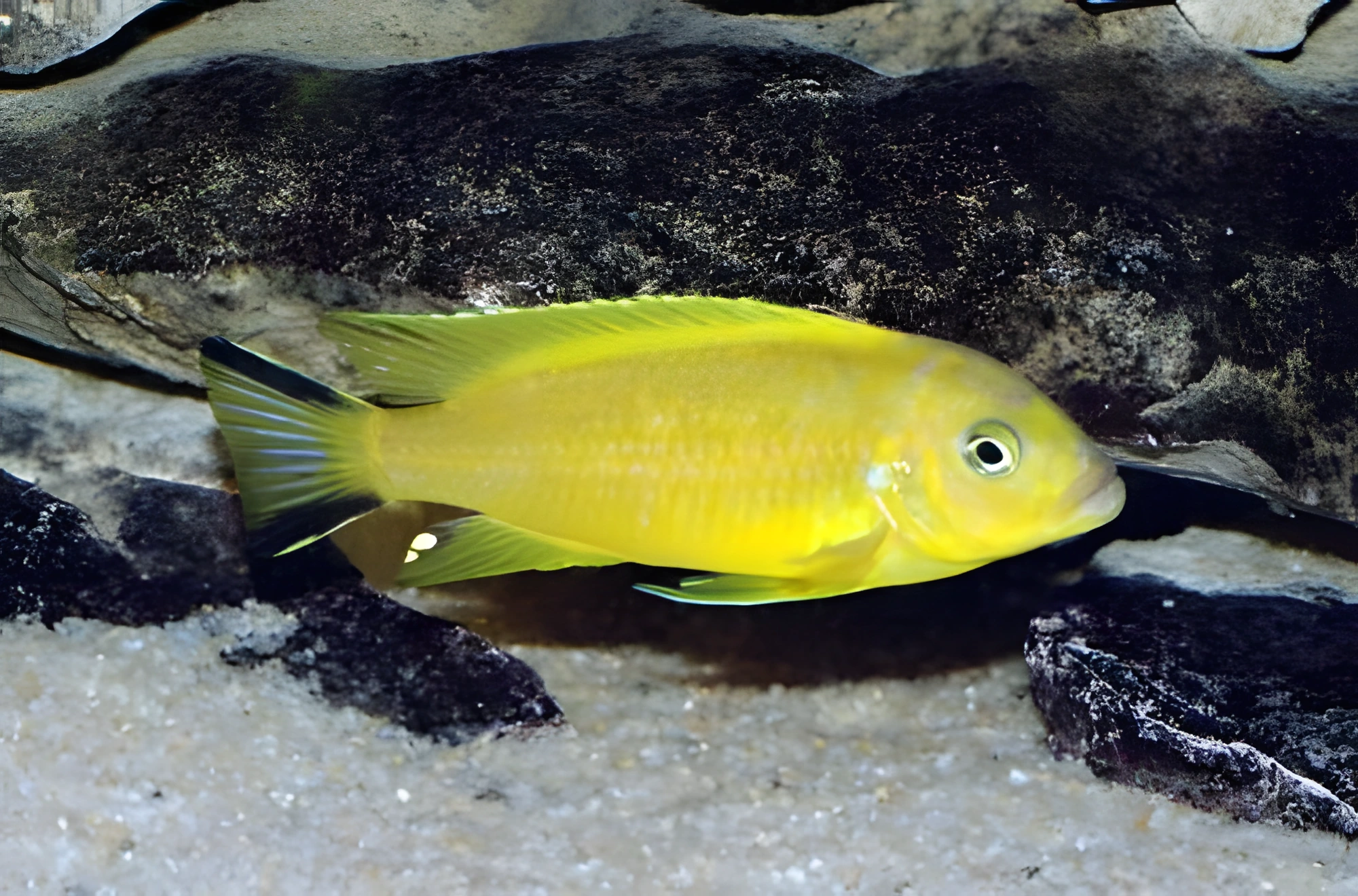
Adult fish typically reach 8–10 cm in length, though they can grow slightly larger in an aquarium. The fish's body has the characteristic 'torpedo-like' shape of Mbuna cichlids. Sexual dimorphism is weakly expressed; males and females look very similar, with the latter usually being slightly smaller. Their coloration is predominantly yellow, and a distinctive feature is the black stripes located along the upper and lower edges of the tail. It should be noted that, depending on the region of origin, individuals with bluish hues in their coloration may be found. Therefore, when identifying this cichlid species, particular attention should be paid to the pattern of the caudal fin, which remains constant.
Habitat
This species is endemic to Lake Malawi in Africa, which is considered one of the largest lakes on our planet. The body of water is located on the border of Malawi, Tanzania, and Mozambique. This species inhabits the southern part of the lake, where the natural environment is characterized by alternating rocky areas and sandy substrates.
Behavior and Compatibility
Pseudotropheus daktari belongs to the Mbuna cichlid group. Males of this species exhibit rather pronounced aggression towards conspecifics, especially other males, as well as towards fish with similar coloration. It is recommended to keep them in harem groups, with one male per several females. In spacious aquariums, cohabitation with other Lake Malawi species is possible, provided there are enough shelters and free space on the bottom for alpha males to establish their territory.
Care and Maintenance
For a small group of these fish, an aquarium of at least 150–200 liters is recommended. The decor can be quite simple, as the natural habitat of Pseudotropheus daktari is not particularly diverse. Among the minimal decor elements, sandy or gravel substrate and rock formations can be highlighted, from which gorges, caves, and grottoes are formed for shelters. Live plants are not mandatory. One of the key factors for successful keeping is maintaining stable water parameters, including suitable pH and dGH values. This will require the installation of an efficient filtration system, as well as weekly partial water changes (10–20% of the total volume) with fresh water, the frequency of which may vary depending on the number of fish. It is equally important to regularly clean the aquarium of organic waste.
Diet
In the wild, these fish primarily feed on algae, scraping it from the surface of rocks. Along with algae, their diet includes various insect larvae, small crustaceans, and other zooplankton. In a home aquarium, their diet should be based on plant-based foods. Specialized foods developed for Malawian cichlids would be an ideal choice.
Breeding and Reproduction
In a favorable environment, spawning becomes a regular occurrence. During the breeding period, females lay eggs in the alpha male's territory, after which they immediately take them into their mouth for incubation. The entire incubation period, lasting 2–3 weeks, takes place in the female's mouth. This mechanism of clutch protection is a result of evolution and is characteristic of most Malawian cichlids. After the fry emerge, the female guards her offspring for some time, swimming alongside them. In case of danger, the fry can again find refuge in the mother's mouth. It is worth noting that breeding efficiency is higher in species-specific tanks where the young are not endangered by other fish.
Diseases
Most diseases of Malawian cichlids are often caused by unsuitable keeping conditions or poor-quality food, which frequently leads to the development of "Malawi Bloat." If the first symptoms are detected, it is necessary to check the water parameters for high concentrations of dangerous substances such as ammonia, nitrites, and nitrates. If necessary, all parameters should be normalized, and only then should treatment begin. More detailed information on symptoms and treatment methods is available in the "Aquarium Fish Diseases" section.
How to choose
When choosing Maylandia sp. Daktari at the store, pay attention to the activity and appearance of the fish. Healthy individuals should be active, curious, and respond actively to food. It is important to avoid buying fish with signs of emaciation, sunken bellies, damaged scales or fins, or an unnatural film on their bodies. Pay special attention to their behavior: there should be no individuals in the aquarium that appear apathetic, keep away from the group, or constantly hide in corners, as this may be a sign of stress or illness.
- choose fish with bright, rich coloration, characteristic of their sex and age
- avoid specimens with whitish spots, ulcers, or signs of inflammation in the mouth and gill areas
- prefer individuals from aquariums where there are no dead fish or fish with obvious signs of disease in adjacent compartments
- keep in mind that yellow morphs are most commonly found in trade, so when purchasing a group, clarify the male-to-female ratio to form a harem
Frequently asked questions
The essentials: size, tank volume, water parameters and care
How big does Pseudotropheus Daktari get?
An adult reaches 8–10 cm in length. Plan the tank around the maximum size: the fish quickly outgrows a cramped setup.
What size aquarium does Pseudotropheus Daktari need?
The minimum recommended volume is 150 L. A smaller tank speeds up nitrate build-up and raises stress levels.
What water parameters does Pseudotropheus Daktari need?
Temperature 25–29 °C, pH 7.6–9, hardness 10–25 dGH. Stability matters more than exact values: sudden swings are harder on the fish than a small deviation from the ideal.
How long does Pseudotropheus Daktari live?
Around 8 years when kept properly. Lifespan depends directly on tank volume, water quality and a varied diet.
Is Pseudotropheus Daktari aggressive?
Temperament: aggressive / incompatible / unfriendly. Keep this in mind when choosing tank mates.
How many Pseudotropheus Daktari should be kept together?
Recommended setup: harem (1 male and several females). Ignoring this is a common cause of stress and disease.
What does Pseudotropheus Daktari eat?
Diet type: mixed diet (meat + plant-based). Feed small portions that are finished within a couple of minutes — overfeeding does more harm than underfeeding.
What is the scientific name of Pseudotropheus Daktari?
The scientific name of the species is Maylandia sp. Daktari, family Cichlidae.