Temperature18 – 26 °C
Natural range
- Southwest New Guinea area
- Indonesia area
Rainbowfish
Pseudomugil sp. "Red neon", or Red Neon Blue-eye, belongs to the family Pseudomugilidae. This species, which appeared on the market in 2011, has relatively recently attracted the attention of aquarists. A distinctive feature of this miniature fish is its beauty and ability to comfortably exist both in small groups and alone. It does not require special care and is quite easy to keep, which makes it an excellent choice for nano aquariums due to its modest size.
- Required aquarium volume
- 40 L
- Size in aquarium
- 5 cm
- Temperature
- 18 – 26 °C
- Temperament
- Peaceful (regular)
Parameters
Water pHNeutral (6.5) – Neutral (7.5)
Water dHVery soft (2) – Hard (12)
Water salinityno salt (freshwater)
Size in aquarium5 cm
Lifespan2 years
TemperamentPeaceful (regular)
Toward small fishnot a predator
Required aquarium volume40 L
Lightingweak or moderate
Substrateany (no restrictions)
Water flowweak or moderate
FeedingMixed diet (meat + plant-based)
CareBoth solitary and in group (flexible)
Description
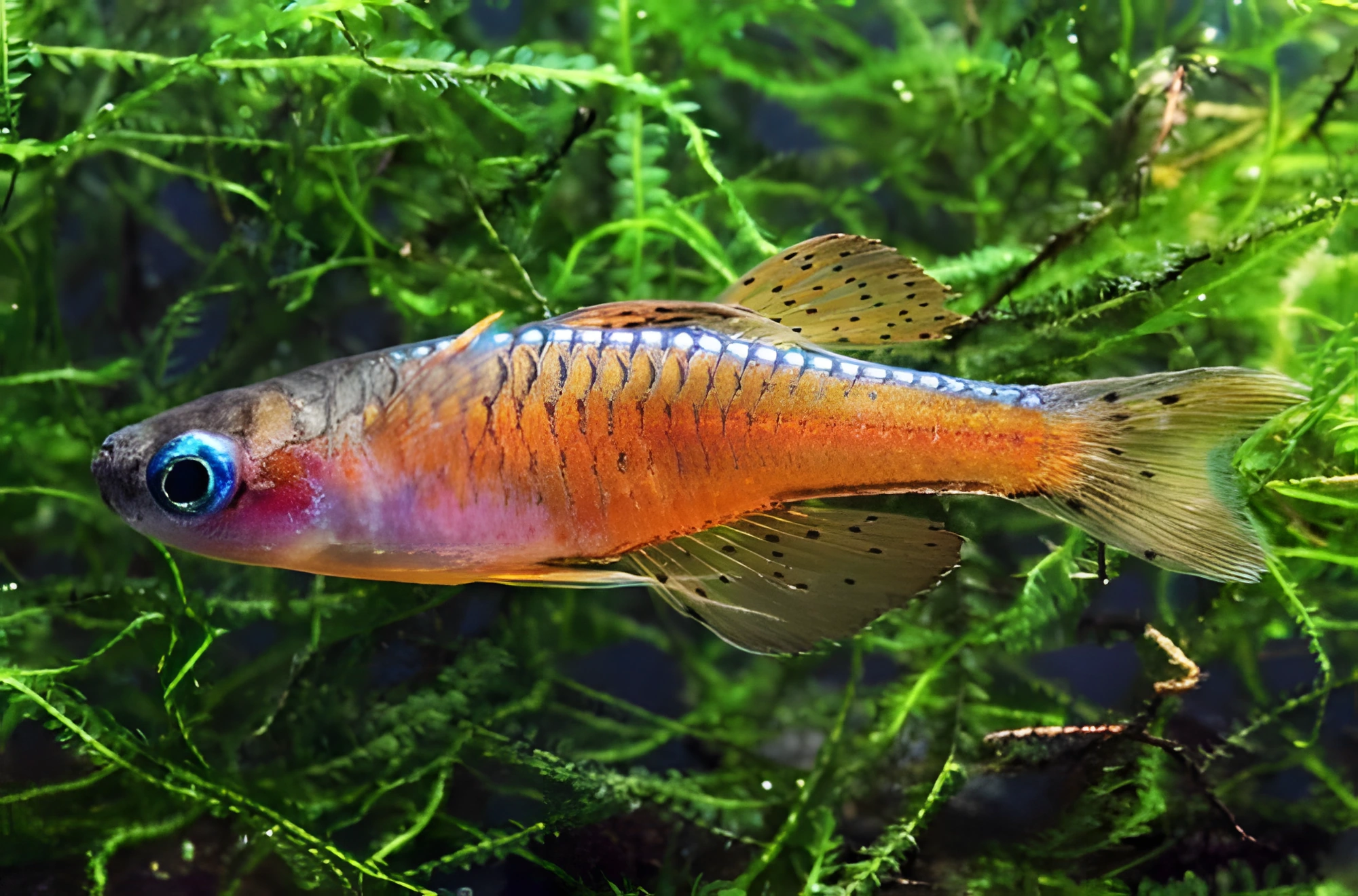
Adults of this fish reach approximately 3.5 cm in length. Their coloration is orange, the back shimmers with blue, and the eyes have a noticeable bluish tint, which gave the species its name. The fins are translucent, adorned with small black speckles. In males, the dorsal and pectoral fins are noticeably longer than in females, which is one of the sexual differences.
Habitat
The natural habitat of these fish covers the southwestern part of New Guinea island, including the territory of Indonesia. They can be found in numerous streams and small rivers flowing into the Arafura Sea. They prefer areas with abundant aquatic vegetation and flooded coastal areas. The water in these places is usually turbid, brownish, with a high content of organic matter.
Behavior and Compatibility
These fish are distinguished by their peaceful and calm disposition. Given the small size of the Red Neon Blue-eye, only species with a similar size and temperament are suitable as tankmates. They live perfectly well both in groups and in pairs.
Care and Maintenance
For the comfortable existence of a group of 8–10 individuals, an aquarium of 40 L or more is suitable. The aquarium decor should include many plants, arranged in groups to leave enough open swimming space. Snags, roots, and tree branches that create shelters will also be appropriate. The choice of substrate depends on the needs of the plants. Lighting should be subdued; floating plants can serve as an additional source of shade. When caring for the fish, it is important to maintain a high level of dissolved oxygen and moderate current. Avoid introducing Pseudomugil paskai into a biologically unstable aquarium and sudden fluctuations in water hydrochemistry.
Diet
The diet is based on live foods, such as Daphnia and Artemia. However, the fish can also adapt to dry foods of appropriate size. When choosing dry foods, it is recommended to give preference to those that float on the water surface.
Breeding and Reproduction
Breeding blue-eyes in a home aquarium is not a difficult task. During the mating season, females lay eggs among dense thickets of fine-leaved low-growing plants or mosses, such as Java moss. Spawning continues for several days, during which the dominant male fertilizes several clutches from different females. These fish lack parental instincts, and adults may eat their offspring. To save the fry, the eggs should be timely transferred to a separate tank with similar water conditions. In this separate aquarium, the fry will remain until they reach a sufficient size. It should be equipped with the same equipment as the main aquarium, with the exception of the filtration system; here, it is better to use a simple air-driven sponge filter, which will provide the necessary cleaning and prevent the fry from being sucked in. The incubation period is about 10 days; its duration depends on temperature. In the first days of life, the fry need micro-food, such as infusoria. After a week, Artemia nauplii can be given.
Diseases
Health problems in these fish arise only in the presence of injuries or keeping in unsuitable conditions, which leads to a weakening of the immune system and the subsequent occurrence of various diseases. At the first signs of illness, it is necessary first to check the water parameters for exceeding permissible values or the presence of toxic substances (such as nitrites, nitrates, ammonia). If deviations are found, all indicators should be normalized, and then treatment should begin. More detailed information on symptoms and treatment methods is available in the "Diseases of Aquarium Fish" section.
How to choose
When choosing healthy specimens, pay attention to their activity: the fish should be mobile, show interest in their surroundings, and not constantly hide in thickets. Inspect the scales for the absence of damage, ulcers, or white spots, and the fins for integrity. Avoid buying fish from aquariums where dead specimens or individuals with signs of emaciation are observed, as this species is sensitive to water quality and transport stress. Keep in mind that in the store, males may be less vibrant due to stress, but their coloration should gradually recover under suitable conditions. Check that the fish do not show signs of rapid breathing, which may indicate water quality problems in the retail aquarium.
Frequently asked questions
The essentials: size, tank volume, water parameters and care
How big does Pseudomugil paskai get?
An adult reaches 5 cm in length. Plan the tank around the maximum size: the fish quickly outgrows a cramped setup.
What size aquarium does Pseudomugil paskai need?
The minimum recommended volume is 40 L. A smaller tank speeds up nitrate build-up and raises stress levels.
What water parameters does Pseudomugil paskai need?
Temperature 18–26 °C, pH 6.5–7.5, hardness 2–12 dGH. Stability matters more than exact values: sudden swings are harder on the fish than a small deviation from the ideal.
How long does Pseudomugil paskai live?
Around 2 years when kept properly. Lifespan depends directly on tank volume, water quality and a varied diet.
Is Pseudomugil paskai aggressive?
Temperament: peaceful (regular). Keep this in mind when choosing tank mates.
How many Pseudomugil paskai should be kept together?
Recommended setup: both solitary and in group (flexible). Ignoring this is a common cause of stress and disease.
What does Pseudomugil paskai eat?
Diet type: mixed diet (meat + plant-based). Feed small portions that are finished within a couple of minutes — overfeeding does more harm than underfeeding.
What is the scientific name of Pseudomugil paskai?
The scientific name of the species is Pseudomugil sp. «Red neon», family Pseudomugilidae.