Temperature24 – 28 °C
Natural range
- Queensland area
- Australia area
Rainbowfish
The Honey Blue-eye, or Pseudomugil cyanodorsalis, belonging to the family Pseudomugilidae, is an interesting choice for aquarists. This active fish is distinguished by its bright coloration and peaceful nature, and is also quite undemanding in terms of care.
- Required aquarium volume
- 60 L
- Size in aquarium
- 4 cm
- Temperature
- 24 – 28 °C
- Temperament
- Peaceful (regular)
Parameters
Water pHSlightly acidic (5.5) – Slightly alkaline (8)
Water dHSoft (5) – Very hard (21)
Water salinityno salt (freshwater)
Size in aquarium4 cm
Lifespan2 years
TemperamentPeaceful (regular)
Toward small fishnot a predator
Required aquarium volume60 L
Lightingweak or moderate
Substrateany (no restrictions)
Water flowweak or moderate
FeedingAny (universal)
CareGroup (8–10 individuals)
Description
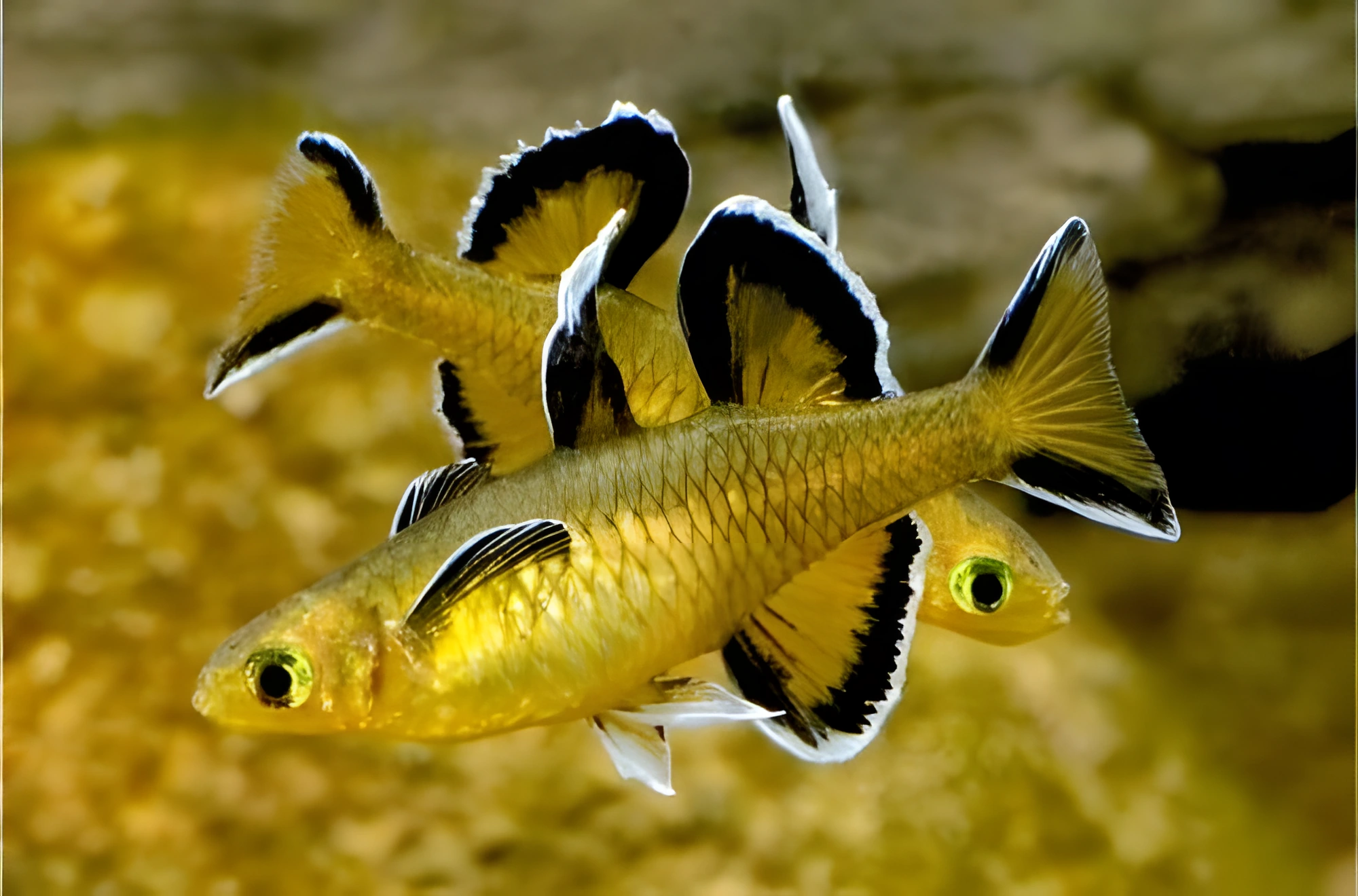
Adults grow up to 3–4 cm in length. These fish exhibit noticeable sexual dimorphism. Males have a brighter and more expressive coloration, typically yellow-orange, which is why the species was given the name “honey.” Their fins and caudal fin are adorned with a contrasting black and white border. Females, on the other hand, have a more modest appearance, their coloration being predominantly grey.
Habitat
The natural habitat of these fish is the northeastern part of Australia, primarily Queensland, where they are found in coastal river systems. They prefer swampy areas and small streams with sandy or silty bottoms, rich in aquatic vegetation. The water in such places often acquires a rich brown hue due to a high concentration of tannins. However, Honey Blue-eyes can also inhabit clear, flowing bodies of water.
Behavior and Compatibility
Honey Blue-eyes are peaceful and active fish. During the breeding season, males may display competitive behavior for the attention of females, but rivalry is usually demonstrative and does not result in injuries. Nevertheless, it is recommended to acquire a group with a predominance of females for the aquarium. In natural conditions, these fish share their habitat with other rainbowfish, which can make good tank mates, provided they are of comparable size.
Care and Maintenance
These fish are quite easy to care for, successfully adapting to changes in water hydrochemistry and temperature fluctuations, including throughout the day. In their natural habitat, temperature swings from 20°C to 30°C and higher are common, and in winter, temperatures can drop to 10°C. Thus, Pseudomugil mellis can well live in an unheated aquarium. Despite their adaptability, the most comfortable conditions are created in soft and acidic water with pH values of 5.5–6.5 and dGH up to 10. For a group of 8–10 fish, the optimal aquarium volume starts from 60 liters. In terms of decor, dense thickets of fine-leaved plants are welcome; otherwise, the choice of decoration is at the aquarist's discretion. For long-term keeping, key attention should be paid to water quality: weekly water changes of at least 20% of the volume with fresh water and regular removal of organic waste are mandatory. These fish are omnivorous and readily accept most popular foods of appropriate size, including dry flakes, pellets, as well as live or frozen brine shrimp, bloodworms, and daphnia.
Diet
These fish are omnivorous and readily accept most common foods of appropriate size: dry flakes, pellets, as well as live or frozen brine shrimp, bloodworms, daphnia, and others. Spawning in Honey Blue-eyes is seasonal, most often occurring from November to January. For successful breeding during this period, it is recommended to place the breeding pair in a separate, specially prepared aquarium. The spawning tank should include dense thickets of low-growing plants, such as Java moss, where females will lay their eggs, using adhesive threads to fix them to the plant surfaces. Newly hatched fry also require protection, especially in the upper water layers. Floating plants, such as Riccia and Mexican hornwort, will provide reliable cover from adult fish, who may eat their own offspring. Spawning lasts from 7 to 9 days, with the female laying up to 15 eggs daily. To save the fry, it is advisable to transfer the adult fish back to the main aquarium after spawning. Given that the Honey Blue-eye lives for about two years, individuals aged one year show maximum fecundity. The incubation period depends on the temperature regime: at 24°C, fry appear after 12–14 days, and in warmer water (25–27°C) — after 5–8 days. In the first days of life, the fry hide in plant thickets near the surface, and then begin to actively swim throughout the water column, preferring to feed in the middle or bottom layer.
Breeding and Reproduction
Spawning in these fish usually occurs seasonally, from November to January. If you plan to breed them, it's advisable to move the fish to a separate, pre-prepared tank during this period. In the spawning aquarium, it's important to provide dense thickets of low-growing plants, such as Java moss, where females will lay their eggs, attaching them to the plants with adhesive threads. The hatched fry also need protection, especially in the upper water layers. Floating plants, such as Riccia and Mexican hornwort, will provide reliable cover from adult fish, which are prone to eating their own offspring. Spawning continues for 7 to 9 days, with the female laying an average of up to 15 eggs daily. To save the fry after spawning is complete, it is recommended to transfer the adult fish back to the main aquarium. Since the lifespan of the Honey Blue-eye is about two years, one-year-old individuals exhibit the highest fecundity. The incubation period of the eggs depends on the temperature: at 24°C, fry appear after 12–14 days, and at 25–27°C — after 5–8 days. For the first few days, the fry spend their time hiding in the vegetation near the water surface, then begin to swim throughout the entire volume of the aquarium, feeding predominantly in the middle or bottom layer.
Diseases
Pseudomugil mellis is sensitive to water quality and the accumulation of organic compounds, which, with poor care, can lead to the development of bacterial infections such as fin rot. The species is also susceptible to typical freshwater fish diseases, including ichthyophthiriasis. Prevention involves regular partial water changes, maintaining stable environmental parameters, and providing a complete diet to strengthen immunity. Due to their short lifespan, it is important to avoid stressful conditions, which significantly reduce the body's resistance.
How to choose
When choosing fish, attention should be paid to the activity of the individuals: healthy pseudomugils should be active and show interest in their surroundings. Avoid specimens with damaged fins, film on the body, spots, or an unnaturally bloated abdomen. In the store, the fish should be kept in clean water at an adequate stocking density. The coloration of young individuals may be less vibrant than that of adults, but it should be clean and uniform. It is recommended to purchase a group of several individuals at once, as these fish are schooling.
Frequently asked questions
The essentials: size, tank volume, water parameters and care
How big does Pseudomugil mellis get?
An adult reaches 4 cm in length. Plan the tank around the maximum size: the fish quickly outgrows a cramped setup.
What size aquarium does Pseudomugil mellis need?
The minimum recommended volume is 60 L. A smaller tank speeds up nitrate build-up and raises stress levels.
What water parameters does Pseudomugil mellis need?
Temperature 24–28 °C, pH 5.5–8, hardness 5–21 dGH. Stability matters more than exact values: sudden swings are harder on the fish than a small deviation from the ideal.
How long does Pseudomugil mellis live?
Around 2 years when kept properly. Lifespan depends directly on tank volume, water quality and a varied diet.
Is Pseudomugil mellis aggressive?
Temperament: peaceful (regular). Keep this in mind when choosing tank mates.
How many Pseudomugil mellis should be kept together?
Recommended setup: group (8–10 individuals). Ignoring this is a common cause of stress and disease.
What does Pseudomugil mellis eat?
Diet type: any (universal). Feed small portions that are finished within a couple of minutes — overfeeding does more harm than underfeeding.
What is the scientific name of Pseudomugil mellis?
The scientific name of the species is Pseudomugil cyanodorsalis, family Pseudomugilidae.