Temperature20 – 23 °C
Natural range
- Fujian Province area
- Zhejiang Province area
LoachesConservation status: Least concern LC
Other scientific names: Hemimyzon zebroidus, Pseudogastromyzon zebroidus, Psilorhynchus fasciatus
Pseudogastromyzon fasciatus, commonly known as the Banded Hillstream Loach, belongs to the family Balitoridae, which includes the hillstream loaches. This fish is native to southeastern China, where its natural habitat consists of mountain streams and river systems. The mountain streams typical of its biotope are usually shallow and fast-flowing, with a bottom covered in stones and sparse aquatic vegetation. The water in such streams is typically oxygen-rich, relatively cool, and the water bodies themselves are well-lit by the sun.
- Required aquarium volume
- 120 L
- Size in aquarium
- 8 cm
- Temperature
- 20 – 23 °C
- Temperament
- Semi-peaceful (including aggression during spawning / intraspecific conflicts)
Parameters
Water pHNeutral (7) – Slightly alkaline (8)
Water dHMedium hardness (8) – Hard (15)
Water salinityno salt (freshwater)
Size in aquarium8 cm
Lifespan8 years
TemperamentSemi-peaceful (including aggression during spawning / intraspecific conflicts)
Toward small fishnot a predator
Required aquarium volume120 L
Lightingbright
Substratepebble (regular)
Water flowmoderate or strong
FeedingSinking (plant-based)
CareSchooling (usually from 5–6 individuals and more)
Description
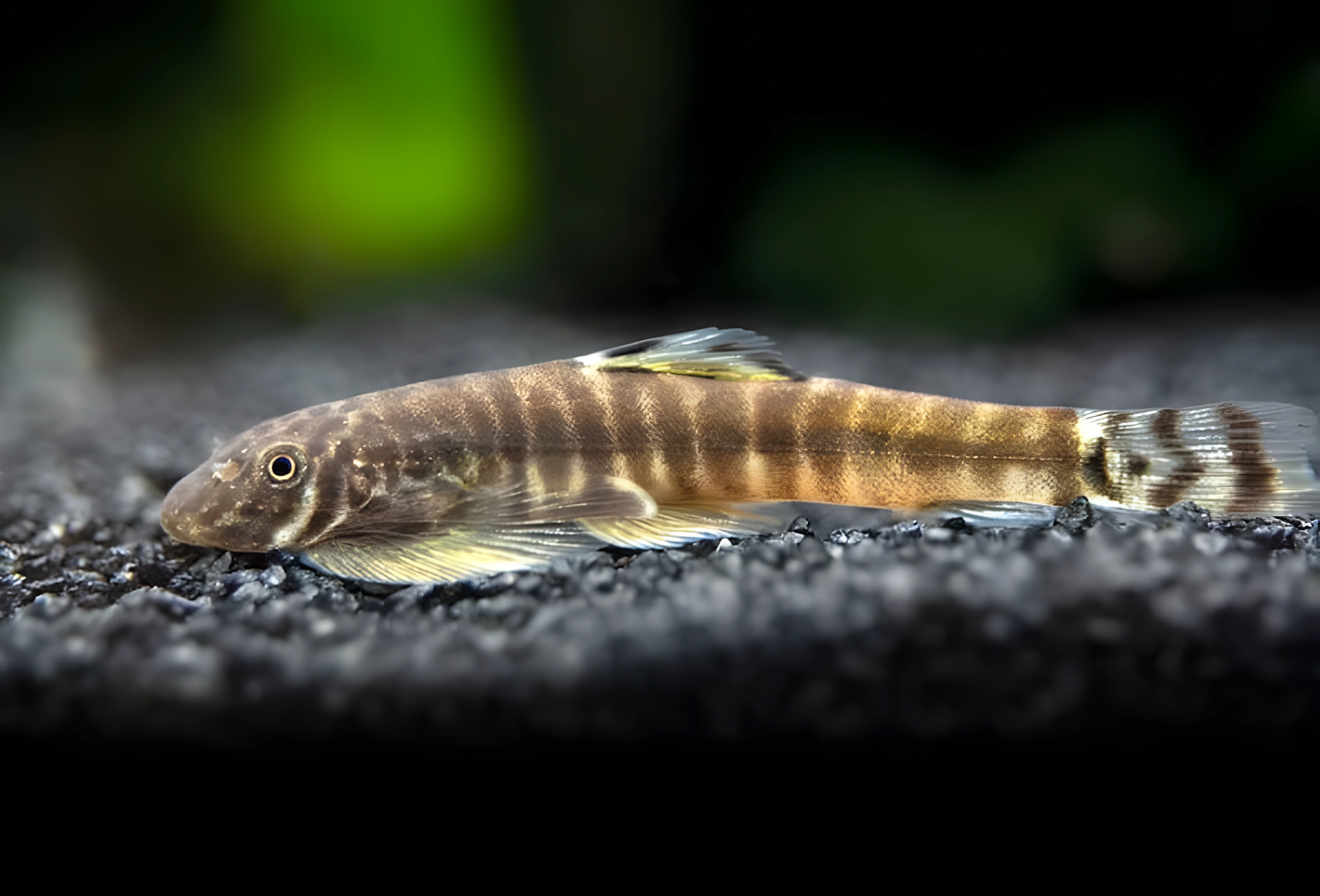
Adults of this fish reach a length of about 8 cm. Pseudogastromyzon fasciatus demonstrates excellent adaptation to life in fast-flowing conditions. The fish's body has a flattened, teardrop shape: the anterior part is wide, and the caudal part is narrow. The pectoral fins serve as an adaptation for securely holding onto the surface of stones or boulders, rather than for active swimming. The coloration is usually gray or yellowish, with noticeable dark stripes arranged in rows. Sexual dimorphism is subtle, but upon closer inspection, males may show small tubercles on their heads that distinguish them from females. Males may appear more slender, but in a mixed-age group, this trait may not be as obvious. In the same regions of southeastern China where Pseudogastromyzon fasciatus lives, similar but smaller related species are found, such as Pseudogastromyzon cheni and Pseudogastromyzon myersi.
Habitat
The species inhabits mountain streams in southeastern Chinese provinces, such as Fujian and Zhejiang. These are bodies of water with fast currents, rocky bottoms, and high dissolved oxygen content. The fish are adapted to life in strong currents, using their flattened bodies to cling to the surface of rocks.
Behavior and Compatibility
Pseudogastromyzon fasciatus is characterized as a conditionally peaceful species. In a spacious aquarium, these fish readily coexist with conspecifics and other species capable of adapting to fast-flowing conditions and relatively low temperatures. However, if space is limited, they may exhibit aggression due to territorial disputes. They prefer to live in groups of conspecifics. Most of their time is spent at the bottom, where they tend to actively sift through gravel in search of food.
Care and Maintenance
For a group of 3–4 individuals, the optimal aquarium volume is 120 to 150 liters. For these fish, the bottom area is more important than the water column height. When decorating, the focus should be on the bottom layer. The aquarium bottom should be covered with fine gravel, supplemented with stones and large boulders. Installing large snags will also be appropriate. Aquatic plants are not an obligatory element, but if desired, species resistant to strong currents can be used, such as aquatic mosses and ferns, which grow well in turbulent flows and can attach to rocks. It is crucial to ensure moderate to strong water flow, which is achieved through an additional pump or a powerful internal filter. Maintaining a high level of illumination is recommended. Intense light promotes the growth of algae, which will be an additional food source for the fish. Since Pseudogastromyzon fasciatus prefers relatively cool water, a heater is usually not required in the aquarium. In nature, their diet consists of filamentous and diatom algae, as well as microorganisms living within them. In a home environment, it is desirable to encourage the growth of such algae; natural snags under bright lighting can be suitable for their development. In the aquarium, fish should be fed sinking vegetable foods (tablets, granules). As a protein supplement, fresh or frozen bloodworms and brine shrimp can be offered. Data source: The Catalogue of Life.
Diet
In natural conditions, the diet of these fish primarily consists of filamentous and diatom algae, as well as the microorganisms that inhabit them. When kept in an aquarium, it is beneficial to create conditions that promote the growth of such algae. Natural snags, well-lit by bright light, can serve as excellent places for their development. In a home aquarium, it is recommended to feed the fish sinking foods, such as tablets or granules, with a high content of vegetable components. As a supplement to provide the protein component of their diet, fresh or frozen bloodworms, brine shrimp, and other similar foods can be used. The scientific information source was The Catalogue of Life database.
Breeding and Reproduction
Breeding in an aquarium is rare and considered a challenging task. During the spawning period, males occupy small territories and dig depressions in the substrate where the female lays her eggs. After fertilization, the male covers the clutch with a thin layer of substrate. Parental care is absent, so a separate breeding tank is recommended for the survival of the fry.
Diseases
These fish lack scales, which makes them extremely sensitive to water quality and many medications. The main risks are associated with poor aeration and the accumulation of organic matter, which quickly lead to bacterial infections and skin lesions. For prevention, it is necessary to maintain clean water and avoid the use of aggressive chemical agents.
How to choose
When purchasing, choose active individuals that confidently cling to glass or rocks. It is important to pay attention to the condition of the belly: it should not be sunken, which may indicate emaciation. Avoid fish with signs of skin damage, whitish spots, or film, as due to the absence of scales, any injuries quickly provoke the development of secondary infections.
Frequently asked questions
The essentials: size, tank volume, water parameters and care
How big does Pseudogastromyzon fasciatus get?
An adult reaches 8 cm in length. Plan the tank around the maximum size: the fish quickly outgrows a cramped setup.
What size aquarium does Pseudogastromyzon fasciatus need?
The minimum recommended volume is 120 L. A smaller tank speeds up nitrate build-up and raises stress levels.
What water parameters does Pseudogastromyzon fasciatus need?
Temperature 20–23 °C, pH 7–8, hardness 8–15 dGH. Stability matters more than exact values: sudden swings are harder on the fish than a small deviation from the ideal.
How long does Pseudogastromyzon fasciatus live?
Around 8 years when kept properly. Lifespan depends directly on tank volume, water quality and a varied diet.
Is Pseudogastromyzon fasciatus aggressive?
Temperament: semi-peaceful (including aggression during spawning / intraspecific conflicts). Keep this in mind when choosing tank mates.
How many Pseudogastromyzon fasciatus should be kept together?
Recommended setup: schooling (usually from 5–6 individuals and more). Ignoring this is a common cause of stress and disease.
What does Pseudogastromyzon fasciatus eat?
Diet type: sinking (plant-based). Feed small portions that are finished within a couple of minutes — overfeeding does more harm than underfeeding.
What is the scientific name of Pseudogastromyzon fasciatus?
The scientific name of the species is Pseudogastromyzon fasciatus, family Balitoridae. It also appears in the literature as: Hemimyzon zebroidus, Pseudogastromyzon zebroidus, Psilorhynchus fasciatus.